
Our Short List of 3

- Best for: A first serious chime for home, studio or worship use.
- 35 bars in a single row
- Custom aluminum and titanium alloy bars, heat-treated and tuned by ear
- Bars left unpainted and unplated for full resonance
- Solid Tennessee black walnut mantle

- Best for: Recording, worship and theatre players who must cut the sound on cue.
- Full-size single row of bars on a Tennessee hardwood mantle
- Adjustable dampening arm with soft felt contact surface
- Knobs on both sides set the dampener position
- Includes a hard-sided gig bag sized to chime and arm

- Best for: Compact rigs, classrooms and players who want a quicker, tidier sweep.
- 23 bars in a single row
- Custom aluminum and titanium alloy bars, heat-treated and tuned by ear
- Bars left unpainted and unplated for full resonance
- Solid Tennessee hardwood mantle
All 5 Picks at a Glance
| Product | Specs | Action |
|---|---|---|
| TreeWorks TRE35 Classic Chime |
| Check price on Amazon |
| TreeWorks TRE630 with Dampening Arm |
| Check price on Amazon |
| TreeWorks TRE23 Classic Chime |
| Check price on Amazon |
 TreeWorks TRE24 MultiTree |
| Check price on Amazon |
 TreeWorks TRE415 Handheld Chime |
| Check price on Amazon |
Key takeaways
- Compare the best bar chimes for home players, from the 35-bar TreeWorks TRE35 to handheld and dampener models, with bar counts, mantles and mounting tips.
A bar chime looks simple, yet the wrong one can disappoint fast: too few bars and the glissando feels thin, a flimsy mantle buzzes against the bars, and cheap cord stretches until the row hangs unevenly. The real decision is matching bar count, bar material and mounting style to where the chime will live, whether that is a home studio corner, a worship band riser or a quiet meditation space.
This guide serves home players who want that shimmering sweep without buying twice. Every pick below is a genuine bar chime from a specialist maker, chosen from Amazon listing titles and stated specifications, and the five span full-size stand-mounted rows, a dampener-equipped model, a multi-instrument tree and a handheld option for small rooms.
Quick Picks
As an Amazon Associate we earn from qualifying purchases
| Product | Best for | Key spec from title |
|---|---|---|
| TreeWorks TRE35 Classic Chime | All-round home and stage use | 35 bars, single row |
| TreeWorks TRE630 with Dampening Arm | Players who need instant silence | Dampening arm and gig bag included |
| TreeWorks TRE23 Classic Chime | Smaller rigs and tighter budgets | 23 bars, single row |
| TreeWorks TRE24 MultiTree | One mount, three sounds | Chime, triangle and finger cymbal |
| TreeWorks TRE415 Handheld Chime | Desks, classrooms and travel | Handheld single row |
How to Choose
Bar count and the length of the sweep
Bar count shapes everything about the sound. A 35-bar row produces a long, dense glissando that blooms and fades slowly, which suits ambient passages, song endings and sound-bath work. A 23-bar row speaks faster and leaves more air between notes, a better match for busy arrangements where the chime is an accent rather than a wash. Handheld models carry fewer bars again and trade sweep length for immediacy. Decide how the chime will be used first, then let that role pick the count instead of assuming bigger always wins.
Bar material and mantle construction
The bars do the singing, so their alloy matters more than cosmetics. Quality makers use heat-treated aluminum and titanium alloy bars that are tuned by ear and left unpainted, because paint, tinting or plating dulls the resonance. The mantle, the wooden rail the bars hang from, should be solid hardwood rather than soft pine or plastic; a dense walnut rail resists warping and keeps the row aligned. Braided cord rated for the load outlasts the thin string or plastic ties found on bargain chimes, which stretch and snap.
Mounting, stands and dampening
Most full-size bar chimes hang from a cymbal stand or a dedicated chime mount through a hole in the mantle, so check that your stand fits before ordering. If the chime will travel, a padded bag sized to the mantle saves the bars from bending in transit. Dampening deserves thought too: in quiet rooms and recording work, a built-in dampening arm lets you silence the bars on cue, while players without one must stop the shimmer by hand, which is slower and less clean.
Single row, double row and handheld formats
A single row keeps the bars in one line, so a hand sweep crosses every pitch in order and the gesture stays simple for beginners. Double-row models pack more bars into the same width and sound denser, but they cost more and can feel crowded. Handheld chimes skip the stand entirely; you hold the mantle and tilt or shake, which works at a desk, in a classroom circle or while walking through a meditation session. Multi-instrument trees add a triangle or finger cymbal beside the row for players who cover several effects parts.
The 5 Best Options
TreeWorks TRE35 Classic Chime
- Best for: A first serious chime for home, studio or worship use.
- 35 bars in a single row
- Custom aluminum and titanium alloy bars, heat-treated and tuned by ear
- Bars left unpainted and unplated for full resonance
- Solid Tennessee black walnut mantle
A first serious chime for home, studio or worship use.
It needs a sturdy cymbal stand or chime mount, which is sold separately.
The TRE35 is the reference point for home bar chimes: a full-size single row of 35 bars with the broad, slow-fading sweep most players picture when they hear the instrument named. It suits the home studio owner, worship percussionist or ambient player who wants one chime that covers nearly every situation. The Tennessee black walnut mantle and hand-braided cord give it a furniture-grade feel that matches its role as a permanent fixture on a stand.
TreeWorks TRE630 with Dampening Arm
- Best for: Recording, worship and theatre players who must cut the sound on cue.
- Full-size single row of bars on a Tennessee hardwood mantle
- Adjustable dampening arm with soft felt contact surface
- Knobs on both sides set the dampener position
- Includes a hard-sided gig bag sized to chime and arm
Recording, worship and theatre players who must cut the sound on cue.
Confirm the bag dimensions suit your storage space before ordering.
The TRE630 builds on the full-size single-row format and adds the feature working players ask for most: a dampening arm. A felt-tipped rod swings toward the bars to stop the sound instantly, which matters in recording sessions, quiet church passages and any moment where a long fade would step on the next cue. The swing arm and chime travel together inside the included hard-sided gig bag as one piece, so setup stays fast for players who move between rooms or venues.
TreeWorks TRE23 Classic Chime
- Best for: Compact rigs, classrooms and players who want a quicker, tidier sweep.
- 23 bars in a single row
- Custom aluminum and titanium alloy bars, heat-treated and tuned by ear
- Bars left unpainted and unplated for full resonance
- Solid Tennessee hardwood mantle
Compact rigs, classrooms and players who want a quicker, tidier sweep.
The shorter row gives a shorter glissando, so ambient players may prefer the 35-bar model.
The TRE23 keeps the same alloy bars and walnut craftsmanship as its bigger sibling but trims the row to 23 bars, which makes the whole instrument lighter, narrower and easier to fit on a crowded percussion table or a small home stand. Its sweep resolves faster, so accents stay tidy inside denser arrangements. For a player adding a first chime to a drum kit corner, a classroom setup or a compact home rig, the medium row often proves to be the practical size rather than a compromise.
TreeWorks TRE24 MultiTree
- Best for: Theatre, pit and worship players covering multiple effects from one stand.
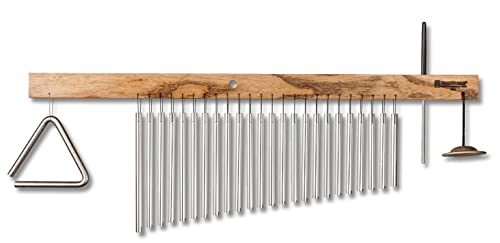
- Three instruments on one frame: bar chime, triangle and finger cymbal
- Single-row chime section with aluminum and titanium alloy bars
- Hand-finished hardwood frame
- Bars suspended on braided cord, tuned by ear
Theatre, pit and worship players covering multiple effects from one stand.
The added instruments make it wider than a plain chime, so check your stand space.
The MultiTree answers a different problem: the percussionist who covers several small effects parts from one position. Its frame carries a single-row bar chime alongside a triangle and a finger cymbal, so one stand and one reach cover three sounds that would otherwise need separate mounts and extra floor space. It fits pit, theatre and worship players especially well, and at home it turns a single corner stand into a compact effects station for recording texture parts without a full percussion table.
TreeWorks TRE415 Handheld Chime
- Best for: Teachers, meditation facilitators and desk-side players who need portability.
- Handheld single-row bar chime, no stand required
- Custom aluminum and titanium alloy bars, heat-treated and tuned by ear
- Solid Tennessee hardwood mantle sized for one-hand holding
- Braided CordLoc cord suspension
Teachers, meditation facilitators and desk-side players who need portability.
A handheld row is shorter, so expect a brief sweep rather than a long glissando.
The TRE415 removes the stand from the equation entirely. This handheld single-row chime is held by its mantle and played with a tilt, a shake or a finger sweep, which makes it the natural pick for teachers moving around a classroom, facilitators walking a meditation group, and home players who want the sound at a desk or sofa without hardware. It keeps the same alloy bar recipe as the larger TreeWorks models, so the tone stays bright and musical rather than toy-like.
Which One Fits Your Situation
You play at home and record your own music
Start with the TRE35. Its 35-bar sweep records beautifully, filling intros and transitions with a slow bloom that smaller rows cannot match, and the walnut mantle keeps the instrument stable on a stand for years. If your recordings demand tight stops between cues, step up to the TRE630 and its dampening arm instead of muting bars by hand.
You play in a worship band or theatre pit
The TRE630 earns its place where cues matter: the dampener silences the bars exactly when the arrangement changes. Players covering several effects parts should look at the TRE24 MultiTree, which folds a triangle and finger cymbal into the same reach, saving stand space on a crowded riser or pit rail.
You teach, lead groups or play in small rooms
The TRE415 handheld chime moves with you, needs no stand and stores in a drawer, which suits classrooms and guided sessions. For a fixed small rig, the TRE23 gives a tidy, faster-resolving sweep that will not overwhelm a small room or a young ensemble.
You are buying a first chime as a gift
Choose the TRE35 for a player who will keep it on a stand at home, since it is the format most tutorials and recordings assume. Pick the TRE415 when the recipient has limited space or would rather pick the instrument up and play anywhere. Either way, add a note that a stand or mount may be needed for the full-size models.
Common Mistakes
- Buying by bar count alone and ignoring bar material, when alloy quality and tuning decide whether the sweep sounds rich or tinny.
- Forgetting the stand: full-size chimes need a cymbal stand or dedicated mount, and many first orders arrive without one.
- Choosing a long 35-bar sweep for fast, cue-driven music where a shorter row or a dampener would serve better.
- Storing a chime uncovered, letting dust and knocks bend bars and stretch the suspension cord.
- Mistaking decorative garden wind chimes for percussion bar chimes, which are tuned instruments built for played sweeps.
Frequently Asked Questions
How many bars should a first bar chime have?
A row between 23 and 35 bars suits most first-time buyers. Thirty-five bars give the longest, fullest glissando for ambient and solo playing, while 23 bars resolve faster and fit smaller rigs. Handheld models carry fewer bars and trade sweep length for portability, so choose by the role the chime will play.
Do bar chimes need a special stand?
Full-size models mount through a hole in the mantle onto a standard cymbal stand or a dedicated chime mount, and many players already own a stand that works. Handheld models need nothing. Before ordering, confirm your stand height and clamp style suit the mantle, since the mount is usually sold separately from the chime.
What is the difference between bar chimes and wind chimes?
Bar chimes are tuned percussion instruments: a player sweeps a hand across graduated metal bars to trigger a controlled glissando. Garden wind chimes are decorative, hang outdoors and sound randomly in the breeze. Their bars, tuning and build quality differ greatly, so a wind chime cannot substitute for a percussion bar chime in music.
How do I stop bar chimes from ringing too long?
Touch the bars lightly with your palm or fingertips to mute them, or choose a model with a built-in dampening arm that presses a felt rod against the row for an instant stop. Playing shorter sweeps and lifting your hand away cleanly also keeps the fade shorter in quiet passages.
More from Amazon
Programs that pair well with the guide above. Offers and eligibility are set by Amazon and may change.
Free shipping on eligible items, Prime Video and more. Eligible new members can start with a free trial.
Start a Prime free trialAudiobooks and podcasts to listen to on the go. Eligible new members can start with a free trial.
Try Audible freeAd-free music streaming. Eligible new subscribers can start with a free trial.
Try Music Unlimited freeA free business account with business pricing and bulk-buying tools for work, shop or home office.
Create a business accountAs an Amazon Associate we earn from qualifying purchases.


Write Your Review
No reviews yet. Be the first to share your experience!