

Key takeaways
- Compare five instrument cables for guitar, bass and keyboards, from a silent-plug Mogami to budget tweed, with notes on length, plugs and shielding.
An instrument cable is the simplest link in a rig, and one of the easiest to get wrong. A cable that crackles when you move, hums near a power supply, or fails at the plug can undo the sound of a good guitar and a good amp in seconds. The five cables in this guide cover the jobs home players, worship teams, and small-stage guitarists actually need done: a quiet main cable, a spare that survives the gig bag, a long run for bigger stages, and short, tidy leads for practice corners.
Every pick here is a standard 1/4 inch TS instrument cable for guitar, bass, or keyboards, and the differences that matter are practical ones: length, straight versus right-angle plugs, jacket style, shielding approach, and what happens when you unplug between songs. Read the picks with your own setup in mind, because the right cable for a bedroom practice amp is rarely the right cable for a wide stage.
As an Amazon Associate, we earn from qualifying purchases.
Quick Answer
For most home and small-stage players, the Fender Professional Series 10 foot cable is the sensible default: straight plugs, an anti-kink build, and a class that makes owning a spare realistic. Players who swap guitars mid-set should look at the Mogami Gold Silent S-18, while the Pig Hog 25 foot suits big stages and the two tweed picks cover short, tidy runs.
1. Mogami Gold INST Silent S-18 Guitar Instrument Cable

The Mogami Gold Silent S-18 is the pick for players who change instruments during a set. Its silentPLUG connector mutes the cable as you pull it from the jack, so swapping a guitar does not send a loud pop through the amp or the front-of-house system. That one feature solves a real problem for anyone doubling on guitar and bass during the same show.
At 18 feet, it gives enough reach for most small and mid-size stages without the excess slack that turns into a tripping hazard. Mogami builds the Gold series around low-noise handling, and the listing describes gold contacts on the 1/4 inch TS plugs, which resist corrosion at the contact points. It is the premium option in this guide, earned through the silent plug and the brand’s studio-grade cable stock. If you record at home, the same quiet behavior helps when plugging and unplugging between takes.
Specs
- Length: 18 feet
- Connectors: 1/4 inch TS male plugs, straight, with silentPLUG muting connector
- Contacts: Gold
- Model: GOLD INST SILENT S-18
- Cable type: TS instrument cable
- Conductor gauge and capacitance: confirm on the listing
2. Fender Professional Series Instrument Cable, 10 Foot, Black
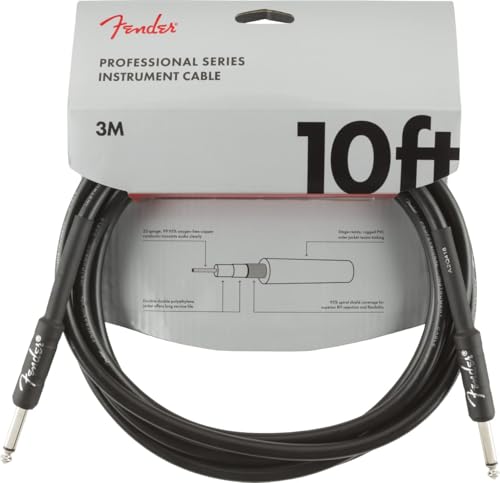
The Fender Professional Series 10 foot cable is the straightforward workhorse of this group. Ten feet is the classic home and rehearsal length: long enough to stand up and move a little, short enough to coil into a gig bag without a fight. Fender markets the series with an anti-kinking design, and the listing describes a thick-gauge build intended to retain tone transparently.
Fender publishes a spiral shield with high oxygen-free copper coverage for this series and backs the line with a lifetime guarantee, which matters more for a cable than almost any other spec. Cables die at the plugs and at kink points, so a maker willing to guarantee the cable for life is telling you something about the strain relief. Choose the straight-to-straight version for a top-jack guitar into a front-facing amp input, and keep a second one as the spare every gig bag should hold.
Specs
- Length: 10 feet
- Connectors: 1/4 inch straight plugs
- Jacket: 8mm PVC, anti-kink design
- Shielding: Spiral shield; maker lists 95 percent oxygen-free copper coverage
- Model: 990820024 (PRO 10′ INST CABLE BLK)
- Warranty: Lifetime guarantee per the maker; confirm terms on the listing
3. GLS Audio Instrument Cable, 6 Foot, Brown/Yellow Braided Tweed

The GLS Audio 6 foot cable is the short-run specialist. Six feet will not cross a stage, and it is not meant to. It is the right length for a practice amp beside your chair, a desktop interface on a desk, or a keyboard sitting close to its amp, where a long cable just becomes a coil of clutter.
The braided tweed cloth jacket in brown and yellow gives it a vintage look that suits tweed amps and retro-styled rigs, and cloth jackets tend to lay flat rather than springing into kinks. One plug is straight and the other is a right angle, which is the practical pairing for a guitar with a side or recessed jack played sitting down. GLS lists oxygen-free copper conductors for the cable. As a second cable for the practice corner, or a tidy lead for a small home studio, it fills a slot the longer picks cannot.
Specs
- Length: 6 feet
- Connectors: 1/4 inch straight to right angle
- Jacket: Braided tweed cloth, brown/yellow
- Conductor: Oxygen-free copper per the maker
- Intended use: Guitar and bass amp cord
- Shielding details: confirm on the listing
4. Pig Hog Instrument Cable, 25 Foot (PH25)

The Pig Hog PH25 is the long option, built for players who actually need 25 feet: wide stages, church platforms where the amp sits well off to the side, and rehearsal rooms where the only free outlet is across the room. Pig Hog’s whole pitch is overbuilding, and the listing points to an extra-thick 8mm jacket with tension-resistant stress relief at the plugs.
The listing describes this model with right-angle plugs at both ends, a configuration that sits flat against many amp inputs and pedalboard jacks and keeps the cable hanging close to the guitar body on side-jack instruments. Pig Hog backs its cables with a lifetime guarantee. One honest caution: longer cables can soften high frequencies slightly with passive pickups, so if your tone lives in the top end, treat the 25 foot length as a stage tool and keep a shorter cable for recording.
Specs
- Length: 25 feet
- Connectors: 1/4 inch right angle to right angle, per the listing
- Jacket: 8mm high-quality PVC outer covering
- Model: PH25
- Weight: 1.27 pounds per the listing
- Warranty: Lifetime guarantee per the maker; confirm terms on the listing
5. Amazon Basics TS 1/4 Inch Guitar Cable, Tweed Cloth Jacket, 10 Foot

The Amazon Basics tweed cable is the budget pick and the obvious spare. At 10 feet with a right-angle plug at one end, it covers the most common home setup: a guitar played sitting down, into an amp or interface a short distance away. The tweed cloth jacket in yellow and brown shrugs off the scuffs of daily practice and looks better doing it than a plain black budget cable.
Amazon lists it as a TS instrument cable for electric guitar, bass, and keyboard, with a right-angle design that keeps the plug from sticking straight out of a side-mounted jack where it can be bumped or levered. Nobody should plan a tour around a house-brand cable, but as the second cable in the bag, the classroom cable, or the first cable for a new player, it is exactly the right level of spending. Buy two and the spare problem is solved.
Specs
- Length: 10 feet
- Connectors: 1/4 inch TS, right-angle design
- Jacket: Tweed cloth, yellow and brown
- Model: BC302YB-10FT
- Compatible devices: Electric guitar, bass, keyboard
- Shielding details: confirm on the listing
How to Choose an Instrument Cable
Start with length, because it decides more than any other factor. Ten feet suits home practice and small rehearsal spaces. Fifteen to eighteen feet covers most small stages. Twenty-five feet is for wide platforms and awkward amp placement, and it brings a small trade-off: with passive pickups, longer cable runs can dull high frequencies slightly, so match the length to the room instead of defaulting to the longest option.
Next, match the plugs to your jacks. A straight plug works well for top-mounted jacks and front-facing amp inputs. A right-angle plug sits flatter on side-jack guitars, Strat-style recessed jacks, and pedalboard inputs, and it reduces the lever arm that gets bumped in tight spaces. Many players keep one of each configuration.
Then look at the jacket and the warranty. Braided and tweed cloth jackets resist tangling and look at home on stage; thick PVC jackets take abuse and wipe clean. Shielding keeps outside interference down, and a conductive layer under the shield helps cut handling noise when the cable moves. Finally, treat the warranty as a durability signal: several makers here offer lifetime guarantees, which is the clearest promise a cable brand can make.
Who Should Skip These Cables
Skip this whole category if you need a balanced connection. These are unbalanced TS instrument cables; microphones and line-level studio links need XLR or TRS cables instead, and a speaker cabinet needs a dedicated speaker cable, never an instrument cable. Using an instrument cable between an amp head and a cab is a genuine equipment risk, not a tone choice.
Also skip these picks if you want to go cable-free with a wireless system, if you need a stereo or TRS lead for a keyboard’s balanced outputs, or if your only need is short pedalboard jumpers. Patch cables for linking pedals are a different, much shorter product, and buying a 6 foot instrument cable for that job leaves loops of slack on the board.
FAQ
Are instrument cables and guitar cables the same thing?
Yes. Guitar cable is the common name; instrument cable is the broader term for the same unbalanced 1/4 inch TS cable. The same cable works for electric guitar, bass, and most keyboards, which is why the listings name several instruments for a single product.
Does cable length affect tone?
It can, slightly. With passive pickups, a longer cable adds capacitance, which can soften the highest frequencies. The effect is subtle at 10 to 18 feet and more noticeable at 25 feet and beyond. Players who hear it usually keep a shorter cable for recording and the long one for stage reach.
What does a silent plug do?
A silent plug, like the one on the Mogami pick in this guide, mutes the cable automatically while it is unplugged. That prevents the loud pop and buzz that normally happen when you pull a live cable from an amp input, which makes instrument changes during a set much cleaner.
How long should an instrument cable last?
A well-made cable with sound strain relief should last for years of regular use, and the most common failures happen at the plugs rather than in the middle of the run. Coiling loosely instead of wrapping tightly around an elbow, and never yanking a cable out by the cord, will extend the life of any pick here.
Final Verdict
Most players should start with the Fender Professional Series 10 foot cable: it is the right length for home and rehearsal, and the lifetime guarantee removes the usual worry about cable lifespan. Add the Mogami Gold Silent S-18 if you swap instruments live, the Pig Hog PH25 if your stage demands reach, and either tweed pick for short, tidy practice setups. One good cable and one spare will cover nearly every situation a home or small-stage player meets.
More from Amazon
Programs that pair well with the guide above. Offers and eligibility are set by Amazon and may change.
Free shipping on eligible items, Prime Video and more. Eligible new members can start with a free trial.
Start a Prime free trialAudiobooks and podcasts to listen to on the go. Eligible new members can start with a free trial.
Try Audible freeAd-free music streaming. Eligible new subscribers can start with a free trial.
Try Music Unlimited freeA free business account with business pricing and bulk-buying tools for work, shop or home office.
Create a business accountAs an Amazon Associate we earn from qualifying purchases.
Write Your Review
No reviews yet. Be the first to share your experience!