

Key takeaways
- Compare the best DI boxes for guitar, bass and keyboards, from passive stereo units to active models with pads, ground lifts and phantom power options.
- Top Pick: Radial ProD2 Passive 2-Channel Direct Box
- Runner-up: Pyle PDC22 Premium Direct Injection Audio Box
- Also consider: Behringer Ultra-DI DI100 Active DI Box
A DI box solves a problem that shows up in almost every karaoke setup, rehearsal room and small stage: keyboards, acoustic guitars and basses produce a high-impedance, unbalanced signal that loses clarity and picks up hum over long cable runs. A direct box converts that signal into a low-impedance, balanced one that can travel down a microphone cable to a mixer or PA system cleanly, and most models add a ground lift switch for breaking the hum caused by ground loops.
The five picks below cover the main shapes the category takes: passive stereo boxes for keyboards and DJ rigs, an active box that runs on phantom power or a battery for weaker signals, and compact units that make sense as gig-bag spares. Each entry lists the specifications published for that model, so match the connectors, pad range and power needs against the gear already in the room.
As an Amazon Associate, we earn from qualifying purchases.
Quick answer
For most home and karaoke rigs, a passive stereo DI such as the Radial ProD2 covers keyboards and playback devices with no power supply, while an active model such as the Behringer Ultra-DI DI100 suits low-output instruments and longer runs. The Pyle PDC22 packs two passive channels into one case, the Radial Pro48 is a phantom-powered box for high-output instruments, and the Behringer DI400P is a compact passive spare.
Radial ProD2 Passive 2-Channel Direct Box

The ProD2 is the stereo member of Radial’s Pro series, built for sources that arrive in pairs: keyboards, DJ mixers, drum machines and media players. Each of its two channels is fully independent, with its own input, thru jack and balanced output, so a stereo keyboard rig needs one box instead of two. Because the design is passive, it needs no battery or phantom power and can be dropped into a setup permanently.
At the heart of each channel sits a custom isolation transformer. Radial publishes an input impedance of around 140,000 ohms for the Pro series design, intended to reduce loading on the instrument, and the transformer isolation lets the ground lift switch break ground loops cleanly. A -15 dB pad on each channel tames hot line-level sources.
Specs
- Type: passive direct box, 2 channels (stereo)
- Model: R800 1102
- Inputs: 2 x 1/4 inch instrument inputs, each with a thru jack
- Outputs: 2 x balanced XLR
- Pad: -15 dB per channel
- Ground lift: yes, per channel
- Power: none required (passive)
- Transformer: custom Radial isolation transformer
For a karaoke host running a laptop or keyboard into a house PA, this is the set-and-forget option: stereo sources reach the mixer balanced and quiet.
Pyle PDC22 Premium Direct Injection Audio Box
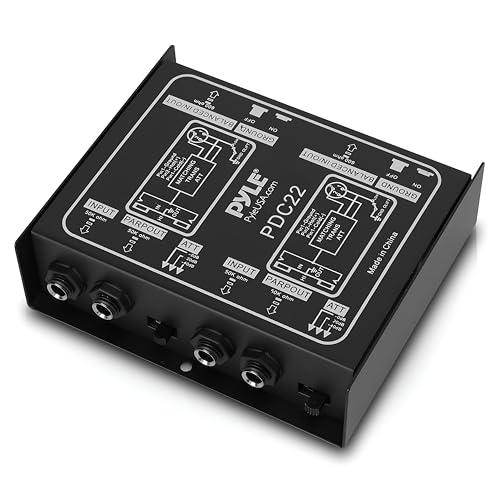
The PDC22 takes the opposite approach to size and cost: it squeezes two complete passive DI channels into a single all-steel enclosure measuring about 5.5 by 4.72 by 1.57 inches. Pyle describes it as two direct boxes in one unit, which suits a small stage box or a home studio where an acoustic guitar and a keyboard both need converting at the same time.
Each channel offers a 50,000 ohm unbalanced TS instrument input, a parallel link output for sending the original signal on to an amplifier, and a balanced XLR output rated at 600 ohms. The switchable input attenuator offers 0, -20 and -40 dB positions, so the same box can accept anything from a quiet passive pickup to a strong line-level feed. A switchable ground lift rounds out the controls.
Specs
- Type: passive direct box, 2 channels in one enclosure
- Model: PDC22
- Construction: all-steel chassis
- Inputs: 2 x 1/4 inch TS, 50,000 ohm unbalanced
- Outputs: 2 x balanced XLR (600 ohm), plus parallel link outputs
- Attenuation: switchable 0, -20 and -40 dB
- Ground lift: switchable
- Dimensions: 5.5 x 4.72 x 1.57 inches
- Power: none required (passive)
The wide pad range is the headline here: the -40 dB setting gives this compact box unusual flexibility with very hot line signals.
Behringer Ultra-DI DI100 Active DI Box

The DI100 is an active design, which changes what it can do. Active circuitry presents a higher input impedance and adds a small amount of gain, making it a better match for passive pickups and other low-output sources that can sound dull through a passive box. It runs on a 9 volt battery or on phantom power from the mixer, and its internal battery shuts off automatically when phantom power is applied.
Behringer fits its OT-1 output transformer, gold-plated XLR connectors and a ground lift switch. The switchable input attenuation accepts input levels up to +50 dBu according to the product documentation, and Behringer states the input can even be connected to speaker outputs of up to 3,000 watts when both pad switches are engaged, a feature aimed at recording a guitar amplifier directly. The aluminium case has stackable rubber corners, and the unit weighs about 1.43 pounds.
Specs
- Type: active direct box, 1 channel
- Model: DI100
- Power: 9 volt battery or phantom power (18 to 48 volts)
- Inputs: 1/4 inch and XLR unbalanced inputs
- Outputs: balanced XLR, plus 1/4 inch link out
- Attenuation: switchable, accepts input levels up to +50 dBu per the manufacturer
- Ground lift: yes
- Transformer: Behringer OT-1 output transformer
- Weight: about 1.43 pounds (650 grams)
This is the flexible problem-solver of the group, handling a quiet acoustic pickup at a small gig or a hot amplifier feed in the studio.
Radial Pro48 Active Direct Box
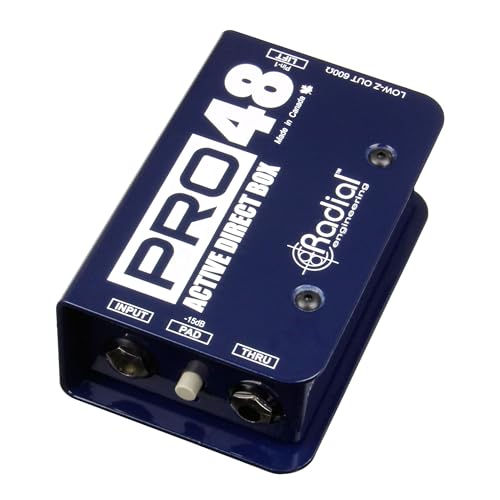
The Pro48 is Radial’s compact active entry, designed for instruments with high output, such as active basses, acoustic guitars with onboard preamps and modern keyboards. Where a passive transformer can saturate under a very hot signal, the Pro48 uses a 48 volt phantom-powered circuit that Radial says provides significantly more headroom, and the manufacturer publishes a frequency response of 20 Hz to 40 kHz.
There is no battery option: the box runs only on phantom power from the mixer or interface, which keeps the design simple and means there is nothing to run flat mid-set, provided the console supplies phantom power. A -15 dB pad and a ground lift switch cover the usual stage problems, and the steel enclosure follows the same compact format as the rest of the Pro series.
Specs
- Type: active direct box, 1 channel
- Model: R800 1105
- Power: 48 volt phantom power only (no battery)
- Frequency response: 20 Hz to 40 kHz (manufacturer specification)
- Pad: -15 dB
- Ground lift: yes
- Inputs: 1/4 inch instrument input with thru jack
- Output: balanced XLR
Players with active electronics who have heard a passive DI flatten their loudest notes are the audience for this one; confirm the current listing specifications before ordering.
Behringer Ultra-DI DI400P Passive DI Box

The DI400P is the smallest and simplest box in this roundup: a single passive channel in a metal case measuring roughly 2.6 by 4.7 by 1.4 inches and weighing about 0.44 pounds. It is the kind of unit a karaoke host or band keeps two or three of in a cable bag, because a passive box never needs power and rarely gives trouble.
Behringer publishes an impedance ratio of 110 to 1 and a level change of 20 dB between input and output. The parallel output passes the input signal through to an amplifier or monitor, the balanced XLR output feeds the mixer, and a ground lift switch deals with hum. The published frequency response is 40 Hz to 20 kHz at -3 dB, which covers its intended instruments, though deep bass players may prefer a wider specified response.
Specs
- Type: passive direct box, 1 channel
- Model: DI400P
- Inputs: 1/4 inch TS (unbalanced), with parallel output
- Output: balanced XLR
- Impedance ratio: 110 to 1 (manufacturer specification)
- Level change: 20 dB
- Frequency response: 40 Hz to 20 kHz, -3 dB (manufacturer specification)
- Ground lift: yes
- Dimensions: about 2.6 x 4.7 x 1.4 inches
- Weight: about 0.44 pounds
- Power: none required (passive)
As a first DI for a home setup, or a gig-bag spare, the DI400P covers the essentials with no setup beyond plugging in two cables.
How to choose
Start with the signal. Passive boxes such as the ProD2, PDC22 and DI400P suit strong sources: keyboards, playback devices and instruments with active electronics. Active boxes such as the DI100 and Pro48 suit quiet passive pickups and long cable runs, but they need phantom power or a battery, so check the mixer before relying on a phantom-only model like the Pro48.
Next, count channels. A stereo keyboard or laptop feed needs two channels, which points to the ProD2 or the dual-channel PDC22. Then look at the pad range: -15 dB handles most hot instruments, while the PDC22 and DI100 offer deeper attenuation for line-level or amplifier feeds. A ground lift switch is close to essential anywhere two pieces of mains-powered gear meet, and every box here includes one.
Who should skip
Anyone whose instrument reaches the mixer through a short cable in a quiet room may not need a DI box at all; an audio interface with a high-impedance instrument input does the same conversion for recording. Players who only perform through their own amplifier, with a microphone in front of it, can also skip the category. And if a mixer lacks phantom power, the phantom-only Pro48 is the wrong pick; a passive model avoids the issue entirely.
Frequently Asked Questions
What does a DI box actually do?
It converts a high-impedance, unbalanced instrument signal into a low-impedance, balanced signal at microphone level. Balanced signals reject interference over long cable runs, so the instrument can reach a distant mixer or PA without the hum and tone loss a long guitar cable would cause.
Should a karaoke or home setup choose active or passive?
Passive is the simpler default for keyboards, laptops and playback devices with strong outputs, and it never needs power. Active suits low-output sources such as passive acoustic pickups. If the mixer supplies phantom power, an active box is easy to run; otherwise a passive box removes the power question.
Why does the ground lift switch matter?
When an instrument rig and a mixer sit on different mains circuits, a ground loop can add a constant hum. The ground lift disconnects the ground connection at the DI box output, which often breaks the loop. It is a switch worth trying first whenever a new setup hums, before changing cables.
Can one DI box feed both an amplifier and the mixer?
Yes, if it has a thru or parallel output, as all five picks here do. The instrument connects to the DI input, the thru jack sends the unchanged signal to the stage amplifier, and the balanced XLR output carries the signal to the mixer, so the player hears the amp while the audience hears the PA.
Final verdict
For a stereo keyboard or playback rig, the Radial ProD2 is the dependable passive choice, and the Pyle PDC22 delivers the same two-channel convenience in a smaller steel case with a wider pad range. For low-output instruments, the active Behringer DI100 adds battery or phantom flexibility, while the Radial Pro48 is the phantom-powered specialist for hot active instruments. The Behringer DI400P rounds out the list as the compact passive spare every cable bag can justify.
More from Amazon
Programs that pair well with the guide above. Offers and eligibility are set by Amazon and may change.
Free shipping on eligible items, Prime Video and more. Eligible new members can start with a free trial.
Start a Prime free trialAudiobooks and podcasts to listen to on the go. Eligible new members can start with a free trial.
Try Audible freeAd-free music streaming. Eligible new subscribers can start with a free trial.
Try Music Unlimited freeA free business account with business pricing and bulk-buying tools for work, shop or home office.
Create a business accountAs an Amazon Associate we earn from qualifying purchases.






Write Your Review
No reviews yet. Be the first to share your experience!