

Key takeaways
- Compare the best portable digital pianos with 88 weighted keys, slim bodies and battery or Bluetooth options from Yamaha, Roland, Casio and Donner.
- Top Pick: Yamaha P-145BT 88-Key Digital Piano
- Runner-up: Roland FP-10 88-Key Digital Piano
- Also consider: Casio Privia PX-S1100 Digital Piano Bundle
A portable digital piano gives you the full 88-key range and a weighted hammer action in a slab you can slide under a bed, lean against a wall, or carry to a lesson. Unlike furniture-style console pianos, these models are built around a slim body and a manageable weight, with a stand added only when you want one.
This guide compares five portable digital pianos from Yamaha, Roland, Casio, and Donner. Each has 88 weighted keys, built-in speakers, and a headphone output. The differences that matter are weight, key action, polyphony, speaker power, and connectivity.
As an Amazon Associate, we earn from qualifying purchases.
Quick Answer
For most buyers, the Yamaha P-145BT is the portable digital piano to start with: 88 GHC weighted keys, Bluetooth audio, and a 24.5-pound body. The Roland FP-10 suits players who want a more detailed hammer action, the Casio Privia PX-S1100 is the slimmest option here, and the Donner DEP-20 adds the most voices and the loudest speakers.
Yamaha P-145BT 88-Key Digital Piano
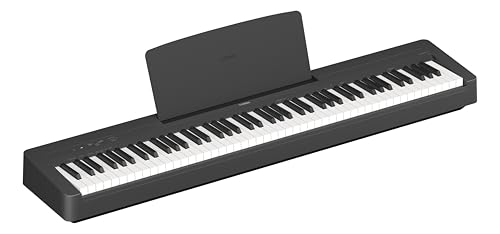
The P-145BT is Yamaha’s entry point into the P Series, built around the idea that a first piano should be easy to move and easy to live with. At 24.5 pounds, one person can carry it between rooms or load it into a car, and the shallow depth fits a sturdy table or a basic X-stand in a small room.
The GHC (Graded Hammer Compact) keyboard gives you weighted, touch-sensitive keys with matte black keytops, and the sound is built around a sampled Yamaha grand piano voice with damper resonance that adds depth when the pedal is down. Bluetooth audio separates this model from older entry-level Yamahas: you can stream songs from a phone through the speakers and play along. Duo mode splits the keyboard into two identical halves for lessons, and USB to Host carries MIDI and audio over a single cable. A sustain foot switch and music rest are in the box.
Specs
- Keys: 88, GHC weighted hammer action, touch sensitive
- Polyphony: 64 notes
- Voices: 10
- Speakers: built-in stereo, 7-watt amplification per the listing
- Connectivity: Bluetooth audio, USB to Host
- Weight: 24.5 pounds
- Included: sustain foot switch, music rest
- Extras: Duo mode, Smart Pianist app support
Roland FP-10 88-Key Digital Piano

The FP-10 is the entry model in Roland’s FP series, and its main claim is the keyboard. The PHA-4 Standard action is a full hammer action with escapement, the mechanism that lets a key reset before it returns all the way, which matters for fast repeated notes and for players coming from an acoustic piano.
Sound comes from Roland’s SuperNATURAL piano engine, which models the character of an acoustic grand rather than relying only on short samples. Bluetooth MIDI connects the piano to apps such as Roland’s Piano Partner 2 without a cable, and USB MIDI covers computer software. Twin Piano mode splits the keyboard into two matching ranges for lessons. At 27 pounds it is a little heavier than the Yamaha and Casio picks here, and it runs on AC power only. Speaker output is modest, so confirm the wattage on the listing if you plan to fill a large room.
Specs
- Keys: 88, PHA-4 Standard hammer action with escapement
- Sound engine: SuperNATURAL piano tones
- Connectivity: Bluetooth MIDI, USB MIDI
- Weight: 27 pounds
- Dimensions: 50.55 x 10.16 x 5.51 inches
- Included: DP-2 pedal switch, music rest, power adaptor
- Extras: Twin Piano mode, headphone output
- Speakers: built-in stereo, confirm wattage on the listing
Casio Privia PX-S1100 Digital Piano Bundle

The PX-S1100 is the slimmest piano in this guide. Casio designed the Privia PX-S body to be barely larger than the keys themselves, and at roughly 25 pounds with battery operation available, it is the pick for players who move their piano often, or who practice where the piano has to disappear afterward. The listing used here is the Austin Bazaar bundle in black, which adds a stand, bench, and sustain pedal, so the box covers a complete starter setup.
The Smart Scaled Hammer Action keyboard uses simulated ebony and ivory textured keys, and the sound is built around a German grand piano tone with string and damper resonance, plus 17 additional tones per the listing copy. Casio includes the WU-BT10 Bluetooth adapter in the box, adding Bluetooth audio and MIDI for the Casio Music Space app, so you are not paying extra for wireless later. A USB to Host port covers wired connections. Because this listing is a bundle, confirm which accessories are included before ordering, since the piano is also sold on its own elsewhere.
Specs
- Keys: 88, Smart Scaled Hammer Action, textured key surfaces
- Tones: German grand piano plus 17 more per the listing
- Connectivity: Bluetooth via included WU-BT10 adapter, USB to Host
- Weight: about 25 pounds
- Power: AC adaptor or batteries
- Included in this bundle listing: stand, bench, sustain pedal, book, lessons, DVD, cloth
- Polyphony and speaker wattage: confirm on the listing
Yamaha P-45 88-Key Digital Piano
The P-45 has been Yamaha’s straightforward portable piano for years, and it remains the pick for buyers who want the fewest distractions between sitting down and playing. There is no Bluetooth and no app ecosystem to set up. You get the GHS (Graded Hammer Standard) weighted action, heavier in the bass and lighter in the treble like an acoustic piano, and Yamaha’s AWM stereo sampling.
At 25.3 pounds and just under 30 centimeters deep, it is easy to move and fits in tight spaces. Ten voices cover the basics, including two grand pianos, electric pianos, and strings, and split mode lets you divide sounds for simple ensemble playing. USB to Host connects to a computer for MIDI, and the headphone jack handles silent practice. The sustain foot switch, music rest, and power adapter are included. Buyers who want Bluetooth streaming or app-based lessons should look at the P-145BT above instead, because the P-45 predates those features at this level.
Specs
- Keys: 88, GHS (Graded Hammer Standard) weighted action
- Voices: 10
- Connectivity: USB to Host, 3.5 mm headphone jack
- Weight: 25.3 pounds (11.5 kilograms)
- Dimensions: 52.25 x 11.5 x 6 inches
- Included: sustain foot switch, music rest, AC adaptor
- Extras: split mode, built-in speakers (wattage: confirm on the listing)
Donner DEP-20 Beginner Digital Piano
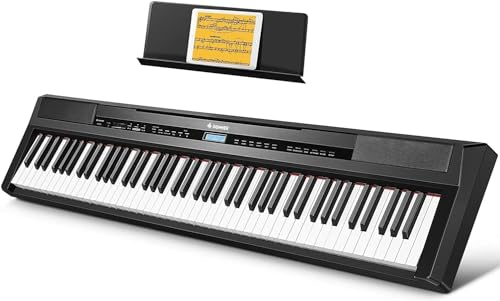
The DEP-20 is the value pick in this guide, and it takes the opposite approach to the Yamaha P-45: instead of trimming the feature list, Donner loads it. You get 238 tones, 128-note polyphony, and a dual tone mode that layers two sounds at once, all controlled from a backlit LCD panel. For beginners who want to experiment with different instrument voices, that breadth is the appeal.
The keyboard is a fully weighted hammer action with adjustable touch response, and the speaker system is the strongest in this guide on paper, with two 25-watt amplifiers, which helps in a classroom where headphones are not the plan. USB MIDI connects to DAWs and learning software, and the 6.35 mm headphone jack is the larger studio style, so check your headphone plug or plan on an adapter. This listing is the piano-only version at 11.6 kilograms, with a sustain pedal, sheet music stand, and power adapter included. A furniture stand version is sold separately.
Specs
- Keys: 88, fully weighted hammer action, adjustable touch response
- Polyphony: 128 notes
- Tones: 238, with dual tone layering
- Speakers: two 25-watt amplifiers
- Display: backlit LCD
- Connectivity: USB MIDI, 6.35 mm headphone jack
- Weight: 11.6 kilograms
- Dimensions: 52.17 x 11.61 x 7.6 inches
- Included: sustain pedal, sheet music stand, power adapter
How to Choose
Start with the key action, because it is the part you cannot upgrade later. All five pianos here have 88 weighted keys, but the actions differ: Roland’s PHA-4 adds escapement for a more acoustic-like release, Yamaha’s GHS and GHC actions are graded and dependable, Casio’s scaled hammer action keeps the body slim, and Donner’s action adds adjustable touch response.
Weight and depth decide how portable the piano really is. Everything here sits between about 24 and 27 pounds, which one adult can carry, but the Casio’s shallow body and battery option make it the easiest to store and the only one that plays away from an outlet. Next, check connections. Bluetooth audio lets you play along with streamed songs, Bluetooth MIDI connects lesson apps without cables, and USB to Host is enough if you only plan to record into a computer. Finally, look at what is in the box: a stand, bench, and pedal add up when bought separately.
Who Should Skip
Skip this category if you want a furniture piece that stays in one room, because a console piano with a fixed stand and a three-pedal unit will feel more solid and look better doing it. Skip these models if you need 61 or 76 keys for synth-style playing, since arranger keyboards are lighter for that job. The P-45 is the wrong pick if app lessons and Bluetooth streaming are part of your plan, and the Donner’s larger headphone jack and menu-driven controls are a poor fit for a young beginner who needs the simplest possible piano. Players performing in large rooms should plan on an external amplifier.
FAQ
Do portable digital pianos feel like a real piano?
They come close in the ways that matter for learning. All five picks here use weighted hammer actions, so the keys resist your fingers and respond to playing dynamics much like an acoustic piano. Feel varies by brand and action design, and none reproduce the full vibration of a wooden grand, but for lessons and daily practice these actions are the accepted standard.
Can I use a portable digital piano without a stand?
Yes, any of these pianos can sit on a sturdy, flat table or desk at the right height, and that is how many owners use them in small rooms. A dedicated stand gives you correct playing height and pedal stability once sessions get longer. Check that the surface is level and strong enough for a piano of around 25 pounds.
Which of these pianos works with piano learning apps?
The Yamaha P-145BT, Roland FP-10, and Casio PX-S1100 connect to apps wirelessly, through Bluetooth audio, Bluetooth MIDI, or both, and all three also work over USB. The Yamaha P-45 and Donner DEP-20 connect by USB only, which still works with most lesson and recording apps, with the right cable and possibly an adapter.
Do I need to buy a sustain pedal separately?
Not for most of these picks. The Yamaha models include a sustain foot switch, the Roland FP-10 includes a pedal switch, and the Casio bundle and the Donner both include a sustain pedal. A basic foot switch is fine for starting out, and you can upgrade to a piano-style pedal later if your playing reaches that point.
Final Verdict
For a first portable digital piano, the Yamaha P-145BT balances weight, a graded hammer action, and Bluetooth audio better than anything else here. Choose the Roland FP-10 if key feel is your top priority, the Casio Privia PX-S1100 bundle if you want the slimmest piano with a stand and bench included, the Yamaha P-45 for the simplest setup with no wireless features to manage, and the Donner DEP-20 for the most tones, the highest polyphony, and the strongest speakers.

More from Amazon
Programs that pair well with the guide above. Offers and eligibility are set by Amazon and may change.
Free shipping on eligible items, Prime Video and more. Eligible new members can start with a free trial.
Start a Prime free trialAudiobooks and podcasts to listen to on the go. Eligible new members can start with a free trial.
Try Audible freeAd-free music streaming. Eligible new subscribers can start with a free trial.
Try Music Unlimited freeA free business account with business pricing and bulk-buying tools for work, shop or home office.
Create a business accountAs an Amazon Associate we earn from qualifying purchases.
Write Your Review
No reviews yet. Be the first to share your experience!