

Key takeaways
- Compare five 88-key weighted digital pianos with graded hammer actions from Yamaha, Roland, Casio, Korg, and Donner for home practice and lessons.
- Top Pick: Yamaha P-225 88-Key Digital Piano (P225B)
- Runner-up: Roland FP-30X 88-Note Digital Piano
- Also consider: Casio CDP-S160 88-Key Digital Piano
A weighted key digital piano is the closest a home instrument gets to the feel of an acoustic piano. Real hammer actions make the bass keys heavier and the treble keys lighter, so finger strength and control develop the way a teacher expects. That matters for anyone taking lessons, returning to the piano after years away, or setting up a practice corner that will not need replacing after the first year.
This guide compares five 88-key models that all use genuine weighted hammer actions rather than semi-weighted or synth-style keys, from slim slabs that slide onto a table to a furniture-style console with its own stand and three pedals.
As an Amazon Associate, we earn from qualifying purchases.
Quick Answer
For a weighted key digital piano that feels close to an acoustic, start with the Yamaha P-225 for a compact graded hammer action, the Roland FP-30X for the most detailed touch response, or the Casio CDP-S160 for a slim, light option. The Korg B2SP adds a stand and three pedals, while the Donner DDP-80 suits a fixed home corner.
Yamaha P-225 88-Key Digital Piano (P225B)

The P-225 is Yamaha’s compact answer for players who want a graded hammer action without a bulky cabinet. Its Graded Hammer Compact action is heavier in the low keys and lighter in the high keys, which keeps scales and exercises honest when a student also practices on an acoustic piano at lessons. The sound is built around Yamaha’s CFX concert grand voice with Virtual Resonance Modeling, so the tone carries string and body resonance rather than a flat sample.
At about 25 pounds, this is one of the easiest full-size weighted pianos to move between rooms or store upright against a wall. Two headphone jacks make it practical for a teacher and student to listen together, and the Smart Pianist app support opens up lesson and recording features from a phone or tablet. A sustain foot switch, music rest, and power adapter are included in the box.
Specs
- Keys: 88, touch-sensitive
- Action: Graded Hammer Compact weighted action, heavier in the low keys
- Sound: Yamaha CFX grand piano voice with Virtual Resonance Modeling
- Speakers: built-in speakers
- Headphones: two 3.5 mm jacks
- Connectivity: USB, Smart Pianist and Rec’n’Share app support
- Weight: 25.4 lb
- Dimensions: 52.21 x 10.71 x 5.08 inches
- Included: sustain foot switch, music rest, power adapter
- Voices and polyphony: confirm on the listing
Roland FP-30X 88-Note Digital Piano

Roland’s FP-30X uses the PHA-4 Standard keyboard, an 88-note hammer action with ivory-feel key surfaces that many advancing players pick for its detailed response to dynamics. The SuperNATURAL piano engine reacts smoothly from very soft to very loud playing, which suits classical repertoire and graded exam pieces where control matters more than extra sounds.
The built-in stereo speaker system is rated at 22 watts in the listing, noticeably fuller than most slim slabs, and there are two headphone outputs for duet practice or late-night sessions with a partner listening in. Bluetooth audio and MIDI let you stream play-along tracks through the piano’s speakers or connect lesson apps without a cable. At just under 33 pounds it is heavier than the lightest picks here, so it fits best on a dedicated stand at home.
Specs
- Keys: 88
- Action: PHA-4 Standard hammer action with ivory-feel keys
- Sound: SuperNATURAL Piano engine
- Speakers: 22 W stereo speaker system
- Headphones: dual headphone outputs
- Connectivity: Bluetooth audio and MIDI, USB Type A and Type B
- Weight: 32.7 lb
- Dimensions: 51.2 x 11.2 x 6 inches
- Model: FP-30X-BK
- Polyphony: confirm on the listing
Casio CDP-S160 88-Key Digital Piano

The CDP-S160 is the slimmest and lightest weighted piano in this roundup, with a body barely deeper than the keys themselves. Casio’s Scaled Hammer Action gives the full 88-key range proper graded resistance, and the simulated ebony and ivory key surfaces help fingers grip during fast passages instead of sliding. Ten tones keep the focus on piano practice, and Duet Mode splits the keyboard into two identical ranges so a student and teacher can play side by side.
Flexibility is the real draw here. The piano runs on the included power supply or on six AA batteries, so it can be played on a patio, in a classroom, or anywhere an outlet is awkward. It weighs about 23 pounds, connects to the Casio Music Space app for lessons and score viewing, and includes a sustain pedal and music rest. A one-button recorder captures practice takes for quick review.
Specs
- Keys: 88
- Action: Scaled Hammer Action Keyboard
- Tones: 10, including a stereo grand piano
- Keytops: simulated ebony and ivory textures
- Speakers: built-in stereo speakers
- Connectivity: USB-MIDI, Casio Music Space app support
- Power: AC adapter or six AA batteries
- Headphones: 3.5 mm jack
- Weight: 23.2 lb
- Dimensions: 52.05 x 9.13 x 3.9 inches
- Included: power supply, sustain pedal, music rest
Korg B2SP 88-Key Digital Piano with Stand

The B2SP packages Korg’s B2 piano with a matching stand and a three-pedal unit, which makes it a tidy option for a permanent home setup where pedaling technique is part of the plan. Its Natural Weighted Hammer Action reproduces the acoustic pattern of heavier low keys and lighter high keys, and the pedal unit supports damper, soft, and sostenuto functions with half-pedaling on the damper, so expressive playing habits transfer cleanly to an acoustic piano.
Korg keeps the sound library deliberately focused on piano-family tones drawn from several grand piano sources, plus electric piano, organ, harpsichord, and strings, so beginners spend time playing rather than scrolling menus. USB Audio and MIDI connections let the piano work with recording software and lesson apps on a computer, and bundled software is included per the listing. Because the stand and pedals are part of the package, there is less extra shopping before the first practice session.
Specs
- Keys: 88
- Action: NH (Natural Weighted Hammer Action), graded like an acoustic piano
- Package: stand and three-pedal unit included
- Pedals: damper, soft, and sostenuto, with half-pedaling support
- Connectivity: USB Audio and MIDI
- Software: bundled software included per the listing
- Model: B2SP BK
- Number of sounds: confirm on the listing
- Weight: confirm on the listing
Donner DDP-80 88-Key Weighted Digital Piano
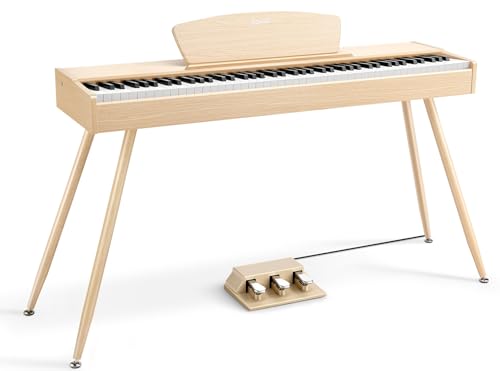
The DDP-80 takes the opposite approach to the portable slabs: it is a furniture-style console in a natural wood finish that is meant to stay in one place and look like part of the room. The 88 keys use a full-weighted hammer action, and a fixed triple pedal unit sits under the keyboard the way it does on an upright piano, which keeps pedal placement consistent for students building proper technique.
At roughly 55 pounds, this is a two-person assembly job rather than a grab-and-go instrument, and that weight buys a stable, wobble-free playing platform. USB-MIDI connects it to lesson and recording apps, a 3.5 mm headphone jack covers quiet practice, and the box includes the sheet music stand, triple pedal, and power adapter. Players who want one dedicated practice spot at home, and who like a traditional wood look, are the natural audience for this model.
Specs
- Keys: 88 full-size
- Action: full-weighted hammer action
- Format: furniture-style console with stand, Natural Wood finish
- Pedals: triple pedal unit included
- Connectivity: USB-MIDI
- Headphones: 3.5 mm jack
- Weight: 24.95 kg (about 55 lb)
- Model: DDP-80
- Included: sheet music stand, triple pedal, power adapter
- Polyphony and speaker output: confirm on the listing
How to Choose
Start with the action name, because it tells you what your fingers will feel. Graded hammer actions from Yamaha, Roland, Casio, and Korg all make the bass heavier than the treble, but they differ in key surface, travel, and how firm the bottom of the keystroke feels. If you take lessons on an acoustic piano, matching that general weight at home keeps your technique consistent between the two instruments.
Next, decide between a slab and a console. Slabs like the P-225, FP-30X, and CDP-S160 sit on a table or a folding stand and can be stored away, which suits apartments and shared rooms. A console like the DDP-80, or a package like the B2SP, fixes the keyboard at proper playing height with pedals in the right place, which is better for daily practice posture.
Then check the practical extras on the listing: whether a sustain pedal is included, whether there are one or two headphone jacks, and whether the piano connects to lesson apps by Bluetooth or only by USB cable. Finally, confirm the playing position: a stand that puts the keys at roughly elbow height when seated prevents wrist strain during longer sessions.
Who Should Skip
Skip weighted pianos entirely if the player is a young child who only needs a lightweight keyboard for casual fun, since a full hammer action can feel tiring for small hands during the first months. Skip the console and stand packages if you plan to move the piano between rooms or take it to classes every week, because the portable slabs are far easier to carry. Skip any model whose listing does not confirm a headphone jack if most practice will happen at night in a shared home. And if you mainly want hundreds of sounds, rhythms, and auto-accompaniment for songwriting, an arranger keyboard will serve you better than these piano-focused instruments.
FAQ
Are weighted keys really necessary for piano lessons?
For most lesson paths, yes. Teachers generally expect a hammer action because it builds the finger strength and dynamic control that acoustic pianos demand. A student who practices on unweighted keys often struggles to control volume when they sit down at a real piano.
What is the difference between graded hammer action and semi-weighted keys?
A graded hammer action uses real hammer mechanics and makes the low keys heavier than the high keys, like an acoustic piano. Semi-weighted keys use springs and added weight for some resistance, but they feel uniform across the range and lighter overall, which is less accurate for piano training.
Can these pianos be used with headphones?
Yes. Every model in this guide lists a headphone connection, and the Yamaha and Roland picks offer two outputs so a teacher, parent, or duet partner can listen along. Check the exact jack size and whether an adapter is needed on the listing before ordering.
Do I need a stand and bench, or is a table fine?
A sturdy table at the right height works at first, but a proper stand holds the keyboard steady at standard piano height and leaves room for pedals underneath. If you practice daily, a stand and an adjustable bench make a real difference to posture and comfort over time.
Final Verdict
All five pianos here deliver genuine weighted hammer actions, so the choice comes down to setup and habits. The Yamaha P-225 is the easiest all-round pick for a compact home setup, the Roland FP-30X rewards advancing players with the most detailed touch and stronger speakers, and the Casio CDP-S160 is the lightest route to a real action, battery power included. Choose the Korg B2SP if you want the stand and three pedals settled in one package, and the Donner DDP-80 if a fixed, furniture-style practice corner suits your home best.
More from Amazon
Programs that pair well with the guide above. Offers and eligibility are set by Amazon and may change.
Free shipping on eligible items, Prime Video and more. Eligible new members can start with a free trial.
Start a Prime free trialAudiobooks and podcasts to listen to on the go. Eligible new members can start with a free trial.
Try Audible freeAd-free music streaming. Eligible new subscribers can start with a free trial.
Try Music Unlimited freeA free business account with business pricing and bulk-buying tools for work, shop or home office.
Create a business accountAs an Amazon Associate we earn from qualifying purchases.
Write Your Review
No reviews yet. Be the first to share your experience!