

Key takeaways
- Compare five karaoke amplifiers for home singing, with peak power, channel counts, mic inputs, echo controls and Bluetooth streaming checks for each pick.
- Top Pick: Pyle PTA62BT.5 6-Channel Bluetooth Karaoke Amplifier
- Runner-up: Moukey MAMP1 2-Channel Stereo Karaoke Amplifier
- Also consider: Pyle PDA77BU 4-Channel Karaoke Amplifier Receiver
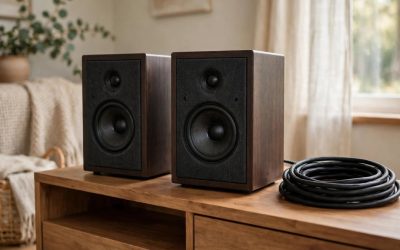
A karaoke amplifier is the box that ties a home singing setup together: it powers a pair of passive speakers, mixes your voice over the backing track, and adds the echo that makes a living-room performance sound finished. Unlike an all-in-one karaoke machine, a separate amplifier lets you keep the speakers you already own and upgrade one piece at a time.
The five amplifiers below cover the main shapes this category takes, from a compact two-channel desktop receiver to a rack-mount mixing amplifier built for bigger rooms. Each one includes at least two microphone inputs, some form of echo or reverb control, and Bluetooth streaming for playing backing tracks from a phone or tablet.
As an Amazon Associate, we earn from qualifying purchases.
Quick Answer
For most home singers, the Pyle PTA62BT.5 is the balanced pick: six channels, two microphone inputs with echo, Bluetooth streaming and a subwoofer output. The Moukey MAMP1 suits smaller rooms and simpler stereo setups, the Donner MAMP5 adds optical and coaxial inputs for TV audio, and the Pyle PMXAKB2000 is the high-power rack-mount option.
1. Pyle PTA62BT.5 6-Channel Bluetooth Karaoke Amplifier

The PTA62BT.5 is the most input-rich home unit in this group. It is a six-channel amplifier rated at 750 watts peak, designed to drive multiple speakers rated between 4 and 8 ohms, which makes it a sensible center for a living-room or small party setup. Two quarter-inch microphone inputs sit on the front panel, each ready for a wired mic, and the amplifier adds echo to the vocal channel so singers are not left with a dry, flat sound.
Playback sources are broad: Bluetooth streaming, USB, micro SD card, AUX, RCA line input and a built-in FM radio with a digital display. A microphone talk-over function dips the music when someone speaks into the mic, which is handy for hosts making announcements between songs. There is also a subwoofer output for adding low-end weight, a headphone jack with its own volume control for quiet practice, and a remote control in the box.
Specs
- Peak power: 750 watts
- Channels: 6
- Speaker impedance: 4 to 8 ohms
- Microphone inputs: 2 quarter-inch jacks with echo
- Playback: Bluetooth, USB, micro SD, AUX, RCA, FM radio
- Extra outputs: subwoofer out, headphone jack, REC out
- Weight: 9.59 pounds
- Dimensions: confirm on the listing
- Power supply: 110 and 220 volt switchable
2. Moukey MAMP1 2-Channel Stereo Karaoke Amplifier
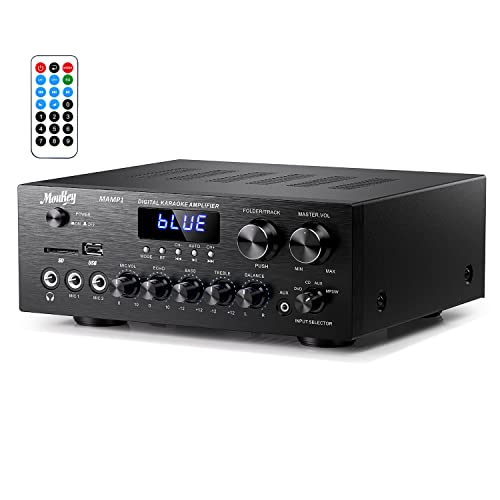
The Moukey MAMP1 takes the opposite approach: a compact two-channel desktop receiver for a single pair of speakers. It is rated at 400 watts peak with a listed continuous output of 25 watts per channel, which is the honest working figure for a small room, a desktop setup or a modest pair of bookshelf speakers used for family karaoke nights.
Two quarter-inch microphone inputs with echo adjustment cover duets, and the front panel carries separate controls for treble, bass, master volume and microphone volume, so the vocal balance can be set without digging through menus. Inputs include Bluetooth streaming, USB, SD card, AUX, two pairs of RCA connectors and FM radio, with an LED display showing the selected source. Banana plug speaker outputs make swapping speakers straightforward.
Specs
- Peak power: 400 watts
- Listed continuous output: 25 watts per channel
- Channels: 2
- Microphone inputs: 2 quarter-inch jacks with echo
- Playback: Bluetooth, USB, SD card, AUX, RCA, FM radio
- Controls: treble, bass, master volume, microphone volume
- Speaker outputs: banana plug connectors
- Weight: 7.54 pounds
- Bluetooth range: listed up to 40 feet or more
3. Pyle PDA77BU 4-Channel Karaoke Amplifier Receiver

The PDA77BU is a four-channel receiver rated at 800 watts maximum, aimed at homes that want one box for music, movies and karaoke. Its karaoke section is more adjustable than most: alongside microphone volume it offers reverb and delay controls, so the vocal effect can range from a short room echo to a longer, more spacious repeat.
Two quarter-inch microphone inputs have independent controls, which matters when two singers have very different voices. Playback runs through Bluetooth, USB-A with MP3 playback, SD card, RCA in and out, AUX and FM radio, and a digital LED display tracks volume and source. A headphone jack is included for late-night practice, and the unit ships with a remote control.
Specs
- Maximum power: 800 watts
- Channels: 4
- Microphone inputs: 2 quarter-inch jacks with independent controls
- Vocal effects: echo with reverb and delay adjustment
- Playback: Bluetooth, USB, SD card, RCA, AUX, FM radio
- Display: digital LED
- Extras: headphone jack, remote control included
- Weight: confirm on the listing
- Dimensions: confirm on the listing
4. Donner MAMP5 4-Channel Karaoke Amplifier

The Donner MAMP5 stands out in this group for its digital inputs. Alongside the usual Bluetooth, USB, FM and RCA connections, it adds optical and coaxial inputs, which let a television feed its audio straight into the amplifier in digital form. For karaoke played from a smart TV app, that removes an extra conversion step and keeps the setup tidy.
It is a four-channel amplifier rated at 1000 watts peak, with a listed continuous output of 25 watts per channel, feeding speakers between 4 and 8 ohms. Two microphone inputs include volume and echo adjustment for duets. The listing also states a frequency response of 20 hertz to 20 kilohertz and a signal to noise ratio of 83 decibels. A remote control is included, though the listing notes its batteries are not.
Specs
- Peak power: 1000 watts
- Listed continuous output: 25 watts per channel
- Channels: 4
- Speaker impedance: 4 to 8 ohms
- Microphone inputs: 2 with echo adjustment
- Playback: Bluetooth, USB, FM radio, RCA
- Digital inputs: optical and coaxial
- Frequency response: 20 hertz to 20 kilohertz as listed
- Remote control: included, batteries not included
5. Pyle PMXAKB2000 2000W Rack-Mount Karaoke Mixing Amplifier

The PMXAKB2000 is the heavyweight of the group: a dual-channel rack-mount mixing amplifier rated at 2000 watts maximum, listed as 1000 watts per channel at 4 ohms. It is built for larger rooms, rented halls and dedicated karaoke rigs where a desktop receiver would run out of headroom, and the rack ears let it mount into a standard equipment rack alongside other gear.
As a mixing amplifier it goes further on vocal shaping than the home receivers above. It mixes two microphones with Bluetooth or RCA input audio, and adds digital echo, key control for shifting a song’s pitch, and a microphone talk-over function. Three pairs of RCA output connectors feed external systems or a second amplifier, USB and SD readers handle local files, and a built-in cooling fan manages heat under sustained use. Power is switchable between 110 and 220 volts for use in different regions.
Specs
- Maximum power: 2000 watts, listed as 1000 plus 1000 watts at 4 ohms
- Channels: dual channel, rack mountable
- Microphone mixing: 2 microphones with digital echo
- Vocal features: key control, microphone talk-over
- Playback: Bluetooth, USB reader, SD reader, RCA
- Outputs: 3 pairs of RCA connectors
- Dimensions: 13.5 by 16.5 by 5.5 inches
- Power supply: 110 and 220 volt switchable
- Cooling: built-in fan
How to Choose a Karaoke Amplifier
Start with your speakers. Every amplifier here drives passive speakers, so check the impedance range your speakers need and match it to the amplifier’s stated range. Then look past the headline watt figure: peak watts describe a short burst, while the continuous per-channel figure, where the maker lists one, is the better guide to everyday volume in your room.
Count your microphones next. Two inputs are the practical minimum for duets, and independent volume controls help when one singer is louder than the other. Echo is standard in this category; reverb and delay controls, or key control on the rack-mount model, matter if you sing often enough to notice a plain echo’s limits.
Finally, match the inputs to your backing-track source. Phone-based singers only need Bluetooth. Anyone running karaoke from a television should look for optical or coaxial inputs, like the Donner MAMP5 offers, while hosts who keep music on local files will use the USB and SD readers several of these amplifiers include.
Who Should Skip a Karaoke Amplifier
Skip this category if you do not own passive speakers and do not want to buy a pair: an amplifier alone makes no sound, and an all-in-one karaoke machine or powered speaker with a microphone input is the simpler purchase. Singers who only perform occasionally at small gatherings may also find a portable Bluetooth karaoke speaker covers the job with far less wiring.
A separate amplifier is also the wrong buy if your television and soundbar already handle vocals well through a karaoke mixer, or if you need battery power for outdoor events, since every unit here runs from a wall outlet. And if your priority is recording or streaming performances, a dedicated audio interface and mixer will serve that goal better than a home amplifier.
FAQ
Do karaoke amplifiers work with any speakers?
They work with passive speakers that fall inside the amplifier’s stated impedance range, which is 4 to 8 ohms for most models in this guide. Powered speakers have their own built-in amplification and are not the right match; they connect to a mixer instead. Always confirm your speakers’ impedance on their label before pairing them with an amplifier.
What is the difference between peak watts and continuous watts?
Peak watts describe the maximum short burst an amplifier can deliver, while continuous or RMS watts describe the output it can sustain. Listings in this category lead with large peak figures, so when a maker also publishes a per-channel continuous figure, use that number to judge how the amplifier will suit your room and speakers.
Can I connect a television to a karaoke amplifier?
Yes, if the inputs line up. The simplest route is an RCA or AUX cable from the television’s audio output. For a direct digital connection, choose an amplifier with optical or coaxial inputs, such as the Donner MAMP5 in this guide, and set the television’s audio output format to match what the amplifier accepts.
How many microphone inputs do I need for karaoke?
Two inputs cover the common cases: solo singing with a spare, or duets. Independent volume controls on each input help balance two different voices. If you host group singing with three or more microphones at once, none of these amplifiers is the right tool; a small standalone mixer feeding an amplifier handles that better.
Final Verdict
For a typical home setup, the Pyle PTA62BT.5 offers the widest mix of channels, inputs and vocal features in a single box. The Moukey MAMP1 is the compact stereo choice, the Pyle PDA77BU adds reverb and delay control for singers who like to shape their vocal sound, and the Donner MAMP5 is the one to pick when the television is the main karaoke source. Reserve the Pyle PMXAKB2000 for big rooms and rack setups where its power and key control earn their keep. Match the amplifier to your speakers first, and the rest of the decision gets much easier.
More from Amazon
Programs that pair well with the guide above. Offers and eligibility are set by Amazon and may change.
Free shipping on eligible items, Prime Video and more. Eligible new members can start with a free trial.
Start a Prime free trialAudiobooks and podcasts to listen to on the go. Eligible new members can start with a free trial.
Try Audible freeAd-free music streaming. Eligible new subscribers can start with a free trial.
Try Music Unlimited freeA free business account with business pricing and bulk-buying tools for work, shop or home office.
Create a business accountAs an Amazon Associate we earn from qualifying purchases.
Write Your Review
No reviews yet. Be the first to share your experience!