

Key takeaways
- Compare the best quick change capos for one-handed key swaps, with spring tension, fretboard fit, and build notes for acoustic and electric guitars.
- Top Pick: Kyser Quick-Change Guitar Capo, Black (KG6BA)
- Runner-up: D'Addario NS Tri-Action Capo, Black (PW-CP-09)
- Also consider: Dunlop 83CN Trigger Acoustic Guitar Capo, Nickel
A quick change capo earns its name in the middle of a song. When a singer asks for a different key between verses, or a karaoke host moves a backing track up a step, there is no time to unscrew a clamp, slide a yoke into place, and check the tuning string by string. A spring-loaded trigger capo solves that problem: squeeze the handles, move the bar behind the next fret, release, and keep playing. The whole change takes one hand and a couple of seconds, which is why this style dominates live rigs, worship teams, open mics, and home music rooms where songs change fast.
Not every trigger capo behaves the same, though. Spring strength decides how firmly the bar seats and how much the strings get pulled sharp, the pad shape has to match a curved or flat fretboard, and the handle profile decides whether the capo stays clear of the fretting hand at higher positions.
As an Amazon Associate, we earn from qualifying purchases.
Quick answer
For most players, the Kyser Quick-Change KG6BA is the safest quick change capo: a strong steel spring, an aluminum body, and a curved pad shaped for six-string acoustic guitars. Players who want control over clamping force should look at the D’Addario NS Tri-Action, which adds a tension dial. The Dunlop 83CN suits curved acoustic fretboards in a low-profile nickel build, the WINGO JX-09 adds picks in the box, and the Nordic Essentials two-pack covers a second guitar or a twelve-string.
Kyser Quick-Change Guitar Capo, Black (KG6BA)

The KG6BA is the capo most people picture when they hear the words quick change. Kyser has built this design around a strong steel spring and a distinctive curled handle that parks on the headstock between songs, so the capo is always within reach during a set. The body is aircraft-grade aluminum, which keeps it light on the neck while the spring does the clamping work. The pad is curved to match the radius of a typical steel-string acoustic fretboard, and the fixed tension is calibrated for six-string acoustics rather than lighter electric strings.
Because the tension is fixed, placement matters: set the bar just behind the fret wire and center it so the outer strings get even pressure. Players with several guitars in different colors will find the same design sold in many finishes, but the black KG6BA listing is the standard reference version. It is a straightforward, single-purpose tool with no adjustments to manage, which is exactly what many live players want.
Specs
- Type: spring-loaded trigger capo
- Body: aircraft-grade aluminum with a steel spring
- Fit: six-string acoustic guitars, curved fretboard radius
- Tension: fixed, not adjustable
- Operation: one hand, parks on the headstock
- Dimensions: 4 x 3.25 x 0.5 inches
- Color: black; other finishes are listed separately, confirm on the listing
D’Addario NS Tri-Action Capo, Black (PW-CP-09)

The NS Tri-Action takes the trigger format and adds the one thing most spring capos lack: control over clamping force. Its patented Tri-Action geometry reduces the force needed to open and close the capo, and a micrometer tension dial lets the player back the pressure off for light string sets or add more for heavier gauges. That makes it a strong fit for players who move one capo between an acoustic and an electric, where the ideal pressure differs.
The design comes from Ned Steinberger and uses a lightweight aluminum frame with an integrated pick holder, a small detail that helps during live sets. D’Addario describes the geometry as applying even tension regardless of neck profile, and the trigger action still works one-handed, so it keeps the speed advantage of this category while reducing the pulled-sharp tuning problem that strong fixed springs can cause. A silver version is also listed; confirm color and current configuration on the listing before ordering.
Specs
- Type: trigger capo with Tri-Action geometry
- Tension: micrometer adjustment dial
- Body: lightweight aluminum
- Fit: six-string acoustic and electric guitars
- Extras: integrated pick holder
- Operation: one hand
- Color: black; silver version also listed, confirm on the listing
Dunlop 83CN Trigger Acoustic Guitar Capo, Nickel

Dunlop’s 83CN is the traditional alternative to the Kyser pattern. It uses a spring-loaded trigger in an aircraft aluminum body with a nickel finish, shaped for curved acoustic fretboards. The profile sits lower against the neck than many trigger capos, and the handle tucks behind the neck, which players who fret with the thumb over the top often appreciate. Dunlop describes the clamping as positive and accurate, and the design has been a staple of acoustic rigs for decades.
The spring is fixed, so like the Kyser it rewards careful placement just behind the fret. The nickel finish pairs well with standard chrome hardware, and black and gold versions of the same trigger design exist in the Dunlop line. Weight and packaged dimensions vary by listing, so confirm those details on the listing itself.
Specs
- Type: spring-loaded trigger capo
- Body: aircraft aluminum
- Fit: curved acoustic guitar fretboards
- Finish: nickel
- Profile: low-profile design with the handle behind the neck
- Tension: fixed, not adjustable
- Weight: confirm on the listing
WINGO Guitar Capo, Rosewood Color (JX-09)
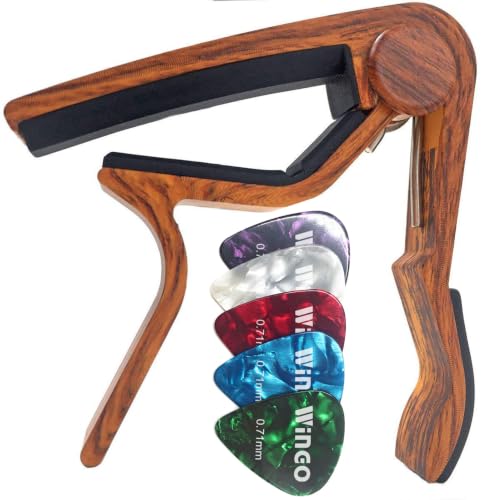
The WINGO JX-09 is the value option in this group. It is a trigger capo built from aluminum alloy with a rosewood-color finish laid over the frame, so it reads as a wood accessory on an acoustic guitar while keeping a metal core. A thick silicone pad protects the neck and fretboard, and the box includes five picks, which makes it a common gift and starter-kit choice.
WINGO lists the JX-09 for acoustic and electric guitars, and the same listing family covers bass and ukulele use, so it suits a home music room with several instruments. The spring tension is fixed, and the pad is a general curved shape rather than a model-specific radius, so players with very flat or very round fretboards should check the fit notes on the listing. A black version is sold under the same model line.
Specs
- Type: spring-loaded trigger capo
- Body: aluminum alloy with a rosewood-color finish
- Pad: silicone
- Fit: acoustic and electric guitars; also listed for bass and ukulele
- Includes: five picks, per the listing
- Model: JX-09
- Tension: fixed, not adjustable
Nordic Essentials Guitar Capo 2-Pack, Black and Silver

The Nordic Essentials set takes a different approach to value: two capos in one box, one black and one silver, each with a carry pouch. The capos are trigger style, built from aluminum, and the listing describes them as ultra lightweight at about 1.2 ounces each, with silicone grip material where the capo meets the neck. The set is listed for six-string and twelve-string instruments, including acoustic and electric guitars, ukulele, banjo, mandolin, and bass.
A two-pack makes practical sense for players who keep one capo parked on a headstock and another in a gig bag, or who play both a six-string and a twelve-string in the same set. The spring tension is fixed, and the twelve-string coverage is worth checking against the pad width notes on the listing. Confirm the current set contents before ordering, as bundle contents can change.
Specs
- Type: spring-loaded trigger capo, two-pack
- Body: aluminum
- Weight: about 1.2 ounces per capo, per the listing title
- Grip: silicone
- Fit: six-string and twelve-string instruments, per the listing
- Includes: one black capo, one silver capo, two carry pouches
- Tension: fixed, not adjustable
How to choose
Start with the fretboard. Most steel-string acoustics and electrics have a curved, or radiused, fretboard, and every capo above is shaped for that curve. Classical guitars have flat, wide fretboards and need a flat classical capo instead; none of these five is the right tool for nylon strings. Twelve-string players should check pad width, because the bar has to cover paired courses evenly.
Next, decide on tension. Fixed-spring capos like the Kyser, Dunlop, WINGO, and Nordic Essentials are the fastest and simplest, but a strong spring can pull strings slightly sharp, especially on light electric sets. If one capo has to serve several guitars, or tuning stability matters more than raw speed, the D’Addario Tri-Action and its tension dial are the better match. Handle shape is the third factor: curled handles park neatly on a headstock, while low-profile handles stay clear of the fretting hand. Finally, think about how many instruments need a capo at once; a two-pack removes the mid-set swap entirely.
Who should skip
Players who rarely change keys mid-song may prefer a screw or yoke capo with fully adjustable tension and a lower price of entry in patience rather than hardware. Classical and flamenco players should skip this entire category and look at flat capos made for nylon strings. Recording players who are sensitive to any tuning shift may also find fixed springs frustrating and should choose the adjustable option or a different clamp style. And anyone whose guitar has an unusually thick or V-shaped neck should confirm fit on the listing first, because trigger capos have a limited opening range.
FAQ
What makes a capo a quick change capo?
A quick change capo uses a spring-loaded trigger or clamp that opens with a squeeze and closes on its own, so it can be fitted, moved, or removed with one hand in seconds. There are no screws to turn and no straps to thread, which is what separates this style from yoke, screw, and elastic capos.
Do quick change capos work on classical guitars?
Generally no. Classical guitars have flat, wide fretboards and nylon strings that need gentle, even pressure from a flat capo. The curved pads and strong springs on quick change capos are designed for narrower steel-string necks, so a dedicated classical capo is the correct choice.
Can a quick change capo pull the guitar out of tune?
It can, if the spring pressure is stronger than the string set needs or the capo is placed in the middle of the fret space. Placing the bar just behind the fret wire, centered across the strings, reduces the effect. An adjustable model such as the Tri-Action lets the player dial the pressure down further.
Where should a quick change capo sit when it is not in use?
Most players clamp it on the headstock, which keeps it reachable between songs and avoids setting it down on stage. The Kyser handle shape is designed with headstock parking in mind. Just check that the pad rests on the headstock face rather than pressing on a tuner or the nut.
Final verdict
Quick change capos trade fine adjustment for speed, and for live, karaoke, and home playing that trade is usually worth it. The Kyser KG6BA remains the reference point for a fixed-spring acoustic capo, while the D’Addario NS Tri-Action is the pick for players who want that speed with a tension dial. The Dunlop 83CN covers the traditional low-profile niche, the WINGO JX-09 is the budget-friendly single, and the Nordic Essentials two-pack is the practical choice for multi-guitar households. Match the pad to the fretboard, place the bar close behind the fret, and any of the five will change keys as fast as the song demands.
More from Amazon
Programs that pair well with the guide above. Offers and eligibility are set by Amazon and may change.
Free shipping on eligible items, Prime Video and more. Eligible new members can start with a free trial.
Start a Prime free trialAudiobooks and podcasts to listen to on the go. Eligible new members can start with a free trial.
Try Audible freeAd-free music streaming. Eligible new subscribers can start with a free trial.
Try Music Unlimited freeA free business account with business pricing and bulk-buying tools for work, shop or home office.
Create a business accountAs an Amazon Associate we earn from qualifying purchases.




Write Your Review
No reviews yet. Be the first to share your experience!