

Key takeaways
- The best wireless microphones for church services compared: dual and four-channel UHF systems with handhelds and headsets for pastors and worship teams.
A church buying wireless microphones is not really shopping for microphones. It is buying a Sunday morning that never makes the congregation wince: enough channels live at the same moment for the preacher, the worship leader and the person reading scripture, with no dropout landing in the middle of a prayer. The real decision is how many people must be wireless simultaneously, who among them needs both hands free, and how crowded the airwaves around your building already are.


This guide serves three kinds of buyers. Small congregations replacing a single wired pulpit microphone need something a volunteer can switch on and trust. Growing churches with a full worship team need four channels that stay out of each other’s way. Pastors who preach from a headset need a bodypack in the mix, not another handheld. Every pick below was chosen from its Amazon product page, and the channel counts, frequency ranges and battery figures quoted are the manufacturers’ published specifications from those pages.
Quick Picks
As an Amazon Associate we earn from qualifying purchases
| Product | Best for | Key spec from title |
|---|---|---|
| Shure BLX288/PG58 | Two vocalists who want a proven vocal capsule | 2 PG58 handhelds, 300 ft range, 14-hour battery |
| Phenyx Pro PTU-7000-4H | A four-singer worship team | 4 handhelds, auto scan, 328 ft range |
| Innopow WM400BH | Handhelds plus bodypacks in one receiver | 2 handhelds and 2 bodypacks, 150-200 ft range |
| Phenyx Pro PTU-71-1H1B | A headset preacher plus one singer | Handheld and bodypack set, auto scan, 328 ft range |
| Phenyx Pro PTU-5000-4H | A choir on a simple fixed-frequency setup | 4 handhelds, fixed frequencies, 260 ft range |
How to Choose
Count simultaneous channels, not microphones in the box
Walk through your busiest service moment and count heads. The pastor is preaching, two vocalists are holding harmony lines, and a reader is waiting at the lectern: that is four live channels, even if only three people speak in the average week. A dual system asked to cover that moment forces awkward microphone hand-offs mid-service. Buy for the Easter and Christmas roster rather than the quiet August one, because a system that falls one channel short cannot be expanded later; the receiver’s channel count is fixed at purchase.
Decide who gets a handheld and who gets a bodypack
Handhelds suit singers and readers: they can be passed along a choir row, set down on a stand, and shared between services. Bodpacks suit people whose hands are busy or whose delivery moves around the platform. A preacher who gestures, holds a tablet or turns to a screen keeps a constant mouth-to-microphone distance on a headset, which keeps the preaching level steady. Guitarists and drama teams also belong on bodypacks. If even one regular speaker needs that freedom, shortlist systems that mix bodypacks with handhelds instead of forcing everyone onto handhelds.
Fixed frequencies versus room to move
Every wireless channel occupies a slice of UHF spectrum that your building shares with broadcast television and every other wireless user nearby. Fixed-frequency systems transmit on preset channels: simple, predictable, and perfectly reliable where the airwaves are quiet. Selectable systems, especially those with auto-scan, search for an open frequency and move there when something interferes. A rural church may run fixed frequencies for years without a glitch. A downtown sanctuary surrounded by TV transmitters and neighbouring churches running their own wireless rigs should pay for scanning and selectable channels.
Range, receiver placement and the battery plan
Published range figures assume a clear line of sight between transmitter and receiver antennas. Real sanctuaries have balconies, brick walls and a sound booth at the back, all of which eat range, so place the receiver high, visible from the platform, and well inside the stated distance. Battery discipline matters just as much. Note whether a system runs two hours or sixteen on a set of AA batteries, decide who swaps them and when, and keep fresh spares at the booth. A microphone that fades during the sermon is usually a battery routine that never existed.
The 5 Best Options
Shure BLX288/PG58 Dual Handheld System
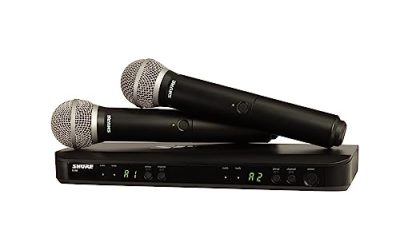
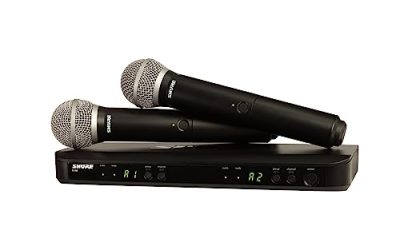
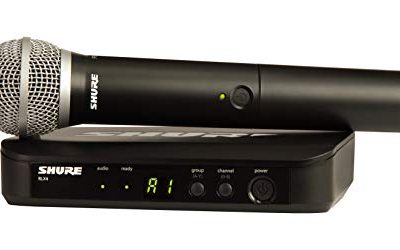
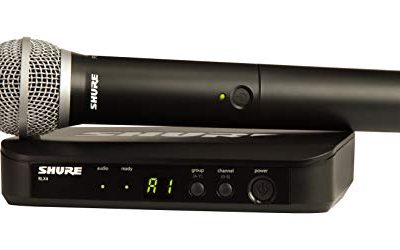
For a church where two voices carry the service, a pastor and a worship leader or two lead vocalists, this dual Shure system trades channel count for polish. The PG58 capsule is a long-standing vocal microphone that tolerates loud singers and plosive consonants gracefully, and the BLX88 receiver’s one-touch scan settles setup before the first hymn. Fourteen hours of transmitter battery life covers rehearsal, two services and an evening meeting on a single set of AAs, which removes one weekly worry for the sound volunteer.
Specs
- Dual-channel BLX88 tabletop receiver
- 2 BLX2 handheld transmitters with PG58 dynamic vocal capsules
- Polar pattern: unidirectional
- Frequency band: H10, 542-572 MHz
- Operating range: up to 300 ft (100 m)
- Battery life: up to 14 hours per transmitter, from 2 AA batteries
- One-touch QuickScan frequency selection
- Connector type: XLR
- Includes 2 microphone clips, power supply and 4 AA batteries
Best for: Two vocalists, or a pastor-and-worship-leader pair, in a small to mid-size sanctuary.
Watch out for: Confirm the H10 band (542-572 MHz) sits clear of your local television stations before ordering, since the same system is sold in other bands.
ASIN: B016APL8RC
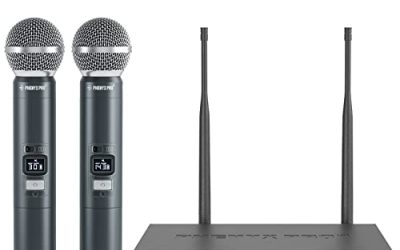
Phenyx Pro PTU-7000-4H
A four-singer worship team is exactly the load this quad Phenyx Pro system was built around. Each of its four channels owns a separate block of 40 selectable frequencies, so the sound volunteer can park every vocalist on clean spectrum and still have room to dodge a new interference source next month. Auto-scan does the hunting automatically, which suits churches where the person running sound changes from week to week. The metal receiver shrugs off life in a busy booth, and the stated battery figure stretches across a full day of rehearsals and services.
Specs
- Quad-channel UHF wireless receiver with metal housing
- 4 handheld dynamic microphones
- 4 x 40 selectable frequencies: channel 1 at 538.3-550 MHz, channel 2 at 554.8-566.5 MHz, channel 3 at 571.3-583 MHz, channel 4 at 587.8-599.5 MHz
- Auto Scan identifies the least-interference frequency for each channel
- Operating range: 328 ft
- 4 antennas
- 8 AA batteries included, up to 16 hours of use
- Includes 1/4-inch audio cable and power adapter
Best for: A four-vocalist worship team in a mid-size or large sanctuary with busy local airwaves.
Watch out for: The full 328 ft range assumes clear line of sight, so plan receiver placement on top of the booth or rack rather than inside a cupboard.
ASIN: B0CL6RMPTC
Innopow WM400BH 4-Channel System
Most church platforms are mixed rosters, and this Innopow set is the one shaped like one: two handhelds for vocalists and readers, plus two bodypack transmitters for the people who need their hands, such as a headset-wearing preacher or the Christmas drama cast. All four channels live in a single metal receiver, which keeps the booth tidy and the setup to one power outlet. Frequencies are fixed, so there is nothing to configure on a Sunday morning; the trade is that the system leans on your local airwaves staying as quiet as they are today.
Specs
- 4-channel UHF wireless system with metal construction
- 2 handheld microphones and 2 bodypack transmitters
- Bodypacks suited to headset and lavalier microphones
- Fixed frequency operation
- Operating range: 150-200 ft
- Battery life: up to 16 hours of use
- Item model number: WM400BH
Best for: Churches mixing handheld vocalists with a headset preacher or presenters on bodypacks.
Watch out for: Its stated range is the shortest in this group, so measure from the platform to the receiver position before committing, especially in long sanctuaries with balconies.
ASIN: B0BYJWF9HV
Phenyx Pro PTU-71-1H1B

Small congregations often need precisely two things: a handheld for the person leading singing or reading, and a headset for a pastor who walks, gestures and never stands where the pulpit microphone points. This dual Phenyx Pro set pairs one handheld with one bodypack that works with both headset and lapel microphones, covering weddings and interviews as readily as Sunday services. Despite the modest channel count, each channel can pick from 100 UHF frequencies and auto-scan finds a clear one, so a small church in a noisy RF neighbourhood is not forced into fixed channels.
Specs
- Dual-channel UHF wireless receiver
- 1 handheld microphone and 1 bodypack transmitter
- Headset and lapel microphones included for the bodypack
- Auto Scan frequency selection
- 2 x 100 selectable UHF frequencies
- Operating range: 328 ft
- Model name: PTU-71-1H1B
Best for: A small congregation whose pastor preaches from a headset while one vocalist or reader uses a handheld.
Watch out for: Two channels is a hard ceiling; a worship team that grows to three vocalists will outgrow this set, so consider it a deliberate small-church choice.
ASIN: B07JY5NVFT
Phenyx Pro PTU-5000-4H

Where the airwaves are clean and the operators are volunteers, simplicity beats flexibility. This quad Phenyx Pro system runs four handheld microphones on fixed frequencies with no scanning menus to learn: switch each channel on and it works, which makes it a comfortable fit for choir members and backup singers who handle their own microphones. The metal receiver and anti-rolling rings suit microphones that get set down on piano tops and pew edges. Its eight-hour battery figure is the honest constraint here, sized for a service day rather than a weekend conference.
Specs
- 4-channel UHF wireless receiver with metal housing
- 4 handheld dynamic microphones
- Fixed frequencies: 541.9 MHz, 546.3 MHz, 561.6 MHz and 568.65 MHz
- Operating range: 260 ft
- 8 AA batteries included, up to 8 hours of operation
- 2 antennas
- Anti-rolling rings included
Best for: A choir or backup-singer group in a small to mid-size church where local airwaves are quiet.
Watch out for: Fixed frequencies cannot move; if a broadcaster or a neighbouring venue later lands on one of these four channels, that channel has nowhere to go.
ASIN: B07GR69D9L
Which One Fits Your Situation
Your pastor preaches with both hands free
Start with the Phenyx Pro PTU-71-1H1B: its bodypack and headset keep the preaching level even while the pastor moves, and the handheld covers the worship leader. If readers or a second presenter also need bodypacks, step up to the Innopow WM400BH, which doubles the bodypack count inside one receiver.
Four vocalists front the worship team
The Phenyx Pro PTU-7000-4H is the natural fit, with four handhelds, per-channel frequency blocks and auto-scan to keep four voices apart in a busy building. Churches in quiet rural areas whose volunteers prefer zero configuration can consider the PTU-5000-4H instead, accepting its fixed frequencies as the trade.
Two voices carry the whole service
When one pastor and one singer, or two lead vocalists, do nearly all the talking and singing, the Shure BLX288/PG58 spends the budget on capsule quality and battery life instead of spare channels. Its fourteen-hour transmitters comfortably span rehearsal plus back-to-back services without a battery swap.
Readers, singers and a drama team share one platform
Choose the Innopow WM400BH. Handhelds pass between readers and vocalists while the two bodypacks stay assigned to the preacher’s headset and a drama or dance performer, so nobody is rewiring anything between items in the service. Its single receiver also keeps a small booth uncluttered.
Common Mistakes
- Counting the microphones in the box instead of the people who must be live at the same moment, then discovering the Easter service needs one channel more than the system owns.
- Buying a fixed-frequency system for a downtown building ringed by broadcast television and other churches’ wireless gear, leaving no way to move a channel when interference arrives.
- Hiding the receiver inside a metal rack or a back room and blaming the microphones for dropouts that walls and distance caused.
- Leaving the same AA batteries in transmitters for months, with no swap routine, until a microphone fades quietly in the middle of the sermon.
- Handing a handheld to a preacher who reads from a tablet and gestures throughout, when a bodypack with a headset matches how the sermon is actually delivered.
Frequently Asked Questions
How many wireless channels does a church actually need?
Count the people who must be heard at the busiest moment of your biggest service: preacher, worship leader, vocalists, reader, and anyone on an instrument who also sings. Most small churches land between two and four channels. Buy for that peak rather than the weekly average, because receiver channels cannot be added later.
Should the pastor use a handheld or a headset microphone?
A headset keeps a fixed distance from the mouth, so the volume stays even when the preacher turns, walks or looks down at notes, and it leaves both hands free. A handheld suits preachers who vary distance for emphasis and regularly hand the microphone to others for readings, testimonies or questions from the floor.
Fixed frequency or selectable frequency: which is safer for a church?
Selectable systems, especially with auto-scan, can move a channel when interference appears, which makes them safer in cities and shared buildings. Fixed-frequency systems are dependable where the airwaves are quiet and are simpler for volunteers to run. Judge your own neighbourhood: the more broadcast and wireless activity around you, the stronger the case for scanning.
Will one of these systems connect to our existing mixer?
Yes. Receivers in this class feed a mixer through standard XLR or quarter-inch outputs, and any spare mixer channel accepts them. Prefer a separate output per wireless channel where the system offers one, because each voice then gets its own fader, mute and EQ at the desk instead of sharing a single summed feed.
More from Amazon
Programs that pair well with the guide above. Offers and eligibility are set by Amazon and may change.
Free shipping on eligible items, Prime Video and more. Eligible new members can start with a free trial.
Start a Prime free trialAudiobooks and podcasts to listen to on the go. Eligible new members can start with a free trial.
Try Audible freeAd-free music streaming. Eligible new subscribers can start with a free trial.
Try Music Unlimited freeA free business account with business pricing and bulk-buying tools for work, shop or home office.
Create a business accountAs an Amazon Associate we earn from qualifying purchases.
Write Your Review
No reviews yet. Be the first to share your experience!