

Key takeaways
- Compare four wireless microphone kits with real-time headphone monitoring, 32-bit float backup recording, published range and battery figures.
Picking a wireless microphone kit with monitoring is a decision about when you find out something went wrong. Without a headphone output you trust the level meters, press record, and only discover the clipped shout, the clothing rustle, or the transmitter that muted itself when you review the footage. A receiver with a monitoring port moves that discovery into the moment, while there is time to fix a mic position or lower the gain. The choice is which kit builds monitoring in, and what else it gives up or adds to get there.
This shortlist is for three kinds of buyers: interviewers recording two people to a camera, solo creators who alternate between a mirrorless camera and a phone, and event or wedding shooters who cannot ask anyone to repeat a line. Every kit below puts a headphone output on the receiver itself. The picks and the specifications quoted for them come from the product names and published details on each kit’s Amazon page, not from marketing roundups.
Quick Picks
As an Amazon Associate we earn from qualifying purchases
| Product | Best for | Key spec from title |
|---|---|---|
| DJI Mic 2 (2 TX + 1 RX + Charging Case) | Creators who split the week between camera and phone | 32-bit float internal recording, 250 m (820 ft) range |
| RØDE Wireless PRO | Planned film shoots that need timecode sync | 32-bit float on-board recording, timecode, 2 lavalier microphones |
| Hollyland Lark Max Duo | Long outdoor recording days away from a desk | Professional ENC, 820 ft (250 m) range, 22H duration |
| Saramonic Blink 500 ProX B2R | Two-person interviews sent to cameras and recorders | On-board recording transmitters, lavaliers included |
How to Choose
Confirm the headphone output sits on the receiver
Plenty of kits advertise monitoring, then deliver it through a phone app or the camera’s own headphone jack, which many mirrorless bodies do not have. For monitoring that works on any shoot, the receiver itself needs a dedicated 3.5mm headphone output, ideally with its own volume control so you can ride the listening level without touching the record gain. Check the product page wording carefully: a 3.5mm socket labelled as the camera output is not a monitor port. All four kits here carry a real headphone output on the receiver, which is exactly why they made this list.
Decide how much backup recording you need
Monitoring tells you a take is going wrong; backup recording decides whether the take survives anyway. Kits differ sharply here. Some transmitters record nothing, some capture a compressed safety track, and the stronger designs here record 32-bit float or 24-bit WAV files onboard, so a sudden shout that clips the camera track can still be recovered from the transmitter file. Think about your failure mode. A seated podcast interview can simply be re-recorded, while a wedding speech or a one-time street interview cannot, and that difference should drive how much onboard recording you pay for.
Match the published range and runtime to your longest shoot
Every range figure on these pages is a line-of-sight number measured outdoors, so treat it as a ceiling rather than a promise. A kit rated at 250 metres will usually cover a large hall comfortably, while walls, crowds and Wi-Fi congestion shrink the real working distance for any 2.4 GHz system. Battery planning matters just as much. Compare the transmitter runtime first, then the total with the charging case, and ask whether the receiver can keep working while it charges. A kit that dies at hour six is a poor match for an all-day conference, however good its monitoring sounds.
Check what the box includes before comparing anything else
Two kits that look similar on a spec table can arrive with very different boxes. Lavalier microphones are the classic cut corner: some systems include a pair, others expect you to clip the transmitter itself to a collar, and a discreet lav costs extra later. Work through the included list on the product page and count the phone adapters, the camera cable, and whether both TRS and TRRS leads are supplied for phones. A charging case also changes daily life more than most buyers expect, because the whole kit tops up together instead of gathering cables every evening.
The 4 Best Options
DJI Mic 2 (2 TX + 1 RX + Charging Case)

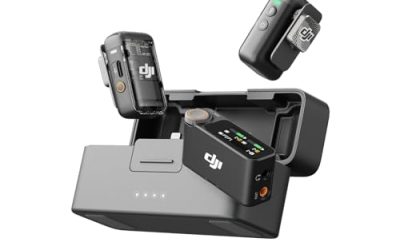
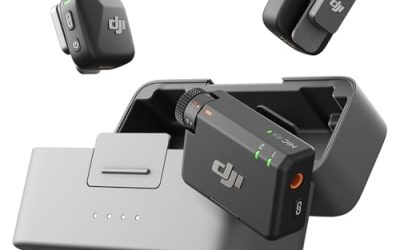
Creators who move between a camera, a phone and a laptop in the same week will feel at home here. The receiver carries a dedicated 3.5mm TRS monitoring port, so you can listen on headphones even when the camera body offers no headphone jack of its own, and its bright OLED screen keeps levels and battery state visible. Intelligent noise cancelling helps on busy streets, while each transmitter records 32-bit float audio internally as a safety net. Lightning and USB-C phone adapters sit in the case, which keeps the whole kit unusually self-contained.
Specs
- Kit contents: 2 transmitters, 1 dual-channel receiver, charging case, Shadow Black finish
- Monitoring: dedicated 3.5mm TRS headphone port on the receiver; monitor output max 12 mW at 1 kHz, 32 Ω
- Internal recording: 32-bit float; 8 GB of storage per transmitter, up to 14 hours of 48 kHz 24-bit audio
- Maximum transmission distance: 250 m (820 ft) under FCC conditions
- Microphone: omnidirectional; max SPL 120 dB; equivalent noise 21 dBA
- In the box: 3.5mm TRS camera cable, Lightning and USB-C phone adapters, clip magnets, windscreens
Best for: creators who record on several different devices and want monitoring that travels with the receiver.
Watch out for: DJI’s listing notes that intelligent noise cancelling and internal recording are unavailable when a transmitter connects to a phone over Bluetooth, and no lavalier microphones are included in the box.
ASIN: B0CFZX734J
RØDE Wireless PRO
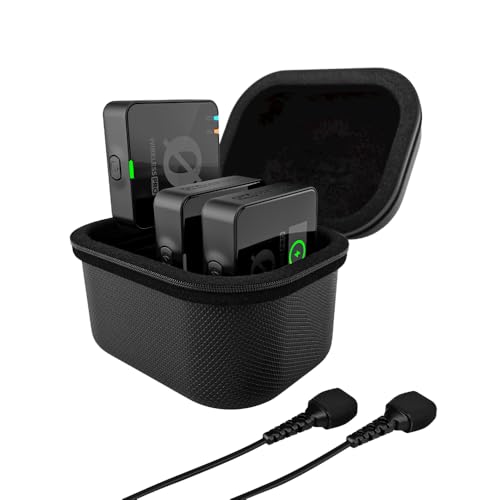
This is the kit aimed at shoots that are planned rather than improvised. Its receiver’s 3.5mm TRRS jack handles headphone monitoring with its own level control, and the same port can take a headset or narrator microphone for a third channel when a production needs one. Timecode support keeps audio and video aligned across long recordings, GainAssist manages input levels automatically, and 32-bit float on-board recording protects loud moments. Two Lavalier II microphones, magnetic clips and a smart charging case are all in the box, so it arrives ready for a two-person set.
Specs
- Kit contents: 2 transmitters, 1 dual-channel receiver, smart charging case, 2 Lavalier II microphones
- Monitoring: 3.5mm TRRS jack on the receiver for headphone monitoring with on-board level control; the jack also accepts a headset or narrator mic
- Recording: 32-bit float on-board recording with timecode and GainAssist automatic level management
- Transmission range: 260 m line of sight; operating time up to 7 hours
- Audio: 20 Hz to 20 kHz frequency range; max SPL 123.5 dB; signal-to-noise ratio 72 dB
- Connectivity: USB-C plus 3.5mm TRS transmitter inputs and TRRS receiver output; locking lavalier connectors
Best for: filmmakers and wedding shooters who sync several cameras and want monitored, timecoded audio.
Watch out for: the shared TRRS jack doubles as a third microphone input, so confirm the receiver configuration before a shoot, and plan around the 7-hour operating time on full-day jobs.
ASIN: B0CB2HGR9Q
Hollyland Lark Max Duo
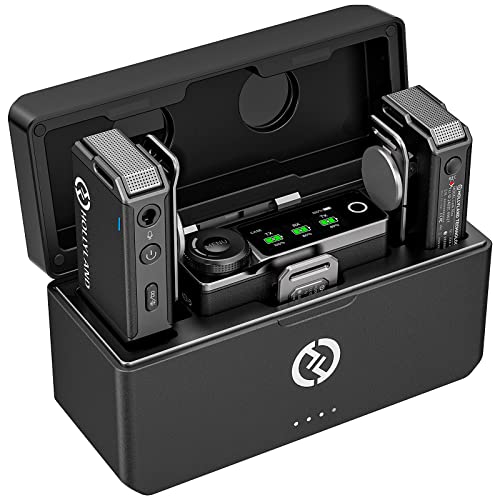
Long outdoor days are where this system earns its place. The dual-channel receiver pairs an AMOLED touchscreen with a 3.5mm headphone output, so levels can be checked by ear and by eye while a subject is still moving. Hollyland’s MaxTimbre capsule and switchable environmental noise cancellation target clear speech in uncontrolled locations, and each transmitter stores up to 14 hours of backup audio on its 8 GB of onboard memory. With a published line-of-sight range of 820 feet and up to 22 hours of total runtime using the charging case, it suits run-and-gun work far from a desk.
Specs
- Kit contents: 2 transmitters, 1 dual-channel receiver, charging case, 2 lavalier microphones
- Monitoring: 3.5mm headphone output on the receiver
- Audio: 48 kHz sampling rate, 24-bit depth; signal-to-noise ratio 70 dB; max SPL 128 dB
- Backup recording: 8 GB onboard memory per transmitter, up to 14 hours of recording
- Range: up to 820 ft (250 m) line of sight with adaptive frequency hopping
- Battery: about 7.5 hours per transmitter and 9 hours for the receiver; up to 22 hours total with the charging case
- Noise control: switchable environmental noise cancellation (ENC); AMOLED touchscreen on the receiver
Best for: outdoor interviews, documentary work and mobile journalism where the crew stays on its feet.
Watch out for: the headline range is an unobstructed outdoor figure that walls and crowds will shorten, and ENC changes the character of a voice, so settle both settings before the real take.
ASIN: B0C5R9H796
Saramonic Blink 500 ProX B2R
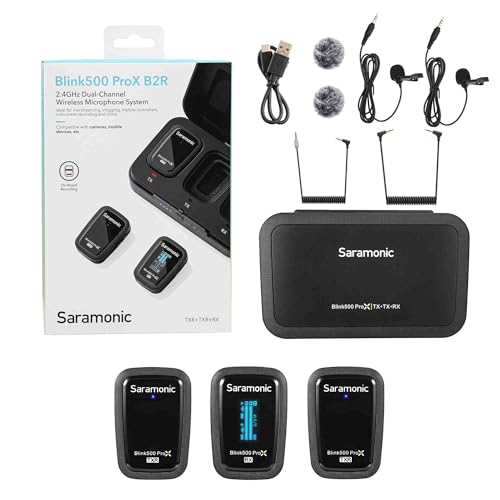
Two-person interviews recorded straight to a camera, recorder or mixer are this kit’s home ground. The camera-mount receiver offers a 3.5mm headphone output with level control, and its OLED screen shows each transmitter’s meter, battery and connection strength alongside the headphone level, which makes faults easy to trace mid-conversation. Both transmitters record 24-bit, 48 kHz WAV backups to 8 GB of internal memory, started and stopped with a tactile switch that is hard to trigger by accident. A selectable mono or stereo output lets you keep two voices on separate channels or mix them down.
Specs
- Kit contents: 2 clip-on transmitters with lavalier microphones, 1 dual-channel camera-mount receiver, charging carry case
- Monitoring: 3.5mm headphone output on the receiver with level control; OLED shows headphone level and transmitter metering
- On-board recording: 8 GB per transmitter; 24-bit / 48 kHz lossless WAV, up to 14 hours 50 minutes
- Transmitter mic: built-in omnidirectional microphone, sensitivity -39 dB; input level control and mute on each transmitter
- Output: selectable mono or stereo; 3.5mm TRS and TRRS output cables included
- Channels: 2, over a 2.4 GHz digital link
Best for: interviewers and journalists who feed cameras, recorders or mixers and want visible metering for both voices.
Watch out for: the receiver connects over 3.5mm only, so a phone without a headphone jack needs a separate adapter, and the recording switch should be checked before every session since it sits outside the menus.
ASIN: B0CQTN6LR9
Which One Fits Your Situation
Two voices, one camera, no second chances
For an interview that cannot be repeated, take the Saramonic Blink 500 ProX B2R. Its receiver shows both transmitters’ meters and battery state next to the headphone level, each transmitter keeps its own WAV backup running, and stereo output mode places the two voices on separate channels for easier editing afterwards.
A wedding or live event with unpredictable volume
Choose the RØDE Wireless PRO when the day moves from whispered vows to a loud reception. GainAssist watches the input level for you, 32-bit float recording leaves headroom for sudden shouting or applause, and timecode keeps the audio aligned with several cameras. The receiver’s headphone output lets you confirm all of that while it happens.
Outdoor filming that runs from morning to evening
The Hollyland Lark Max Duo fits shoots that stay outside and keep moving. Its published 820-foot line-of-sight range gives room to separate from your subject, the transmitters hold up to 14 hours of backup audio each, and the charging case stretches total runtime to 22 hours. The touchscreen receiver keeps settings reachable with cold or gloved hands.
One kit shared between a phone and a camera
Pick the DJI Mic 2 if your recording device changes from project to project. Lightning and USB-C adapters live in its case alongside the camera cable, the receiver’s monitoring port works whichever device is attached, and intelligent noise cancelling helps when a phone session happens on a noisy street. It is the least specialised kit here, in a good way.
Common Mistakes
- Assuming a USB-C port or a phone app counts as monitoring, then discovering on a camera shoot that there is no way to listen while recording.
- Turning the headphone volume up and calling the level healthy, when monitoring volume and record gain are two separate settings.
- Leaving the transmitter backup recording switched off, so a wireless dropout or a clipped peak has no safety copy to recover from.
- Comparing kits by headline range alone, without checking whether lavalier microphones, phone adapters and a charging case are actually included.
- Switching noise cancellation on for every recording, including quiet indoor conversations where it can change the voice more than the room does.
Frequently Asked Questions
What does real-time monitoring actually let you hear?
It plays the signal arriving at the receiver through headphones while you record, so you hear what the camera or recorder is getting: the voice, plus any clothing rustle, wind hits, handling noise or dropouts. Problems surface during the take, when a microphone can still be moved or a gain setting changed, instead of during the edit.
My camera has no headphone jack. Can I still monitor?
Yes, and that gap is the main reason these kits exist in this shortlist. Each receiver carries its own headphone output, so monitoring happens before the signal ever reaches the camera. Connect the receiver to the camera with the supplied cable for the recording itself, and keep your headphones plugged into the receiver for the whole session.
Does monitoring through the receiver add noticeable delay?
The headphone feed comes straight from the receiver, so what you hear matches the signal being handed to your camera or recorder. Every digital wireless link adds a small amount of latency, but at the receiver output it stays low enough for level checks and fault-finding. Monitoring through some phone apps adds extra processing delay, which is another reason to prefer a hardware port.
Can backup recording replace monitoring?
No, because the two features solve different problems. A 32-bit float or WAV backup protects the audio level after the fact, giving you a recoverable file when the main track clips or the link drops. It cannot warn you that a lavalier is rubbing against a jacket or that a transmitter battery is fading. Monitoring catches those faults live; the backup only limits the damage.
More from Amazon
Programs that pair well with the guide above. Offers and eligibility are set by Amazon and may change.
Free shipping on eligible items, Prime Video and more. Eligible new members can start with a free trial.
Start a Prime free trialAudiobooks and podcasts to listen to on the go. Eligible new members can start with a free trial.
Try Audible freeAd-free music streaming. Eligible new subscribers can start with a free trial.
Try Music Unlimited freeA free business account with business pricing and bulk-buying tools for work, shop or home office.
Create a business accountAs an Amazon Associate we earn from qualifying purchases.
Write Your Review
No reviews yet. Be the first to share your experience!