

Key takeaways
- Four long-range wireless microphone systems compared by published working distance, from 300 ft UHF stage sets to 820 ft camera kits, with specs and ASINs.
The real decision in a long-range wireless system is not the biggest distance printed on the box. It is whether the link stays clean at the distance you will actually work: a singer walking the front rows of a sanctuary, a presenter crossing a school gym to take questions, a subject filmed from the far side of a field. Walls, bodies, metal staging, and other transmitters all eat into the headline figure, so the band a system uses, how its antennas are arranged, and how it recovers from interference matter as much as the number itself.

This guide serves two groups. Live-sound volunteers and performers get handheld UHF systems built for stages, churches, and event halls. Videographers and creators get compact clip-on systems that keep recording while the subject moves away from the camera. Every pick below was chosen from the product names and specifications published on its Amazon product page, and the ranges, battery figures, and channel counts quoted here come from those listings.
Quick Picks
As an Amazon Associate we earn from qualifying purchases
| Product | Best for | Key spec from title |
|---|---|---|
| Shure BLX288/PG58 | Two singers sharing one receiver on a church or school stage | 300 ft range, 14-hour battery life, UHF |
| Phenyx Pro PTU-7000-4H | Four vocalists on a single receiver for events and karaoke nights | 328 ft long range, 4×40 UHF frequencies, auto scan |
| Hollyland Lark Max Duo | Two-person interviews and wedding films shot far from the camera | 820 ft (250 m) range, 22H duration, ENC |
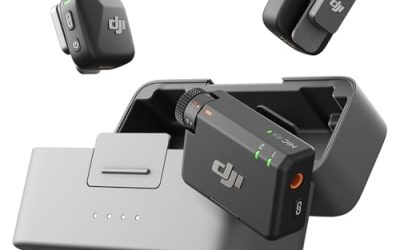
| DJI Mic 2 | Creators recording two voices to phones and cameras outdoors | 820 ft (250 m) range, 32-bit float internal recording |
How to Choose
Read the range figure the way it was measured
Nearly every published range is a line-of-sight number recorded outdoors with nothing between transmitter and receiver. Treat it as a ceiling, not a promise. A system rated at 300 ft may deliver half of that once the signal crosses a crowded room, and a 2.4 GHz camera system rated at 820 ft lists a much shorter figure, around 197 ft, once obstructions enter the path. Work out your longest realistic walk — stage depth plus the trip into the audience, or camera position to the far end of a venue — then choose a rating comfortably above it.
Match the frequency band to the venue
UHF systems in the 500 MHz region travel well through open halls and give you many discrete channels to coordinate, which is why stage systems still use them. The trade-off is that usable UHF spectrum varies by city and shrinks as broadcasters occupy more of it, so a band that is clear in one town can be crowded in another. Digital 2.4 GHz systems avoid band planning entirely and work anywhere, but they share airspace with Wi-Fi and Bluetooth. In a RF-dense convention center, coordinated UHF usually holds up better; for travel and quick setups, 2.4 GHz removes the homework.
Count channels and check how they coordinate
Range means little if four transmitters collide with each other. Look at how a system finds clear frequencies: one-touch scanning on the receiver, automatic scanning with infrared sync, or manual group-and-channel selection. A quad system with 40 selectable frequencies per channel lets a praise team or panel re-coordinate when a visiting act adds more wireless. Also confirm how many compatible systems can run in the same band at once; Shure, for example, publishes up to 12 compatible BLX systems per band, which sets a realistic ceiling for a growing church rig.
Plan power and a backup for long events
A long-range link is wasted if the transmitter dies mid-event. Handheld UHF mics typically run on AA cells, which makes spares cheap and replacements instant between songs or speakers; published figures run from about 14 to 16 hours per set. Clip-on camera systems use internal rechargeable batteries with a charging case, trading swap-ability for a pocketable kit. Two of the picks below also record inside the transmitter itself, so even if the wireless link drops for a second, the audio survives on the backup track — a genuine safety net for one-take events like weddings.
The 4 Best Options
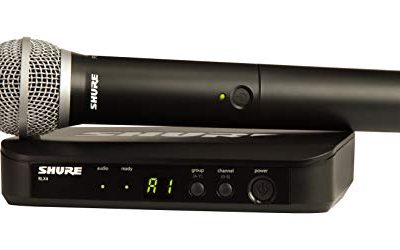
Shure BLX288/PG58
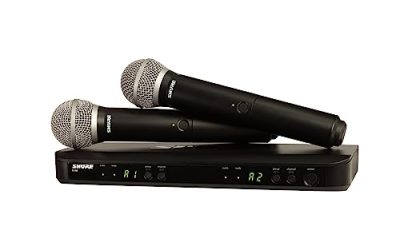
Two vocalists who trade verses and walk the aisles need one receiver that stays locked while both transmitters move. This system pairs two BLX2 handhelds fitted with PG58 cardioid dynamic capsules — a forgiving pattern for untrained singers — with a single BLX88 dual-channel receiver. QuickScan picks a clear group and channel during setup, and the published 300 ft line-of-sight range covers most sanctuaries, school stages, and club rooms with headroom. AA batteries keep spares inexpensive and easy to find anywhere, and XLR plus 1/4-inch outputs connect to almost any mixer already installed in the building.
Specs
- Operating range: up to 300 ft (100 m), line of sight
- Battery life: up to 14 hours per transmitter from 2 AA batteries
- Frequency band: H10, 542-572 MHz UHF
- Transmitters: 2 BLX2 handhelds with PG58 cardioid dynamic capsules
- Receiver: BLX88 dual-channel with QuickScan frequency selection
- Outputs: XLR and 1/4-inch
- System expansion: up to 12 compatible systems per frequency band
Best for: A lead and backing vocalist, or a pastor and worship leader, sharing one receiver
Watch out for: Confirm the H10 band is clear in your area before ordering, since the same system is sold in several different frequency bands
ASIN: B016APL8RC
Phenyx Pro PTU-7000-4H
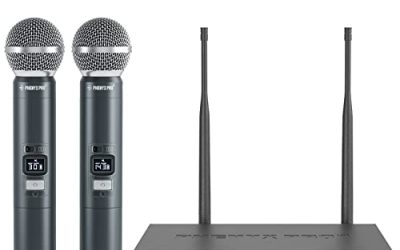
When four people need microphones at once — a praise team, a panel discussion, a karaoke rotation — stacking separate dual systems turns setup into a wiring project. The PTU-7000-4H puts four handheld dynamic mics on a single metal receiver, and each channel draws from its own bank of 40 selectable UHF frequencies. Auto Scan hunts for the least-interference frequency and infrared sync pairs each mic in seconds, which matters when the hall’s other electronics are already running. The stated 290 to 328 ft line-of-sight range suits banquet halls and outdoor stages, and individual channel outputs keep the mix flexible at the board.
Specs
- Channels: quad channel receiver with 4 handheld dynamic microphones
- Frequencies: 4 x 40 selectable UHF channels (538.3-550, 554.8-566.5, 571.3-583, 587.8-599.5 MHz)
- Frequency selection: Auto Scan with infrared synchronization
- Operating range: 290-328 ft, line of sight
- Battery: 8 AA batteries included, up to 16 hours of use
- Receiver: metal construction with 4 antennas
- In the box: quad receiver, 4 handheld mics, 1/4-inch audio cable, power adapter, anti-rolling rings
Best for: Churches, schools, and event hosts who need four wireless voices from one rack unit
Watch out for: Check that all four fixed channel bands are usable at your venue, because each channel is tied to its own frequency range
ASIN: B0CL6RMPTC
Hollyland Lark Max Duo
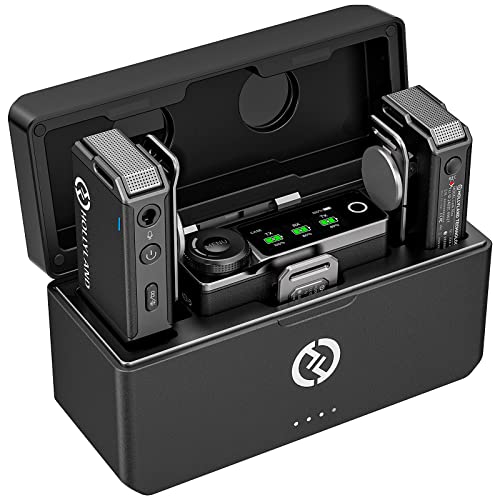
Camera work changes the geometry of the problem: the receiver stays on the camera while the subject walks away from it, so usable range decides how much of a venue, field, or procession route you can cover in one position. The Lark Max Duo is a two-transmitter lavalier system rated to 820 ft line of sight, using adaptive frequency hopping to hold the link as conditions shift. Each transmitter records to 8 GB of internal storage for up to 14 hours, so a brief dropout does not have to mean lost dialogue. Environmental noise cancellation and 48 kHz/24-bit capture are aimed at speech in busy locations.
Specs
- Transmission range: up to 820 ft (250 m) line of sight; 197 ft (60 m) with obstruction
- Audio format: 48 kHz/24-bit with MaxTimbre microphone technology
- Onboard storage: 8 GB per transmitter, up to 14 hours of backup recording
- Noise control: environmental noise cancellation (ENC)
- Battery duration: up to 22 hours total with the charging case
- Attachment: magnetic clip-on transmitters
- Compatibility: DSLR cameras, iPhone, Android, and PC
Best for: Two-person interviews, wedding films, and documentary work at long camera distances
Watch out for: The 820 ft figure is an unobstructed outdoor measurement, so plan around the 197 ft obstructed figure for indoor venues
ASIN: B0C5R9H796
DJI Mic 2

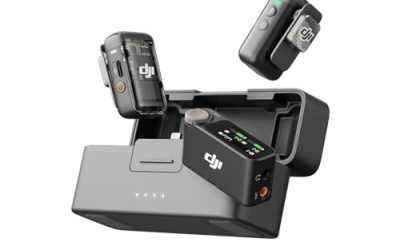
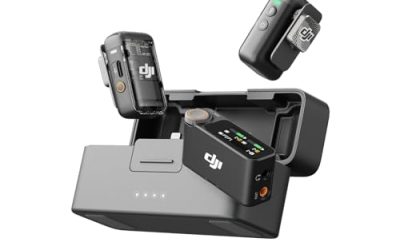
This kit takes the same class of 820 ft FCC-rated distance and adds protection against level mistakes: each transmitter records internally in 32-bit float, preserving shouts and whispers that would clip a fixed-gain recording. Two transmitters and one receiver arrive in a charging case with Lightning and USB-C phone adapters and a 3.5 mm camera cable in the box, so one kit moves between a phone interview and a mirrorless shoot without extra purchases. Intelligent noise cancelling helps on streets and at events, the receiver carries a touchscreen for level checks, and magnetic clips keep the transmitters discreet on clothing.
Specs
- Max transmission distance: 250 m (820 ft) FCC; 160 m under CE rules
- Internal recording: 32-bit float, up to 14 hours per transmitter
- Noise control: intelligent noise cancelling
- Kit contents: 2 transmitters, 1 receiver, charging case
- Battery life: up to 18 hours of total operating time with the charging case
- Included connections: Lightning adapter, USB-C adapter, 3.5 mm TRS camera cable
- Attachment: clip and magnetic mounting, windscreens included
Best for: Solo creators and two-person teams filming outdoors across phones and cameras
Watch out for: The full 820 ft range applies under FCC rules, so expect the shorter CE distance if you film in regions that follow CE limits
ASIN: B0CFZX734J
Which One Fits Your Situation
A worship team spread across a wide platform
Start with the Shure BLX288/PG58 if two voices carry the service, since its 300 ft rating and one-touch scanning suit volunteers who set up quickly. When the team grows to four singers, the Phenyx Pro PTU-7000-4H covers the same distances from a single receiver and gives each channel its own frequency bank for coordination.
An outdoor ceremony filmed from the back
The Hollyland Lark Max Duo fits a videographer parked at the rear of a garden or beach ceremony. Its transmitters keep recording internally even if the link thins at distance, and the magnetic clips hide on formal clothing. Position the camera receiver high and clear of the crowd to keep the path between subject and lens as open as possible.
A presenter who works the whole room
Teachers, auctioneers, and conference speakers who leave the stage need handheld range plus instant battery swaps. Either UHF pick works; choose the Shure for two speakers or the Phenyx Pro when a panel of four passes microphones around. Both publish ranges near or above 300 ft, which covers a gym or ballroom with the receiver placed at the side of the stage rather than behind it.
A creator filming walk-and-talk segments across a park
Pick the DJI Mic 2 when the route is long and the audio cannot be redone. The 32-bit float internal recording protects against clipping when a subject laughs or shouts mid-sentence, and the case keeps both transmitters topped up between locations. The Lark Max Duo is the alternative when onboard backup recording matters more than float headroom.
Common Mistakes
- Trusting the headline range as an indoor promise, then blaming the system for dropouts that walls, staging, and audience bodies predictably cause.
- Ordering a UHF band without checking local occupancy, even though the same model is sold in several bands and only some will be clear in your city.
- Hiding the receiver inside a closed metal rack or behind speakers, where its antennas are shielded from the transmitters it needs to hear.
- Leaving every transmitter on its factory default channel at a multi-system event instead of scanning and coordinating frequencies before doors open.
- Starting a long event on partially used batteries, with no fresh AAs for handhelds or no charging case rotation for clip-on systems.
Frequently Asked Questions
How far will a wireless microphone actually work indoors?
Expect noticeably less than the published line-of-sight figure. A 300 ft UHF rating often translates to reliable coverage across a large hall with the receiver in clear view, while 2.4 GHz systems publish a separate obstructed rating — 197 ft for the Lark Max — that is the safer planning number indoors. Raising the receiver and keeping it out of metal racks recovers much of the lost distance.
Is UHF or 2.4 GHz better for long range?
They solve different problems. UHF stage systems publish ranges around 300 ft and offer many coordinatable channels, which suits fixed venues and multi-mic events. Digital 2.4 GHz camera systems publish up to 820 ft line of sight and need no band planning, but they share spectrum with Wi-Fi. Choose by venue and channel count, not by the range number alone.
Can I run several long-range systems at the same time?
Yes, provided each transmitter gets its own coordinated frequency. Scan before the event, keep channels spaced as the manufacturer directs, and respect the published system ceiling — up to 12 compatible systems per band for the Shure BLX line, and up to 16 simultaneous transmitters on the Phenyx Pro quad platform. Adding a second brand on overlapping bands without coordination invites dropouts.
What should I check about frequency bands before ordering?
Confirm the exact band in the listing title, because systems like the BLX288/PG58 are sold in several bands covering different slices of UHF spectrum. Check that the band is legal for wireless microphone use in your country and reasonably free of local broadcast activity. If your venue sits near strong TV transmitters, a different band of the same model may perform far better.
More from Amazon
Programs that pair well with the guide above. Offers and eligibility are set by Amazon and may change.
Free shipping on eligible items, Prime Video and more. Eligible new members can start with a free trial.
Start a Prime free trialAudiobooks and podcasts to listen to on the go. Eligible new members can start with a free trial.
Try Audible freeAd-free music streaming. Eligible new subscribers can start with a free trial.
Try Music Unlimited freeA free business account with business pricing and bulk-buying tools for work, shop or home office.
Create a business accountAs an Amazon Associate we earn from qualifying purchases.
Write Your Review
No reviews yet. Be the first to share your experience!