
Key takeaways
- Two 6.5-inch 3-way component speaker sets compared for November 2026, with dedicated midrange drivers, crossover details, and door-fit checks.
A two-way component set asks one woofer to cover everything from bass guitar to the edge of the vocal range, and that compromise shows up when a singer and a snare drum compete for the same driver. A three-way set splits the job three ways, giving vocals their own midrange driver, so each driver works in a narrower band and stays cleaner as volume climbs. The real decision is not whether three drivers sound better in theory, but whether your car has somewhere sensible to put a separate midrange, and whether your amplifier can feed three drivers per side without running out of headroom.
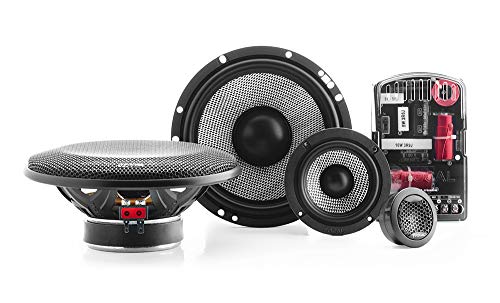

This guide is for drivers replacing factory door speakers, installers planning a custom door or pillar build, and listeners who care most about vocal clarity rather than sheer bass output. Every pick below uses the names and specifications stated on its Amazon product page, including woofer and midrange sizes, power handling, sensitivity, and crossover details, so you can compare the sets on what the listings promise.
Quick Picks
As an Amazon Associate we earn from qualifying purchases
| Product | Best for | Key spec from title |
|---|---|---|
| Focal Access 165AS3 | Balanced three-way staging on a moderate amplifier | 6.5-inch woven fiberglass woofer, 3-inch midrange, TN44 tweeter |
| Morel Maximo Ultra 603 | Warm, detailed front stage with room for louder listening | 6.5-inch treated paper composite woofer, 2.5-inch midrange, 100W RMS |
How to Choose
Measure for three drivers, not one
A three-way set needs a home for a woofer, a midrange, and a tweeter on each side, and the midrange is where most installs get complicated. Check the woofer cutout diameter and top-mount depth against your door, then look for a flat spot on the dash, sail panel, or A-pillar that can take a 3-inch or 2.5-inch midrange without blocking an airbag or a vent. Tweeter pods help, but a midrange crammed into a door pocket aimed at your knees will not deliver the soundstage the set was designed for. If no clean midrange location exists, a two-way set will serve you better than a three-way set installed badly.
Match RMS power to your amplifier
Both sets here are built around an amplifier, not a factory head unit, and the RMS figure is the number that matters. The Focal set handles 80 watts RMS per side while the Morel set handles 100 watts RMS, so plan amplifier channels that can deliver clean power in that range without clipping at highway volume. A head unit alone will leave either set sounding thin, because the woofers need current to control their cones at low frequencies. Count channels too: a passive three-way set still runs off one amplifier channel per side, but an active version of the same idea would need three channels per side and a processor.
Read the crossover before you buy
The crossover decides how smoothly the woofer hands over to the midrange and the midrange hands over to the tweeter, and a good one is worth as much as a good driver. Look for an external crossover network with tweeter-level adjustment, which lets you tame bright highs when the tweeters sit close to your ears. The Morel set ships with its MXR crossover, while the Focal set uses an external crossover with tweeter-level control, and both keep the wiring simpler than a fully active setup. Avoid any listing that hides the crossover entirely, because a three-way set without a proper network will sound disjointed no matter how good the drivers are.
Weigh woofer and midrange materials against your doors
Car doors are damp, hot, and vibrating, so cone material is a durability question as well as a sound question. Focal builds its woofer and midrange around woven fiberglass, which resists moisture and holds its shape when a door flexes, while Morel uses a treated paper composite that tends to sound warmer and more relaxed on vocals. Neither choice is wrong, but paper cones deserve dry, sealed doors and intact vapour barriers, whereas fiberglass tolerates rougher conditions. Check whether grilles are included as well, since exposed cones in a door card pocket collect scuffs from shoes, bags, and seatbelts.
The 2 Best Options
Focal Access 165AS3
Focal’s Access 165AS3 suits a driver who wants a genuine three-way front stage without stepping up to a large multi-channel amplifier or a processor. Its woven fiberglass woofer stays composed in a damp door, the separate 3-inch midrange lifts vocals out of the woofer’s workload, and the TN44 tweeter adds air at the top without demanding huge power. With 80 watts RMS per side and 90 dB sensitivity, it pairs sensibly with a compact four-channel amplifier and rewards careful tweeter placement more than raw wattage. The external crossover keeps the handover between drivers smooth.
Specs
- 6.5-inch woven fiberglass woofer
- 3-inch midrange driver
- TN44 tweeter
- 80 watts RMS power handling, 160 watts maximum
- Frequency response: 55–20,000 Hz
- Sensitivity: 90 dB
- Impedance: 4 ohms
- External crossover with tweeter-level adjustment
- 20% fiberglass-filled ABS chassis
Best for: Drivers who want a balanced three-way front stage on a moderate amplifier.
Watch out for: Confirm your car has a mounting spot for the separate 3-inch midrange before ordering, since the kit needs a dash, sail panel, or pillar location.
ASIN: B00II0WBXS
Morel Maximo Ultra 603
Morel’s Maximo Ultra 603 suits a listener who puts vocal tone first and is willing to feed the set with a solid amplifier to get it. Its treated paper composite woofer and 2.5-inch midrange produce a warmer, more relaxed presentation than fiberglass rivals, and the 100-watt RMS rating gives the system headroom for louder listening without strain. The included MXR crossover and grilles make it a complete package for a door build, provided the doors are dry and the midrange has a proper home. The grilles and crossover in the box mean fewer extra parts to source.
Specs
- 6.5-inch treated paper composite woofer with butyl rubber surround
- 2.5-inch treated paper midrange driver
- 1-inch tweeter
- 100 watts RMS power handling, 180 watts peak power
- Frequency response: 50–20,000 Hz
- Sensitivity: 90.5 dB at 2.83 volts
- Impedance: 4 ohms
- External Morel MXR crossover
- Woofer mounting depth: 2-5/16 inches
- Grilles included
Best for: Listeners who want warm, detailed vocals and headroom for louder sessions.
Watch out for: Check the listing is the passive 603 with crossovers included, not the active 603A version that ships without crossovers and needs a processor.
ASIN: B07RT2K4L4
Which One Fits Your Situation
Upgrading a daily driver on a modest amplifier
Choose the Focal Access 165AS3. Its 80-watt RMS rating and 90 dB sensitivity make it the easier load for a compact four-channel amplifier, and the fiberglass cones cope well with the moisture and temperature swings of a daily-driven door. A compact amplifier leaves room in the budget for door deadening, which matters as much as the speakers. The shallow-depth design also helps when the door cavity is tight.
Building a louder front stage with a dedicated amplifier
Choose the Morel Maximo Ultra 603. Its 100-watt RMS handling and 90.5 dB sensitivity give you clean output before distortion creeps in, and the warmer paper-cone tone stays pleasant when the volume stays high for a whole drive rather than a single song. Pair it with an amplifier rated near 100 watts RMS per side and keep the gains conservative, since clean power keeps the paper cones sounding smooth.
Fitting shallow doors with limited depth
Choose the Focal Access 165AS3. The set is built around a shallow-depth layout, so it is the safer pick when a deep woofer basket would hit the window mechanism or the inner door skin. Measure depth with the window down, since a woofer that clears at rest can still foul the regulator. Measure the available depth first either way, and keep a spacer ring in mind as a fallback.
Chasing vocal clarity for acoustic and jazz recordings
Choose the Morel Maximo Ultra 603. The dedicated 2.5-inch treated paper midrange keeps voices and strings distinct from the bass line, and the relaxed top end suits long listening sessions where a bright tweeter would become tiring. The relaxed top end also suits long drives, where a bright tweeter turns tiring after the first hour, so give the midrange a solid mount and seal the doors well.
Common Mistakes
- Buying a three-way set with no plan for the midrange location, then mounting it where it fires into a seat or a door pocket and wondering why the soundstage collapses.
- Powering a component set from a factory head unit and wondering why the bass sounds thin and the tweeters sound harsh at motorway speed.
- Comparing peak wattage figures instead of RMS ratings when choosing an amplifier, which inflates expectations and starves the woofers.
- Ordering the active version of a set by mistake and discovering no crossovers are in the box, leaving the install half-finished.
- Skipping the cutout diameter and mounting depth check, then finding the woofer fouls the window regulator when the glass drops.
Frequently Asked Questions
Do 6.5-inch 3-way component speakers fit any car?
No. The 6.5-inch woofer fits many factory door openings, but the midrange and tweeter each need their own mounting location, and woofer depth must clear the window mechanism. Check cutout diameter, mounting depth, and available dash or pillar space against your vehicle before ordering. Adapter rings and wiring harnesses help, but the midrange location is one no adapter can solve.
Is a three-way set always better than a two-way set?
Not always. A three-way set gives vocals their own driver, which improves separation and reduces distortion at higher volumes, but it demands more mounting space and careful crossover setup. A well-installed two-way set beats a poorly installed three-way set in cars. Installation quality decides it: a three-way set only earns its extra driver when every driver has a home.
Do I need an amplifier for these speakers?
Yes. Both sets here are rated for 80 to 100 watts RMS per side, far more than a factory head unit delivers. A compact four-channel amplifier provides the clean power the woofers need for controlled bass and clear vocals. Match the amplifier to the speakers’ RMS figure per channel, and set the gains with care to avoid clipping.
Can I install a three-way component set myself?
It depends on your experience. Fitting woofers in doors is straightforward, but mounting a midrange in a pillar or dash, routing crossover wiring, and setting tweeter levels take patience and trim tools. If your car needs custom pods or pillar fabrication, use a professional installer. Budget a full afternoon for a first install and test every driver before refitting door cards.
More from Amazon
Programs that pair well with the guide above. Offers and eligibility are set by Amazon and may change.
Free shipping on eligible items, Prime Video and more. Eligible new members can start with a free trial.
Start a Prime free trialAudiobooks and podcasts to listen to on the go. Eligible new members can start with a free trial.
Try Audible freeAd-free music streaming. Eligible new subscribers can start with a free trial.
Try Music Unlimited freeA free business account with business pricing and bulk-buying tools for work, shop or home office.
Create a business accountAs an Amazon Associate we earn from qualifying purchases.


Write Your Review
No reviews yet. Be the first to share your experience!