
Key takeaways
- Rechargeable AA batteries for wireless guitar transmitters compared: high-capacity NiMH for long sets, USB-C lithium cells, and rotation-ready packs.
The real decision here is not which cell carries the biggest number on the wrapper. It is whether your transmitter is still alive for the last song of the night, and how honestly it warns you before it dies. A wireless guitar pack drains its two AA cells at a steady, unforgiving rate, and rechargeable chemistries behave very differently under that load: NiMH cells start at a lower voltage and sag gradually, while regulated lithium cells hold a flat 1.5V and then stop. That behavior, more than raw capacity, decides whether a rechargeable setup feels dependable or risky on stage.

This roundup is for gigging guitarists running AA-powered bodypack transmitters, worship and cover-band players who rotate batteries every week, and home players who are tired of feeding a practice rig with disposables. Every pick below is an AA rechargeable that fits the transmitters used by the major wireless guitar systems, and every specification comes from the product’s Amazon listing rather than from brand marketing pages.
Quick Picks
As an Amazon Associate we earn from qualifying purchases.
| Product | Best for | Key spec from title |
|---|---|---|
| Panasonic eneloop pro AA (4-Pack) | Longest sets between battery swaps | High-capacity Ni-MH, up to 500 recharges |
| Ernie Ball USB-C Rechargeable AA by Paleblue (4-Pack) | Players who do not own a bay charger | Lithium-ion, charges directly by USB-C |
| Panasonic eneloop AA (8-Pack) | Rotating spares across several packs | Up to 2,100 recharges per cell |
How to Choose
Match the chemistry to your transmitter’s battery gauge
Most AA wireless guitar transmitters were designed around 1.5V alkaline cells, and their battery meters are calibrated for that voltage curve. A NiMH cell is rated at 1.2V, so a freshly charged pair can read as half empty on the gauge within the first hour even though most of its energy is still available. Regulated lithium AA cells solve the reading problem by outputting a constant 1.5V, but they hold that voltage until the energy is nearly gone and then cut off fast, which shortens your warning window. Neither behavior is a defect. The mistake is not knowing which one your pack shows you, so check what your system maker approves before choosing a chemistry.
Capacity decides how much of the night one pair covers
Capacity, listed in milliamp hours, is the fuel tank your transmitter drains. A bodypack pulls current continuously from the moment you switch it on, including soundcheck, the support slot, and the encore you did not plan for. High-capacity NiMH cells in the class of the eneloop pro exist precisely for high-drain devices like this, while standard-capacity cells trade some runtime for a much longer cycle life. Think in terms of your longest realistic day rather than a single set: if soundcheck plus the show regularly stretches past four or five hours, capacity should be your first filter and cycle count your second.
Charging has to fit the hours before a show
NiMH cells need a proper bay charger, ideally one that charges cells individually rather than in fixed pairs, and a full charge takes hours rather than minutes. That is painless if your routine is to charge the night before, and a genuine problem if you remember at load-in. USB-C rechargeable cells remove the bay charger from the equation entirely: each cell has its own port and can top up from a laptop, a power bank, or the same adapter you carry for your phone. The trade-off is that you manage a cable per cell instead of dropping cells into slots. Pick the system that matches the routine you actually keep, not the one you wish you kept.
Buy rotation, not just capacity
One pair of rechargeables is a way to run out of power with extra steps. Working players treat AA cells for wireless packs the way they treat strings: a set in the transmitter, a charged set in the gig bag, and ideally a third set at home on the charger. Self-discharge matters for those spares, because a cell that leaves the charger full and sits in a bag for two months should still be close to full when you reach for it. Low-self-discharge NiMH is built for exactly that pattern. Label your pairs, keep them together, and rotate them so every set ages at roughly the same rate.
The 3 Best Options
Panasonic eneloop pro AA (4-Pack)
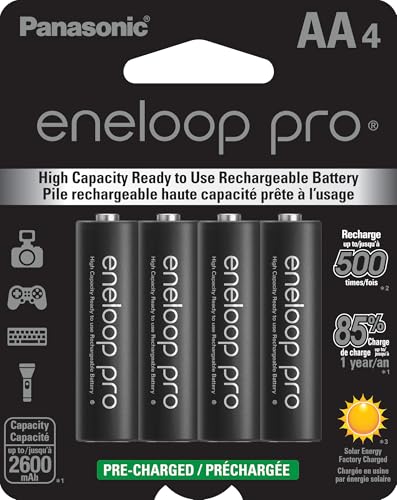
This is the pick for players whose transmitters eat batteries and whose sets run long. The eneloop pro is Panasonic’s high-capacity NiMH line, built for high-drain devices, and it is the cell that wireless users have standardized on for years because the runtime per charge is the longest in this roundup. The cells arrive pre-charged and hold their charge in storage, so a pair charged on Monday is still a reliable pair on Saturday. Four cells cover one transmitter with a full spare set, which is the minimum sane rotation for a single guitar pack.
Specs
- Model: BK-3HCCA4BA
- Size and count: AA, 4 cells
- Chemistry: Ni-MH (nickel-metal hydride)
- Recharge cycles: up to 500
- Charge retention: maintains 85% of charge for up to 1 year when stored
- Pre-charged at the factory using solar energy, ready to use out of the pack
- Temperature performance: works in extreme temperatures down to -4 degrees F
- Charger: not included
Best for: Gigging players running long shows on AA bodypack transmitters who want the most runtime per swap.
Watch out for: The listing summary has shown “No featured offers” alongside strong recent buying signals, a common buy-box artifact on this listing, so confirm the pack is in stock before ordering. You also need a NiMH charger, which is not in the box.
Ernie Ball USB-C Rechargeable AA by Paleblue (4-Pack)
Ernie Ball built this line with Paleblue specifically for musicians, and the concept is simple: each AA cell is a lithium-ion battery with its own USB-C port, so the charger is whatever cable you already carry. Output is a constant, regulated 1.5V, which keeps transmitter battery gauges reading the way they do with alkalines instead of the pessimistic readings NiMH cells produce. There is no bay charger to pack, no proprietary dock, and the four cells come in a reusable case with the charging cable. For players whose whole rig already runs on USB power, this removes the last odd charger from the bag.
Specs
- Model: P09643
- Size and count: AA, 4 cells
- Chemistry: Lithium-ion
- Output: constant 1.5V
- Capacity: 2750 mWh (1933 mAh)
- Recharge cycles: over 1,000
- Charging: built-in USB-C port on each cell, no external charger required
- In the box: 4 AA batteries, charging cable, reusable case
Best for: Players who travel light, charge everything from USB, and want alkaline-style gauge behavior from a rechargeable.
Watch out for: Some wireless makers only approve NiMH cells for their transmitters, so check your system’s manual before switching to a lithium cell. This is also the newest listing in the roundup, so verify it is in stock when you order.
Panasonic eneloop AA (8-Pack)
The standard eneloop is the rotation workhorse of this roundup. Its capacity per cell is lower than the pro version, but the cells are rated for up to 2,100 recharge cycles, several times the lifespan of the high-capacity line, and the low-self-discharge design means spares pulled from a gig bag after weeks of storage are still ready. Eight cells means two transmitters fully loaded with a charged spare pair for each, or one transmitter with deep backup. For bands that run several wireless packs and swap batteries on a schedule rather than on a warning light, this pack is the economical shape of the same idea.
Specs
- Model: BK-3MCCA8BA
- Size and count: AA, 8 cells
- Chemistry: Ni-MH (nickel-metal hydride)
- Capacity: 2000 mAh
- Recharge cycles: up to 2,100
- Low self-discharge design holds charge while stored
- Pre-charged and ready to use
- Charger: not included
Best for: Bands and worship teams rotating batteries across multiple transmitters every week.
Watch out for: Runtime per charge is shorter than the eneloop pro, so plan swaps at set breaks instead of stretching a pair across a whole evening. Like the pro pack, this is cells only, so budget a charger if you do not already own one.
Which One Fits Your Situation
You play long gigs and swap batteries at the set break
Take the eneloop pro 4-pack. Your constraint is runtime per pair, and the high-capacity cells give you the widest margin between soundcheck and the last song. Charge both pairs the night before, run the first pair until the break, and swap on schedule rather than waiting for the transmitter to complain. The gauge will read pessimistically because of the NiMH voltage curve, so your swap schedule, not the meter, is the plan.
Your rig charges from a laptop and a power bank
Take the Ernie Ball USB-C cells. A touring or fly-date setup has no room for a dedicated battery charger, and these cells top up from the same USB power that handles your phone and tablet. The constant 1.5V output also means the battery meter on your transmitter behaves the way it did with disposables, which makes warnings easier to judge. Just confirm your wireless maker allows lithium cells in the pack before you commit.
You run several wireless packs and rotate batteries weekly
Take the eneloop 8-pack. With multiple transmitters in play, cycle life and stored charge matter more than squeezing the last hour from a single pair. Eight cells keep every pack loaded with charged spares waiting, and the 2,100-cycle rating means the set survives years of weekly rotation. Pair it with an individual-cell charger so weak cells can be spotted and retired one at a time.
Your transmitter maker only approves NiMH
Take either Panasonic pack and skip the lithium option entirely. Some wireless systems specify NiMH or alkaline cells only, and a maker’s restriction outranks any convenience argument. Between the two, choose the pro pack for runtime or the standard 8-pack for cycle life, using the same reasoning as the situations above.
Common Mistakes
- Mixing one old cell and one fresh cell in the same transmitter, which limits the pair to the weaker cell and can end a set early.
- Trusting the battery gauge literally with NiMH cells, then swapping out pairs that still hold most of their charge.
- Running a regulated lithium cell until it cuts off, having ignored that this chemistry gives almost no low-battery warning period.
- Leaving cells sitting in the transmitter for months between gigs instead of storing them out of the pack, charged, in their case.
- Buying rechargeable cells with no charging plan, then discovering on show day that the NiMH pack you bought includes no charger.
Frequently Asked Questions
Can I use rechargeable AA batteries in any wireless guitar system?
Most AA-powered guitar transmitters accept NiMH rechargeables, and makers such as Audio-Technica specifically recommend NiMH cells in the 2000 to 2700 mAh range for their systems. Lithium AA cells are the exception to check: some makers warn against them because unregulated versions can output far more than 1.5V. Read your transmitter’s manual and match the chemistry it approves.
Why does my transmitter show half battery with freshly charged NiMH cells?
Because the gauge expects alkaline voltage. An alkaline cell starts around 1.5V, while a NiMH cell is rated at 1.2V and delivers most of its energy near that level. The meter interprets the lower voltage as a partly drained battery even when the cell is full. Judge NiMH runtime by hours played rather than by the gauge, and swap on a schedule.
How many rechargeable batteries should I own for one transmitter?
Two pairs is the working minimum: one pair in the transmitter and one charged pair in the gig bag. A third pair at home makes the rotation forgiving when you forget a charge cycle. Keep pairs together and labeled, since cells that live and age together perform predictably, while a strong cell paired with a tired one performs like the tired one.
Are rechargeable batteries worth it for a wireless guitar rig?
For anyone playing wireless every week, yes. A transmitter consumes a pair of AA cells per show, and rechargeable cells rated for hundreds or thousands of cycles replace that ongoing stream of disposables with a small rotating stock. The break-even arrives quickly in playing terms; the real cost is the discipline of charging the night before instead of buying a fresh pack on the way to the venue.
More from Amazon
Programs that pair well with the guide above. Offers and eligibility are set by Amazon and may change.
Free shipping on eligible items, Prime Video and more. Eligible new members can start with a free trial.
Start a Prime free trialAudiobooks and podcasts to listen to on the go. Eligible new members can start with a free trial.
Try Audible freeAd-free music streaming. Eligible new subscribers can start with a free trial.
Try Music Unlimited freeA free business account with business pricing and bulk-buying tools for work, shop or home office.
Create a business accountAs an Amazon Associate we earn from qualifying purchases.
Write Your Review
No reviews yet. Be the first to share your experience!