
Our Short List of 3

- Best for: A beginner or returning player who wants one compact amp for daily practice, lessons, and first recordings.
- 25-watt digital modeling combo amplifier
- 8-inch Fender Special Design speaker
- 30 preset effects listed on the Amazon product page
- Built-in tuner

- Best for: A home player who practises with backing tracks, learns songs through the app, and records ideas on a computer.
- 40-watt combo practice guitar amplifier for electric, bass, and acoustic guitar
- 33 amp models and 43 effects listed in the Amazon product comparison
- 4 onboard presets
- USB audio interface for home recording

- Best for: A desk-based player who wants wireless practice, a compact footprint, and an amp that doubles as a Bluetooth speaker.
- 20-watt desktop guitar combo amplifier, listed as 10 watts plus 10 watts stereo
- Two 3-inch speakers
- 15 guitar amp models
- 8 effects
All 5 Picks at a Glance
| Product | Specs | Action |
|---|---|---|
| Fender Mustang LT25 Guitar Amp |
| Check price on Amazon |
| Positive Grid Spark 40-Watt Combo Practice Guitar Amplifier |
| Check price on Amazon |
| Yamaha THR10II Wireless Desktop Guitar Amp |
| Check price on Amazon |
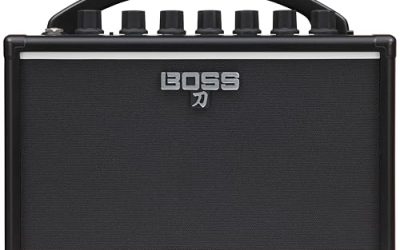
 BOSS Katana-50 Gen 3 Guitar Amplifier |
| Check price on Amazon |
 Fender Mustang GTX50 Guitar Amplifier |
| Check price on Amazon |
Our Top Picks
A digital guitar amp replaces a shelf of single-purpose gear with one box that can sound clean, crunchy, or heavily driven at the turn of a dial. That flexibility is the real decision here, because the wrong choice is not usually a bad tone. It is an amp whose controls, outputs, or volume range do not match where and how the guitar actually gets played. A bedroom player needs quiet practice and simple presets, while a player who records needs a direct USB connection and a headphone output that still sounds full.
This article is for beginners who want one amp to learn on, home players who practise after work, songwriters who record ideas quickly, and gigging players who need a light combo for rehearsals and small rooms. Every amp below was chosen from its name and listed features on its Amazon product page, with attention to wattage, speaker size, amp models, effects, and connections, so the comparison stays grounded in what each model is built to do.
Quick Picks
As an Amazon Associate we earn from qualifying purchases
| Product | Best for | Key spec from title |
|---|---|---|
| Fender Mustang LT25 Guitar Amp | Learning and daily practice in a bedroom | 25-Watt Combo Amp with 30 Preset Effects |
| Positive Grid Spark 40-Watt Combo Practice Guitar Amplifier | App-guided practice and home recording | 40-Watt Combo Practice Guitar Amplifier with Spark Mobile App |
| Yamaha THR10II Wireless Desktop Guitar Amp | Desktop playing and wireless practice | 20-Watt Desktop Guitar Combo Amplifier, Wireless |
| BOSS Katana-50 Gen 3 Guitar Amplifier | Rehearsals and small gigs with a full-size speaker | Compact 50-Watt Combo Amp with Custom 12-Inch Speaker |
| Fender Mustang GTX50 Guitar Amplifier | Deep preset editing through a phone app | 50-Watt Digital Modeling Combo with 200 Presets |
How to Choose
Match the wattage and speaker to the room
Wattage decides how much clean volume an amp can hold before it starts to break up, and speaker size shapes how full the low end feels. A 10-watt or 25-watt combo with a small speaker suits a bedroom, a desk, or an apartment, because it reaches a pleasant practice level without filling the whole home. A 50-watt combo with a 12-inch speaker suits rehearsals and small venues, where the amp has to project across a room beside drums or another guitar. A large amp in a small room often runs at its lowest setting, while a tiny amp in a band setting leaves no headroom when the volume rises.
Count the amp models, not just the presets
Presets are useful starting points, but amp models decide how wide the tonal range really is. An amp with 15 or 20 models can cover clean, crunch, and high-gain sounds, while an amp with 30 or 40 models adds acoustic, bass, and specialist voices that suit players who switch styles. Look at whether the models are organised clearly on the panel or buried in an app, because a player who likes to turn knobs will use a simple layout far more often. A long preset list sounds impressive on a product page, yet it helps only when the sounds inside it match the music being played.
Check the app, USB, and headphone connections
Digital amps earn their keep through connections as much as through tone. A USB audio interface lets the amp record straight into a computer without a separate interface, which matters for songwriters who capture ideas before they disappear. A headphone output makes late practice possible, and an aux or Bluetooth input lets backing tracks play through the same speaker as the guitar. App control adds deep editing, preset sharing, and practice tools such as automatic chords or jam tracks, but it also adds a phone to the practice routine. Players who dislike screens should favour amps with clear physical controls.
Weigh portability against control
A desktop amp looks neat on a shelf and works well for players who always practise in the same spot, while a larger combo suits players who move between rooms, lessons, and rehearsals. Weight, handle design, and footprint matter more than they appear to on a product page, especially for a player who carries the amp up stairs or in a car already full of gear. Battery power and wireless input add freedom for playing away from a wall socket, yet they also add charging and pairing steps. Decide first where the amp will live most days, then choose the size that fits that routine rather than the largest feature list.
The 5 Best Options
Fender Mustang LT25 Guitar Amp
- Best for: A beginner or returning player who wants one compact amp for daily practice, lessons, and first recordings.
- 25-watt digital modeling combo amplifier
- 8-inch Fender Special Design speaker
- 30 preset effects listed on the Amazon product page
- Built-in tuner
A beginner or returning player who wants one compact amp for daily practice, lessons, and first recordings.
The 8-inch speaker and 25-watt output suit home use rather than loud band rehearsals, so check the room size before expecting it to fill a larger space.
The Mustang LT25 suits a player who wants a straightforward digital amp with plenty of sounds and no extra gear to buy. Its 25-watt output and 8-inch speaker give bedroom practice a full, present tone without overwhelming a small room, and the 30 onboard presets cover clean, rock, and driven sounds that a beginner can explore by turning a dial. A colour display shows the preset name and settings, which makes it easier to learn what each control changes. The built-in tuner and USB recording connection cover the two jobs a first amp is asked to do most often.
Watch out for: The 8-inch speaker and 25-watt output suit home use rather than loud band rehearsals, so check the room size before expecting it to fill a larger space.
Positive Grid Spark 40-Watt Combo Practice Guitar Amplifier
- Best for: A home player who practises with backing tracks, learns songs through the app, and records ideas on a computer.
- 40-watt combo practice guitar amplifier for electric, bass, and acoustic guitar
- 33 amp models and 43 effects listed in the Amazon product comparison
- 4 onboard presets
- USB audio interface for home recording
A home player who practises with backing tracks, learns songs through the app, and records ideas on a computer.
Much of its depth sits inside the app, so a player who prefers knobs alone should check how much can be changed from the top panel.
The Spark 40 suits a home player who likes to practise with an app and wants a wide library of tones without building a pedalboard. Its 40-watt output drives two speakers for a broad stereo sound in a living room or studio corner, and the Spark mobile app opens amp models, effects, and practice tools that the top panel alone cannot show. Smart Jam creates backing tracks that follow the player, while access to a large tone library makes it easy to find a starting point for a new song. The USB audio interface turns the same box into a recording tool when an idea needs capturing.
Watch out for: Much of its depth sits inside the app, so a player who prefers knobs alone should check how much can be changed from the top panel.
Yamaha THR10II Wireless Desktop Guitar Amp
- Best for: A desk-based player who wants wireless practice, a compact footprint, and an amp that doubles as a Bluetooth speaker.
- 20-watt desktop guitar combo amplifier, listed as 10 watts plus 10 watts stereo
- Two 3-inch speakers
- 15 guitar amp models
- 8 effects
A desk-based player who wants wireless practice, a compact footprint, and an amp that doubles as a Bluetooth speaker.
The desktop format and small speakers are built for near-field listening, so it will not project like a full-size combo in a rehearsal room.
The THR10II Wireless suits a player who practises at a desk and wants a good-looking amp that also works as a music speaker. Its desktop shape keeps the controls within reach, and the wireless input removes the cable between guitar and amp for short practice sessions. Fifteen guitar amp models and eight effects cover clean, crunch, and driven tones, while Bluetooth audio lets the amp play music from a phone when the guitar is put down. The THR Remote app adds deeper editing for players who want to shape presets beyond the physical knobs.
Watch out for: The desktop format and small speakers are built for near-field listening, so it will not project like a full-size combo in a rehearsal room.
BOSS Katana-50 Gen 3 Guitar Amplifier
- Best for: A player who rehearses with others, plays small gigs, and wants a full-size speaker with flexible volume.
- Compact 50-watt combo amplifier
- Custom 12-inch speaker
- 12 amp characters
- Onboard BOSS effects
A player who rehearses with others, plays small gigs, and wants a full-size speaker with flexible volume.
The full-size cabinet takes more floor space than a desktop amp, and its deeper editing features sit in software rather than on the panel.
The Katana-50 Gen 3 suits a player who wants a traditional combo feel with digital flexibility and enough volume for rehearsals. Its 50-watt output and custom 12-inch speaker give it the presence of a stage amp, while the power control drops the output for home practice without losing the character of the selected amp voice. Twelve amp characters cover clean, crunch, and high-gain territory, and the onboard BOSS effects remove the need for separate pedals when learning how delay, modulation, and reverb change a sound. BOSS Tone Studio software adds deeper editing for players who enjoy building their own tones.
Watch out for: The full-size cabinet takes more floor space than a desktop amp, and its deeper editing features sit in software rather than on the panel.
Fender Mustang GTX50 Guitar Amplifier
- Best for: A player who wants deep preset editing, a large model library, and a 50-watt combo for rehearsals and small gigs.
- 50-watt digital modeling combo amplifier
- 12-inch Celestion speaker
- 40 amp models
- 200 onboard presets
A player who wants deep preset editing, a large model library, and a 50-watt combo for rehearsals and small gigs.
The preset library is large enough to become a distraction, so it helps to save a small set of go-to sounds before a rehearsal or session.
The Mustang GTX50 suits a player who already knows the Mustang range and wants more models, more presets, and app control in a gig-capable combo. Its 50-watt output and 12-inch Celestion speaker give it a fuller, louder voice than the smaller Mustang models, while 40 amp models and 200 onboard presets cover a wide span of styles without extra pedals. Wi-Fi and Bluetooth connect the amp to the Fender TONE 3.0 app, where presets can be edited, stored, and shared from a phone. A looper and USB connectivity add practice and recording options that suit a player who builds songs layer by layer.
Watch out for: The preset library is large enough to become a distraction, so it helps to save a small set of go-to sounds before a rehearsal or session.
Which One Fits Your Situation
Starting guitar and learning at home
Choose the Fender Mustang LT25. Its 25-watt output, 8-inch speaker, and 30 presets give a beginner enough variety to stay interested without a complicated setup, and the built-in tuner and USB recording cover lessons and first demos in the same box. The clear display shows each preset by name, so a new player can learn what the controls change while practising every day.
Practising with an app and backing tracks
Choose the Positive Grid Spark 40. Its app-guided practice tools, large tone library, and 40-watt stereo output suit a player who learns songs, jams along with backing tracks, and records ideas at home. Smart Jam builds a backing track around the playing, so solo practice feels closer to playing with a band.
Playing at a desk in a small room
Choose the Yamaha THR10II Wireless. Its compact desktop shape, wireless input, and Bluetooth speaker function fit a desk or shelf, and its 15 amp models give a small-room player plenty of tones without a large cabinet. The rechargeable battery and wireless input also make it easy to move the amp to another room for a short session.
Rehearsing and playing small gigs
Choose the BOSS Katana-50 Gen 3. Its 50-watt output, custom 12-inch speaker, and switchable power control suit rehearsals and small gigs, while the onboard effects remove the need for separate pedals. The Fender Mustang GTX50 is the alternative here for a player who prefers app editing and a larger preset library at the same output level.
Common Mistakes
- Buying a 50-watt combo for a small apartment and then running it at its lowest setting, where its tone never opens up.
- Choosing an amp for its preset count without checking whether its amp models cover the styles actually played.
- Ignoring the headphone output and USB connection, then discovering that late practice and recording need extra gear.
- Assuming a desktop amp will fill a rehearsal room, when its small speakers are built for near-field listening.
- Treating app control as a bonus rather than a habit, and then never using the editing tools that justified the purchase.
Frequently Asked Questions
What makes a guitar amp digital?
A digital guitar amp uses digital modeling to recreate the sound of different amplifier circuits, speakers, and effects inside one unit. Instead of relying on a single analogue circuit, it stores amp models and effects that can be selected, combined, and saved as presets, which is why one digital amp can sound clean, crunchy, or heavily driven.
Are digital guitar amps good for beginners?
Yes, digital amps suit beginners because they pack many sounds into one box and remove the need for separate pedals. A beginner can try clean, rock, and driven tones, learn what each control changes, and practise with a tuner and headphone output, all without buying extra gear before knowing which sounds matter most.
Can a digital guitar amp record directly to a computer?
Many digital amps can, when they include a USB audio interface. The amp connects to a computer with a USB cable and appears as an audio input, so a recording program can capture the guitar sound directly. Check the product page for USB audio support, because not every digital amp includes it.
How many watts does a digital guitar amp need for home practice?
A 10-watt to 25-watt amp usually covers home practice, especially with a headphone output for quiet sessions. A 40-watt or 50-watt amp suits players who also rehearse or play small gigs, because the extra headroom keeps the clean sound clear at higher volumes.
More from Amazon
Programs that pair well with the guide above. Offers and eligibility are set by Amazon and may change.
Free shipping on eligible items, Prime Video and more. Eligible new members can start with a free trial.
Start a Prime free trialAudiobooks and podcasts to listen to on the go. Eligible new members can start with a free trial.
Try Audible freeAd-free music streaming. Eligible new subscribers can start with a free trial.
Try Music Unlimited freeA free business account with business pricing and bulk-buying tools for work, shop or home office.
Create a business accountAs an Amazon Associate we earn from qualifying purchases.

Write Your Review
No reviews yet. Be the first to share your experience!