

Key takeaways
- Best family and outdoor choice: Motorola T600 H2O. It combines a rugged waterproof design, NOAA weather alerts, rechargeable batteries, and a useful emergency flashlight.
- Best simple work radio: Retevis RT22. Its compact body, USB charging, and few controls make it easy for staff who do not need advanced programming.
- Best budget family set: Midland X-Talker T71. It offers a straightforward FRS experience with weather channels and a practical feature set at a lower market price.
- Best for demanding commercial use: a licensed UHF business radio such as the Motorola R2. The upfront cost is higher, but the radio, antenna, accessories, and programming are better suited to repeated daily use.
- Best for licensed hobbyists: a dual-band handheld such as the Yaesu FT-65R. It provides far more control than a family radio, but it requires technical knowledge and an amateur-radio license for transmitting.
The best two way radios for most buyers are the Motorola T600 for outdoor and family use, the Retevis RT22 for simple workplace communication, and a properly programmed business-band radio when dependable coverage and fleet management matter more than the lowest price.
Our top picks
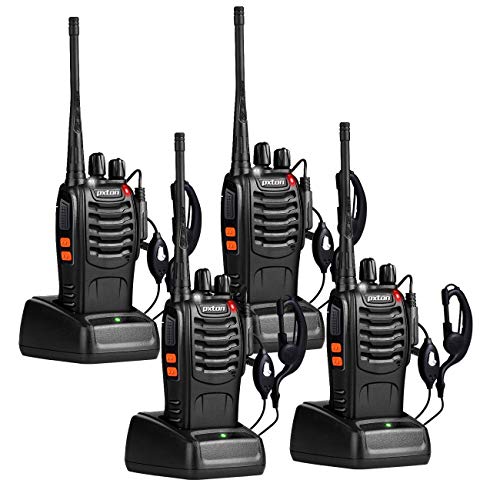


As an Amazon Associate we earn from qualifying purchases at no extra cost to you. Ratings are shown as listed on Amazon.
Quick picks by situation
- Best family and outdoor choice: Motorola T600 H2O. It combines a rugged waterproof design, NOAA weather alerts, rechargeable batteries, and a useful emergency flashlight.
- Best simple work radio: Retevis RT22. Its compact body, USB charging, and few controls make it easy for staff who do not need advanced programming.
- Best budget family set: Midland X-Talker T71. It offers a straightforward FRS experience with weather channels and a practical feature set at a lower market price.
- Best for demanding commercial use: a licensed UHF business radio such as the Motorola R2. The upfront cost is higher, but the radio, antenna, accessories, and programming are better suited to repeated daily use.
- Best for licensed hobbyists: a dual-band handheld such as the Yaesu FT-65R. It provides far more control than a family radio, but it requires technical knowledge and an amateur-radio license for transmitting.
What separates the best two way radios?
Advertised range is the least dependable number on a radio package. A claim of 20, 30, or 40 miles usually assumes unobstructed, elevated terrain. In a neighborhood, office, forest, shopping center, or crowded event, buildings and hills can reduce useful range to well under a mile. A higher antenna position, clear line of sight, and a radio designed for the correct band often matter more than a larger headline number.
Family radios using FRS channels are convenient because they normally require no individual license in the United States. They are suitable for camping, travel, children’s activities, and occasional coordination around a property. GMRS radios can use more power and often work better with external antennas, but an FCC GMRS license is required in the United States; one license generally covers the licensee and immediate family. Business radios may require an FCC Part 90 license, while amateur radios require an amateur license and are not a substitute for a business communication system.
Head-to-head comparison
| Radio or type | Typical power and band | Battery expectation | Weather protection | Best use | Licensing in the U.S. |
|---|---|---|---|---|---|
| Motorola T600 H2O | FRS/GMRS channels; up to 2 watts on applicable channels | About 9 hours with rechargeable cells; longer with alkaline cells depending on use | IP67 waterproofing; floats when correctly configured | Camping, boating, hiking, family trips | FRS channels generally no license; GMRS operation requires a license |
| Midland X-Talker T71 | FRS/GMRS channels; model output varies by channel | Roughly 8–15 hours depending on battery type and transmit time | Basic splash resistance varies by version; not a replacement for a waterproof radio | Travel, neighborhoods, occasional family use | FRS generally no license; GMRS requires a license |
| Retevis RT22 | UHF business-style radio, commonly sold in 16-channel versions | About 10–12 hours from its rechargeable battery under typical duty cycles | Usually marketed as rugged or splash-resistant; verify the exact model’s IP rating | Retail, events, restaurants, warehouses | Business frequencies normally require an FCC license |
| Motorola R2 | Professional UHF or VHF configurations; up to 4 watts depending on version | Approximately 18–22 hours with a high-capacity battery, depending on configuration | IP55-rated protection | Daily commercial and worksite communication | Usually requires an FCC business license |
| Yaesu FT-65R | VHF/UHF amateur handheld; up to 5 watts | Approximately 9–11 hours with its standard battery under typical use | Basic weather resistance; not a waterproof marine radio | Amateur-radio users and technical hobbyists | Amateur license required to transmit |
Battery figures are practical estimates rather than guarantees. Continuous transmitting, weak signals, cold weather, scanning, bright displays, and frequent flashlight use can reduce runtime considerably. Manufacturers also measure battery life under different duty cycles, so numbers from different brands are not perfectly comparable.
Choosing between family radios and work radios
For families, travel, and outdoor recreation
Choose an FRS radio with simple channel selection, a lock button, a visible battery indicator, and weather alerts. Waterproofing is more valuable than an extra group of privacy codes if the radios will be used near rain, snow, pools, or boats. The Motorola T600 H2O is particularly practical when floating ability and water protection justify its higher general market price, usually around $70–$120 for a pair depending on the package.
Remember that privacy codes do not make a conversation private. They only prevent your speaker from opening for some other transmissions. Another person with a compatible radio can still listen on the underlying channel.
For shops, venues, and small teams
A compact business radio such as the Retevis RT22 is often easier to deploy than a feature-heavy handheld. Its push-to-talk button, charging dock or USB charging arrangement, and limited controls reduce training time. This matters when temporary employees, volunteers, or event staff need to communicate immediately.
For daily use, however, account for accessories and replacement parts. A business radio may need a licensed frequency plan, programming cable, spare batteries, earpieces, and a multi-unit charger. A radio that costs $40–$70 per unit can become a $100–$200-per-user system after those additions.
For large buildings, rural property, and difficult terrain
Do not choose solely by advertised wattage. UHF generally performs well inside buildings and in developed areas, while VHF can be advantageous across open rural terrain. Neither band reliably passes through mountains or heavy concrete. If you need consistent coverage across a large site, ask a radio dealer about a coverage survey, repeater, or commercial system rather than assuming a consumer handheld will solve the problem.
Decision matrix
| Your situation | Recommended direction | Why | What to avoid |
|---|---|---|---|
| First-time buyer, occasional use, limited budget | Basic FRS pair such as Midland X-Talker T71 | No individual FRS license, simple controls, affordable replacement | Complex programmable radios with unclear channel settings |
| Wet weather, boating, kayaking, or beach trips | IP67-rated floating family radio such as Motorola T600 H2O | Water protection and recovery after an accidental drop | Radios described only as “weather resistant” without an IP rating |
| Frequent workplace use by several employees | Licensed UHF business radios | Better accessories, controlled channels, support, and durability | Using consumer channels as an informal business network |
| Technically experienced hobbyist | Licensed amateur handheld such as Yaesu FT-65R | Access to programmable channels and amateur repeaters | Transmitting before obtaining the required license |
Range and runtime: a realistic calculation
Suppose a pair of radios is advertised for 25 miles, but your group will use it among trees and low buildings. A sensible planning assumption might be 0.5–2 miles of dependable direct communication, with less inside reinforced buildings. Test the exact route before relying on the radios for safety-critical coordination.
For battery planning, assume a radio is rated for 12 hours but your team transmits for 10 percent of a 10-hour day. If heavy transmission, scanning, and cold conditions reduce the rating by 30 percent, the usable estimate is:
12 hours × 0.70 = 8.4 hours of practical rated runtime.
That may be enough for one shift, but not enough for a second day without charging. For work, buy at least one spare battery per active radio or choose a multi-bay charger. For family use, carry fresh alkaline batteries only when the model supports them and keep rechargeable cells in a labeled rotation.
Ownership details that affect long-term value
- Protect the charging port. Moisture and grit often damage the port before the radio electronics fail. Close its cover fully and let the unit dry before charging.
- Clean after outdoor use. Wipe dirt and salt from the case with a slightly damp cloth, then dry it. Do not use solvents or pressure-wash a handheld radio.
- Inspect seals and battery contacts. Cracked covers, flattened gaskets, corrosion, and loose belt clips are early warnings that water resistance may be compromised.
- Replace worn accessories first. Batteries commonly lose noticeable capacity after repeated charging cycles. Earpiece cables, belt clips, rubber port covers, and charging cradles are also consumables.
- Standardize every radio. Set the same channel, code, volume expectations, and emergency procedure before handing radios to a group. A mismatched privacy-code setting can look like a defective radio.
Final buying advice
Buy the Motorola T600 H2O when water protection and outdoor simplicity are priorities. Choose the Retevis RT22 for a small team that values compact, uncomplicated communication. Select a Midland X-Talker model for occasional family use at a lower cost. If communication affects revenue, staff safety, or coverage across a large facility, move to licensed business radios and budget for programming, spare batteries, and support. The best two way radios are not the ones with the biggest range printed on the box; they are the ones whose band, licensing, battery plan, durability, and controls match the place and people using them.

Write Your Review
No reviews yet. Be the first to share your experience!