
Our Short List of 3

- Best for: A living room where the same speakers handle movies in the evening and music during the day.
- Five timbre-matched speakers: two 2-way bookshelf speakers, a center channel, and two surround speakers
- Bookshelf tweeter: 1-inch neodymium balanced dome, ferrofluid cooled
- Bookshelf woofer: 5-inch polymer-treated driver with butyl rubber surround
- Power handling: 30 to 100 watts RMS for bookshelf, center, and surround speakers
- Best for: A small to medium room where the buyer wants a path to Dolby Atmos later.
- Five speakers: two S 803 bookshelf speakers, two S 801 surround speakers, and one S 81 CEN center channel
- System frequency response: 57 to 26,000 Hz, plus or minus 3 dB
- S 803 recommended amplifier power: 80 watts
- S 803 sensitivity: 87 dB

- Best for: A bedroom, dorm, or rented flat where the speakers must mount on the wall and stay out of the way.
- Five speakers: four satellite speakers and one center channel speaker
- 5.0 audio channels with no subwoofer included
- Impedance: 8 ohms
- Horn-loaded tweeters
All 3 Picks at a Glance
| Product | Specs | Action |
|---|---|---|
| Fluance Elite Compact 5.0 SX50BC |
| Check price on Amazon |
| Jamo S 803 HCS Compact 5.0 |
| Check price on Amazon |
| Klipsch Quintet 5.0 |
| Check price on Amazon |
Key takeaways
- Compare the best compact 5.0 speaker sets for small home theaters: three five-speaker systems with no subwoofer, sized for shelves, walls, and tight rooms.
A 5.0 speaker set gives a small room real surround sound without the box that usually causes the most trouble: the subwoofer. Five speakers — front left, front right, center, and two surrounds — place dialogue in the middle of the screen and effects behind the sofa, while the low end stays with the speakers themselves. That trade suits flats, bedrooms, and living rooms where a large bass cabinet would dominate the floor or disturb the neighbours below.
This guide is for movie fans setting up a first surround system in a tight space, renters who cannot cut holes or run thick cables through walls, and anyone who already owns a subwoofer or plans to add one later. The three sets below were chosen from the names and specifications listed on their Amazon product pages, with attention to cabinet size, driver layout, power handling, and how easily each speaker mounts on a wall or sits on a shelf.
Quick Picks
As an Amazon Associate we earn from qualifying purchases.
| Product | Best for | Key spec from title |
|---|---|---|
| Fluance Elite Compact 5.0 SX50BC | A matched bookshelf set with clear movie dialogue | 5-inch bookshelf drivers, 60 Hz to 20 kHz |
| Jamo S 803 HCS Compact 5.0 | A small-room set ready for Dolby Atmos modules | 57 to 26,000 Hz system response |
| Klipsch Quintet 5.0 | The smallest satellites for wall mounting | Five speakers, 8-ohm impedance |
How to Choose
Check that every speaker fits where it will live
A compact set only works when the cabinets fit the furniture around them. Measure the shelf depth before ordering, since a bookshelf speaker that overhangs the edge looks untidy and can be knocked off by a sleeve. Check the height under the television for the center channel, because a center speaker that blocks the bottom of the screen forces an awkward tilt. Wall mounting solves both problems when the speakers have keyhole slots, so look for that detail on the product page. Rear speakers belong behind the seating area at ear height, and a satellite that mounts flat against the wall keeps the walkway clear.
Match the set to your receiver, not the other way round
Every 5.0 set in this guide is passive, which means an AV receiver supplies the power and does the decoding. Read the impedance and the recommended amplifier power on the listing, then confirm the receiver can drive five channels at that load without strain. A receiver designed for 8-ohm speakers pairs cleanly with an 8-ohm set, while a mismatch can make the sound thin at higher volumes. Count the speaker outputs on the back of the receiver too, and check that it decodes Dolby Digital and DTS, since those formats carry most movie soundtracks. The set and the receiver are a pair, so neither should be chosen alone.
Decide how much bass you are giving up
Leaving out the subwoofer keeps the system small and neighbour-friendly, but it sets a floor under the bass. Bookshelf speakers in a 5.0 set typically reach down to around 60 Hz, which covers voices, most music, and the body of sound effects, while the deepest rumble of an explosion stays out of reach. That matters less in a bedroom than in a large open living room, where a bigger cabinet helps. If deep bass matters to you, pick a set that pairs well with a subwoofer added later, and check that the receiver has a subwoofer output ready for that day. A 5.0 set is a starting point, not a dead end.
Look at the center channel first
Dialogue carries most movies, so the center channel deserves more attention than the four matching speakers around it. A center with two woofers flanking the tweeter spreads voices evenly across the sofa, so someone sitting off to the side hears the same lines as the person in the middle. Check the width of the center speaker against the television stand, and note whether it can sit on a shelf or needs its own riser. A well-matched center keeps whispers audible without turning up the whole system, which matters late at night. When two sets look similar, the better center channel usually wins.
The 3 Best Options
Fluance Elite Compact 5.0 SX50BC
- Best for: A living room where the same speakers handle movies in the evening and music during the day.
- Five timbre-matched speakers: two 2-way bookshelf speakers, a center channel, and two surround speakers
- Bookshelf tweeter: 1-inch neodymium balanced dome, ferrofluid cooled
- Bookshelf woofer: 5-inch polymer-treated driver with butyl rubber surround
- Power handling: 30 to 100 watts RMS for bookshelf, center, and surround speakers
A living room where the same speakers handle movies in the evening and music during the day.
The bookshelf cabinets are deeper than satellite speakers, so measure shelf depth before ordering.
The Fluance Elite Compact 5.0 set builds its surround sound from proper bookshelf speakers rather than tiny satellites, so the front left and right channels carry more weight in music as well as movies. Four 2-way bookshelf speakers and a dedicated center channel arrive timbre-matched, which keeps a sound effect moving smoothly from one side of the room to the other instead of changing character halfway across. The woodgrain MDF cabinets suit a living room shelf, and the bookshelf drivers reach low enough that the missing subwoofer is less noticeable in a small or medium room.
Watch out for: The bookshelf cabinets are deeper than satellite speakers, so measure shelf depth before ordering.
Jamo S 803 HCS Compact 5.0
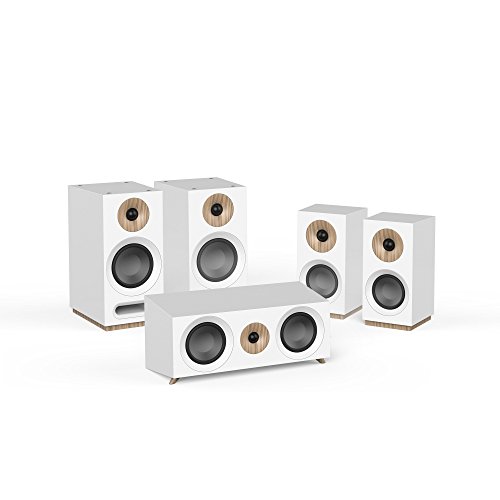
- Best for: A small to medium room where the buyer wants a path to Dolby Atmos later.
- Five speakers: two S 803 bookshelf speakers, two S 801 surround speakers, and one S 81 CEN center channel
- System frequency response: 57 to 26,000 Hz, plus or minus 3 dB
- S 803 recommended amplifier power: 80 watts
- S 803 sensitivity: 87 dB
A small to medium room where the buyer wants a path to Dolby Atmos later.
The Atmos modules and the subwoofer are sold separately, so budget for them if either is part of the plan.
The Jamo S 803 HCS is the most compact system in the Studio 8 range, and it is built for rooms where floorstanding speakers would swallow the floor plan. Two S 803 bookshelf speakers handle the front, two smaller S 801 speakers cover the rear, and the S 81 CEN center keeps dialogue anchored to the screen. The front speakers carry metal fasteners on top that accept optional Dolby Atmos modules, so the set can grow upward without replacing a single cabinet. Bass-reflex enclosures and magnetic grilles keep the look clean, and the whole set suits a bedroom or apartment theater.
Watch out for: The Atmos modules and the subwoofer are sold separately, so budget for them if either is part of the plan.
Klipsch Quintet 5.0
- Best for: A bedroom, dorm, or rented flat where the speakers must mount on the wall and stay out of the way.
- Five speakers: four satellite speakers and one center channel speaker
- 5.0 audio channels with no subwoofer included
- Impedance: 8 ohms
- Horn-loaded tweeters
A bedroom, dorm, or rented flat where the speakers must mount on the wall and stay out of the way.
The small satellites hand off bass earlier than bookshelf speakers, so a subwoofer matters more here when the room grows.
The Klipsch Quintet 5.0 is the smallest set here, built around four satellite speakers and a center channel that mount on a wall and almost disappear into the room. Horn-loaded tweeters give the satellites a lively, forward character that suits action movies, and the keyhole mounts on each speaker make placement a matter of two screws rather than a stand or a shelf. The high-gloss black cabinets suit a modern living room, and the whole set pairs with any receiver and any subwoofer the buyer chooses later. For a renter or a first surround setup, the Quintet keeps the footprint minimal.
Watch out for: The small satellites hand off bass earlier than bookshelf speakers, so a subwoofer matters more here when the room grows.
Which One Fits Your Situation
A living room that doubles as a music room
Choose the Fluance Elite Compact 5.0 SX50BC when the speakers will play albums as often as movies. The bookshelf fronts carry more midrange body than satellites, so voices and instruments sound fuller at moderate volume. Place the fronts on stands or a solid shelf, keep the center under the television, and let the surrounds sit behind the sofa for a balanced soundstage.
A small room with plans to grow
Choose the Jamo S 803 HCS Compact 5.0 when the room is tight now but the system may expand later. The Atmos-ready fronts accept upward-firing modules without new cabinets, and the 8-ohm load suits most receivers. Mount the surrounds on the side walls and leave space above the fronts for the modules if that upgrade is on the list.
A rented flat or a bedroom setup
Choose the Klipsch Quintet 5.0 when space is the deciding factor and the speakers must hug the wall. The keyhole mounts keep every cabinet off the furniture, and the small satellites suit a room where a bookshelf speaker would crowd the shelf. Add a subwoofer later when the living situation allows it.
A first surround system on a modest receiver
Choose the Jamo S 803 HCS Compact 5.0 when the receiver is an entry-level model, since its 8-ohm impedance and 80-watt recommendation sit comfortably within what most home theater receivers deliver. The Fluance set also works here, but its larger cabinets need more shelf space, so measure first and let the room decide.
Common Mistakes
- Buying a 5.0 set and expecting deep bass without a subwoofer, then blaming the speakers for a limit the format sets.
- Placing the rear speakers beside the television instead of behind the seating area, which collapses the surround effect.
- Skipping the impedance check and pairing a set with a receiver that cannot drive five channels cleanly.
- Choosing by satellite size alone and ignoring the center channel, which carries most of the dialogue.
- Running speaker wire across a walkway instead of along the wall, which invites trips and damaged cables.
Frequently Asked Questions
Do I need a receiver with a compact 5.0 speaker set?
Yes, all three sets in this guide are passive, so an AV receiver powers them and decodes the surround formats. Connect the television or console to the receiver, then run speaker wire from the receiver to each of the five speakers. The receiver also handles volume, channel levels, and the crossover that sends low frequencies to a subwoofer if one is added later.
What is the difference between a 5.0 set and a 5.1 set?
A 5.0 set has five speakers and no subwoofer, while a 5.1 set adds a powered subwoofer for the low-frequency effects channel. The five speakers cover the same positions in both layouts, so a 5.0 set can become a 5.1 system by adding a subwoofer to the receiver output. Choose 5.0 when space, neighbours, or budget rule out a bass cabinet for now.
Can I add a subwoofer to a 5.0 set later?
Yes, and that is one of the main reasons to buy a 5.0 set instead of an all-in-one system. Any powered subwoofer connects to the subwoofer output on the receiver, and the receiver settings let you set the crossover so the subwoofer takes over where the bookshelf or satellite speakers roll off. No speaker needs replacing when the subwoofer arrives.
Where should the five speakers go in a small room?
Place the front left and right speakers at ear height on either side of the television, the center channel directly above or below the screen, and the two surrounds slightly behind the seating area at ear height or a little above. Keep the fronts the same distance from the main seat, angle them gently inward, and run the receiver calibration so each channel arrives at the same level.
More from Amazon
Programs that pair well with the guide above. Offers and eligibility are set by Amazon and may change.
Free shipping on eligible items, Prime Video and more. Eligible new members can start with a free trial.
Start a Prime free trialAudiobooks and podcasts to listen to on the go. Eligible new members can start with a free trial.
Try Audible freeAd-free music streaming. Eligible new subscribers can start with a free trial.
Try Music Unlimited freeA free business account with business pricing and bulk-buying tools for work, shop or home office.
Create a business accountAs an Amazon Associate we earn from qualifying purchases.


Write Your Review
No reviews yet. Be the first to share your experience!