
Our Short List of 3
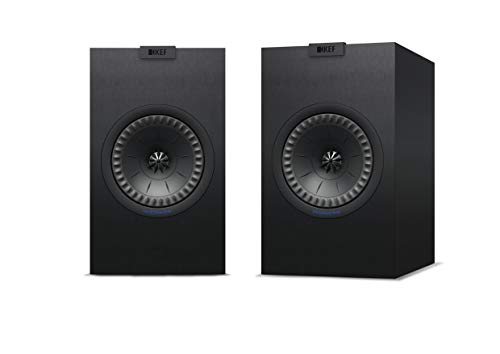
- Design: 2-way bass reflex, rear ported
- Drivers: 5.25-inch aluminium Uni-Q midrange/bass cone, 1-inch vented aluminium dome tweeter
- Frequency response: 51 Hz – 28 kHz (±3 dB)
- Sensitivity: 86 dB (2.83 V at 1 m)

- Design: 2-way bass reflex, rear Tractrix port
- Drivers: 1-inch aluminium LTS tweeter in a 90° x 90° Tractrix horn, 5.25-inch spun-copper TCP woofer
- Frequency response: 58 Hz – 21 kHz (±3 dB)
- Sensitivity: 92 dB (in-room)

- Design: 2-way reflex, rear ported
- Drivers: 4.75-inch C3 Continuous Curved Cone midrange/bass, 0.9-inch sealed tweeter
- Frequency response: 60 Hz – 30 kHz (-6 dB)
- Sensitivity: 87 dB (2.83 V at 1 m)
All 5 Picks at a Glance
| Product | Specs | Action |
|---|---|---|
| KEF Q150 Bookshelf Speakers (Black, Pair) |
| Check price on Amazon |
| Klipsch R-50M Bookshelf Speakers (Black, Pair) |
| Check price on Amazon |
| Q Acoustics 3020c Bookshelf Speakers (Claro Walnut, Pair) |
| Check price on Amazon |
 ELAC Debut 3.0 DB53 Bookshelf Speakers (Walnut, Pair) |
| Check price on Amazon |
 Sony SS-CS5M2 Bookshelf Speakers (Black, Pair) |
| Check price on Amazon |
Our Top Picks
- Sony SS-CS5M2 3-Way 3-Driver Hi-Res Compact Bookshelf Speakers8.7 x 7 x 13.2 inches1 poundsCheck on Amazon
The Bluesound Powernode 2i is a streaming amplifier, not a speaker. Inside its compact case sit a BluOS streaming player, a digital-to-analog converter, and a HybridDigital amplifier that Bluesound publishes at 60 watts per channel into 8 ohms. What it does not have is any way to make sound on its own. Everything it plays — streamed services, network libraries, a television fed through HDMI ARC, a turntable or disc player on its analog and optical inputs — comes out through a pair of passive speakers wired to its 5-way binding posts.
That single fact shapes this entire guide. Powered speakers are the wrong match for this amplifier: the Powernode 2i has no preamp output for a pair of active main speakers, so its amplifier section is designed to drive passive loudspeakers directly. Every speaker below is a passive bookshelf model, sold as a pair, and each one sits inside the electrical window the Powernode 2i works in. The figures that decide the match are sensitivity, which sets how loud a speaker plays for each watt it receives, nominal impedance and the minimum impedance dip, and the maker’s recommended amplifier power range. Get those three right and 60 watts per channel is plenty for a living room, a bedroom, or a desk setup in a home office.
The five pairs here cover the useful spread of that window: a high-sensitivity horn design that plays loud on very little power, two coaxial and cone designs in the middle of the sensitivity range, a 6-ohm model whose recommended power range lines up almost exactly with this amplifier, and a three-way design built for high-resolution file playback. All of them connect with ordinary speaker cable, and all of them can be joined later by a subwoofer through the Powernode 2i’s RCA subwoofer output if the room or the music asks for deeper bass.
KEF Q150 Bookshelf Speakers (Black, Pair)
- Design: 2-way bass reflex, rear ported
- Drivers: 5.25-inch aluminium Uni-Q midrange/bass cone, 1-inch vented aluminium dome tweeter
- Frequency response: 51 Hz – 28 kHz (±3 dB)
- Sensitivity: 86 dB (2.83 V at 1 m)
The Q150 is the speaker most often pictured next to this amplifier, and the electrical match explains why. KEF builds the Q150 around its Uni-Q driver array, which mounts a 1-inch vented aluminium dome tweeter at the center of a 5.25-inch aluminium midrange and bass cone, so both drivers radiate from a single point. KEF publishes a sensitivity of 86 dB and a nominal impedance of 8 ohms, with a recommended amplifier range of 10 to 100 watts — the Powernode 2i’s 60 watts per channel lands in the upper half of that range, which is where a compact speaker of this sensitivity wants to be.
The published frequency response runs from 51 Hz to 28 kHz within a 3 dB window, deep enough for a stand-mount cabinet of this size, and the rear-firing port can be used with the supplied foam bungs when the speakers have to sit close to a wall. The cabinet measures 302 by 180 by 278 mm and each speaker weighs 5.6 kg. The listing covered here is the black finish pair. For a Powernode 2i owner who listens at a desk or across a small room, the Q150’s point-source layout is its main draw: the sound stays coherent at short listening distances where the two drivers of a conventional layout can still be heard as separate sources.
Klipsch R-50M Bookshelf Speakers (Black, Pair)
- Design: 2-way bass reflex, rear Tractrix port
- Drivers: 1-inch aluminium LTS tweeter in a 90° x 90° Tractrix horn, 5.25-inch spun-copper TCP woofer
- Frequency response: 58 Hz – 21 kHz (±3 dB)
- Sensitivity: 92 dB (in-room)
The R-50M answers a different question: what if the room is large, or the listening seat is far away, and 60 watts has to cover the distance? Klipsch publishes an in-room sensitivity of 92 dB for this model, the highest figure in this guide by a wide margin. Sensitivity differences compound quickly — a speaker at 92 dB needs roughly a quarter of the power a speaker at 86 dB needs to reach the same level — so the R-50M leaves the Powernode 2i with headroom to spare even in open-plan spaces.
The high output comes from the horn. A 1-inch aluminium tweeter with Linear Travel Suspension sits in a 90 by 90 degree Tractrix horn, and a 5.25-inch spun-copper TCP woofer handles everything below the 1,560 Hz crossover. Power handling is published at 75 watts continuous and 300 watts peak, comfortably above anything this amplifier can deliver, and the nominal impedance is 8 ohms. The cabinet is rear ported, measures 13.9 by 7 by 9 inches, and weighs 11 lb per speaker. Listeners who watch films through the Powernode 2i’s HDMI ARC input tend to land here, because dialogue clarity and dynamic swings are exactly what a horn-loaded design is built to produce.
Q Acoustics 3020c Bookshelf Speakers (Claro Walnut, Pair)
- Design: 2-way reflex, rear ported
- Drivers: 4.75-inch C3 Continuous Curved Cone midrange/bass, 0.9-inch sealed tweeter
- Frequency response: 60 Hz – 30 kHz (-6 dB)
- Sensitivity: 87 dB (2.83 V at 1 m)
The 3020c is the middle standmount in Q Acoustics’ 3000c series, and its published amplifier window is the neatest fit in this guide: Q Acoustics recommends 25 to 90 watts, so the Powernode 2i’s 60 watts per channel sits almost dead center. The nominal impedance is 6 ohms with a 3.7-ohm minimum, and sensitivity is published at 87 dB, a middle-of-the-road figure that suits near and mid-field listening in ordinary rooms.
The design carries technology down from the maker’s higher series. The 4.75-inch midrange and bass driver uses the C3 Continuous Curved Cone profile, the 0.9-inch tweeter is sealed and isolated from the baffle, and the cabinet uses point-to-point internal bracing to keep the enclosure quiet. Frequency response is published at 60 Hz to 30 kHz on a -6 dB basis, with a 2.6 kHz crossover. Each cabinet measures 279 by 175 by 281 mm and weighs 5.5 kg, making this the narrowest speaker in the guide — useful on crowded shelves and media units. The listing covered here is the Claro Walnut finish.
ELAC Debut 3.0 DB53 Bookshelf Speakers (Walnut, Pair)
- Design: 2-way bass reflex, rear ported
- Drivers: 1-inch aluminium dome tweeter, 5.25-inch aramid fiber woofer
- Frequency response: 48 Hz – 38 kHz
- Sensitivity: 86.5 dB (2.83 V at 1 m)
ELAC’s Debut line is the range that made the maker’s name in this class, and the DB53 is the current third-generation version of its smaller bookshelf model. It pairs a 1-inch aluminium dome tweeter with a 5.25-inch aramid fiber woofer in a rear-ported cabinet of braced 16 mm MDF. ELAC publishes sensitivity at 86.5 dB, nominal impedance at 6 ohms with a 4.8-ohm minimum, and a recommended amplifier range of 20 to 120 watts, which the Powernode 2i meets without strain.
Published frequency response is 48 Hz to 38 kHz, the widest span at both ends in this guide, and the crossover sits at 1,900 Hz. The cabinets measure 6.8 by 12.2 by 10.5 inches and weigh 13.34 lb each. One placement note matters with this model: ELAC fits no wall-mount hardware, so the DB53 is a stand or shelf speaker, and its rear port wants open space behind it. The listing covered here is the walnut finish pair. For Powernode 2i owners moving up from an older Debut generation, this is the like-for-like step: same designer lineage, updated drivers, and an impedance curve that stays friendly to a compact streaming amplifier.
Sony SS-CS5M2 Bookshelf Speakers (Black, Pair)
- Design: 3-way, 3-driver bass reflex, rear ported
- Drivers: 5.12-inch reinforced cellular cone woofer, 0.98-inch tweeter, 0.75-inch super tweeter
- Frequency response: 53 Hz – 50 kHz
- Rated impedance: 6 ohms
Sony’s SS-CS5M2 is the only three-way design in this guide, and it is built around high-resolution playback, which pairs naturally with a streamer that handles files up to 192 kHz. A 5.12-inch reinforced cellular cone woofer, a 0.98-inch tweeter, and a 0.75-inch wide-dispersion super tweeter divide the work across two crossovers, at 2.5 kHz and 17 kHz, and the published frequency response runs from 53 Hz all the way to 50 kHz.
The rated impedance is 6 ohms and the maximum input power is 100 watts, both squarely inside the Powernode 2i’s working range. Sony does not publish a sensitivity figure for this model, so none is listed here; in practice it belongs to the same class of compact bookshelf speakers as the rest of this guide and is sold for use with amplifiers of this size. Each cabinet measures 178 by 335 by 220 mm and weighs 4.3 kg, the lightest in the guide, and the rear bass reflex port and screw-type terminals keep setup simple. Listeners whose libraries lean on high-resolution downloads and lossless streams get the most from this pair, since the super tweeter exists specifically to cover the range those files carry above standard audio.
How to Match Speakers to the Powernode 2i
Start with sensitivity. Sensitivity is the single most useful figure when the amplifier is fixed at 60 watts per channel. Every 3 dB of sensitivity doubles or halves the power a speaker needs for a given volume, so the gap between the 92 dB Klipsch and the 86.5 dB ELAC is not a detail — it is the difference between an amplifier cruising and an amplifier working near its limit in a big room. In a small room or at a desk, that gap shrinks in importance, and the lower-sensitivity designs here play perfectly well within the Powernode 2i’s output.
Check impedance, including the minimum. Bluesound publishes the Powernode 2i’s output into 8 ohms. Nominal impedance alone does not tell the whole story, because every speaker’s impedance dips at some frequencies; the minimum figure in each spec list above is the number to look at. All five speakers here are 6- or 8-ohm nominal designs of the class this amplifier is sold to drive, and none presents the kind of low, sustained load that troubles compact amplifiers.
Stay inside the recommended power window. Each maker publishes an amplifier range or a power handling figure. The healthy position is the same in every case here: the amplifier’s 60 watts per channel meets or exceeds the bottom of the window and stays below the speaker’s maximum. An amplifier far below a speaker’s recommended range is the combination to avoid, because it runs out of clean output first.
Plan for bass separately. No compact bookshelf speaker reaches the bottom octave. The published low-frequency limits here run from 48 to 60 Hz, which covers most music but not film effects or electronic bass lines. The Powernode 2i anticipates this: it carries an RCA subwoofer output, and the BluOS app provides crossover control, so a powered subwoofer can be added at any point without changing the speakers.
Give rear ports room. Four of the five designs here vent through the back panel. A rear port pressed against a wall bloats the bass; a hand’s width or more of clearance, or the foam bungs some makers supply, keeps the low end tidy. Stands that place the tweeter near ear height pay off more than any cable upgrade, and the speakers connect with bare wire or banana plugs at both ends.
Frequently Asked Questions
Does the Powernode 2i work with powered speakers?
Not as its main speakers. The Powernode 2i is an amplifier with speaker terminals, and it has no preamp output for feeding a pair of powered main speakers. Its line-level output is a subwoofer feed, and it also offers a headphone jack. Passive speakers like the five pairs in this guide are what its 60 watts per channel are built to drive.
Are 6-ohm speakers safe to use with the Powernode 2i?
Yes, 6-ohm nominal bookshelf speakers are a normal pairing for this amplifier. Bluesound publishes the output figure into 8 ohms, but the 6-ohm designs here — the Q Acoustics, ELAC, and Sony models — publish minimum impedances between 3.7 and 4.8 ohms, which is typical of the class and well within what a HybridDigital amplifier of this type handles in daily use.
How loud will 60 watts per channel actually play?
It depends almost entirely on speaker sensitivity. With the 92 dB Klipsch R-50M, 60 watts produces more volume than most living rooms can use. With an 86 to 87 dB design such as the KEF, Q Acoustics, or ELAC, the same amplifier still reaches strong listening levels in small and medium rooms, which is the setting these speakers are designed for. Distance matters too: every doubling of listening distance lowers the level at the seat, which is why high sensitivity earns its place in larger spaces.
Can a subwoofer be added to a Powernode 2i system later?
Yes. The Powernode 2i has a dedicated RCA subwoofer output, and the BluOS app lets the crossover between the subwoofer and the main speakers be set from the listening seat. Any of the pairs in this guide can start as a two-speaker system and gain a subwoofer later, which is the sensible order for rooms where shelf or stand space is limited at the outset.
Conclusion
The Powernode 2i narrows the speaker search in a helpful way: passive bookshelf models, 6 or 8 ohms, with published amplifier windows that contain 60 watts. Inside that frame, the choice is about the room and the listening habit. The Klipsch R-50M plays loudest on the least power and suits film-heavy use in bigger rooms. The KEF Q150 keeps its composure at close range. The Q Acoustics 3020c fits the amplifier’s power window most precisely and takes the least shelf width. The ELAC DB53 brings the widest published frequency range and the current Debut generation’s drivers, and the Sony SS-CS5M2 is the pick for high-resolution libraries. Any of the five turns the Powernode 2i into the complete streaming system it was designed to be.
Disclosure: As an Amazon Associate, we earn from qualifying purchases made through links on this page, at no extra cost to you.
More from Amazon
Programs that pair well with the guide above. Offers and eligibility are set by Amazon and may change.
Free shipping on eligible items, Prime Video and more. Eligible new members can start with a free trial.
Start a Prime free trialAudiobooks and podcasts to listen to on the go. Eligible new members can start with a free trial.
Try Audible freeAd-free music streaming. Eligible new subscribers can start with a free trial.
Try Music Unlimited freeA free business account with business pricing and bulk-buying tools for work, shop or home office.
Create a business accountAs an Amazon Associate we earn from qualifying purchases.







Write Your Review
No reviews yet. Be the first to share your experience!