
Our Short List of 3
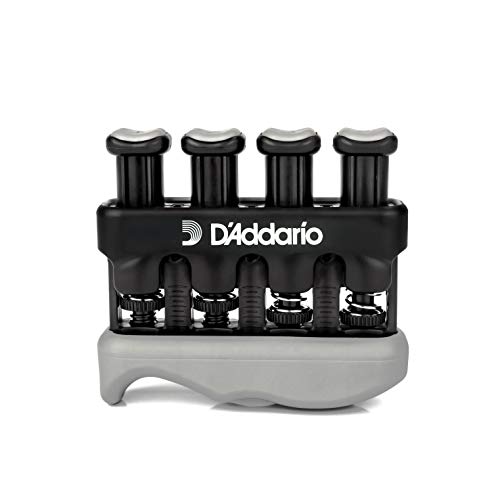
- Best for: Guitarists and other string players who want one adjustable tool for both strength and callus upkeep.
- Tension adjusts individually for each finger
- Reversible moulded grip uncovers simulated strings for callus work
- Over-moulded finger pads
- Item weight: 2.56 ounces

- Best for: Beginners and returning players who need a light, clearly labelled starting tension.
- Spring-loaded finger-piston system isolates each finger
- This listing: 3 lb X-Light tension, yellow
- Gripmaster family tensions run from 1 to 9 lb per finger
- ABS plastic body with stainless steel springs

- Best for: Players who want a structured progression with named steps and a manual to follow.
- Model 10-0741, Red Light
- Resistance: 3 lb per finger, 10 lb for full-hand compression
- Buttons work independently or as one unit
- Illustrated exercise manual included
All 5 Picks at a Glance
| Product | Specs | Action |
|---|---|---|
| D’Addario Varigrip Hand Exerciser |
| Check price on Amazon |
| Prohands Gripmaster Hand Exerciser |
| Check price on Amazon |
| CanDo Digi-Flex Hand and Finger Exerciser |
| Check price on Amazon |
 Fender Callus Builder and Finger Strengthener |
| Check price on Amazon |
 FitBeast Finger Exerciser Set |
| Check price on Amazon |
Key takeaways
- Five finger exercisers for guitarists, pianists and players compared on per-finger tension, callus building and portability, with specs for each pick.
Every instrument makes uneven demands on the hands. A guitarist’s ring finger has to hold its own against a stronger index finger, a pianist needs each finger to strike with independent control, and a new string player quits early more often over sore, weak fingertips than over theory. A finger exerciser is the off-instrument tool built for that gap: a pocket-sized trainer that loads each finger on its own spring or band so practice time away from the instrument still builds strength, dexterity and fingertip toughness.
This guide compares the five finger exercisers for musicians that are actually sold on Amazon US right now, from adjustable per-finger trainers to a graduated colour-coded system and a callus builder shaped around string playing. Each pick was chosen from its Amazon listing details, and the sections below explain how the tension systems differ, who each design suits, and which checks to make before ordering.
Quick Picks
As an Amazon Associate we earn from qualifying purchases
| Product | Best for | Key spec from title |
|---|---|---|
| D’Addario Varigrip Hand Exerciser | Guitarists who want per-finger control | Adjustable tension for each finger |
| Prohands Gripmaster Hand Exerciser | Beginners starting with light resistance | Spring-loaded piston for every finger |
| CanDo Digi-Flex Hand Exerciser | Players following a graduated program | Red Light model, 3 lb per finger |
| Fender Callus Builder and Finger Strengthener | String players building fingertip calluses | Red version rated at 8 lb tension |
| FitBeast Finger Exerciser Set | Anyone who wants a full progression in one box | Five exercisers spanning 1 to 8 lb |
How to Choose
Decide Between Per-Finger Pistons and Whole-Hand Tools
The designs in this guide share one idea: each finger presses its own spring-loaded button, so a weak finger cannot hide behind stronger neighbours. That isolation is the main reason musicians pick these over a plain squeeze gripper, which loads the whole hand at once and lets the index and middle fingers do most of the work. If your goal is even fretting pressure, cleaner piano finger independence or steadier valve and key work, choose a piston-style exerciser. Whole-hand grippers build general crush strength, but they do little for the finger-by-finger control that playing actually requires.
Start With a Lighter Tension Than You Expect
Per-finger resistance is measured in small numbers, and they add up fast across a full set of repetitions. Light models in these ranges run around 1 to 3 lb per finger, medium models sit near 5 to 7 lb, and the firmest musician-focused options reach 8 or 9 lb. A beginner who grabs a heavy unit usually ends up with tired forearms and sloppy form within a minute. Match the tension to your weakest finger rather than your strongest, keep early sessions short, and treat the resistance printed on the listing as the working number for every repetition, not a maximum you squeeze once.
Choose Fixed Tension or On-Device Adjustment
Most piston exercisers are fixed: the colour of the unit tells you its tension, and progressing means moving up to the next colour. That keeps the tool simple and repeatable, which suits players following a steady routine. The Varigrip in this guide works differently, with a small adjustment for each finger, so one device covers a wider span and lets you set the ring finger lighter than the index. Adjustment costs a little simplicity and invites constant fiddling. Decide which habit fits you: a fixed unit you simply pick up, or one adjustable tool you set once and leave alone.
Check Size, Grip Surface and Where It Will Live
These trainers only work if they are within reach, so size matters more than most listings admit. The compact picks here weigh under 3 ounces and disappear into a gig bag pocket, a piano bench or a desk drawer, while sets with several units need a pouch or shelf space. Look at the finger pads as well: over-moulded or cushioned pads spread pressure across the fingertip, which matters during daily sessions, while smooth plastic buttons can dig in on longer sets. Finally, check the listed dimensions against your hand if you have notably small or large hands, because pad spacing is fixed.
The 5 Best Options
D’Addario Varigrip Hand Exerciser
- Best for: Guitarists and other string players who want one adjustable tool for both strength and callus upkeep.
- Tension adjusts individually for each finger
- Reversible moulded grip uncovers simulated strings for callus work
- Over-moulded finger pads
- Item weight: 2.56 ounces
Guitarists and other string players who want one adjustable tool for both strength and callus upkeep.
The adjustment screws are small; set your tensions once, note them, and resist re-tuning every session.
The Varigrip is the pick for players who want to set each finger’s workload separately. Four spring-loaded buttons sit under an ergonomic body, and a small tension adjustment behind each finger lets you run the ring finger lighter than the index instead of forcing one resistance on the whole hand. Flip the removable moulded grip over and it exposes simulated strings, a ridged surface meant to keep fingertip calluses conditioned between playing sessions. At under three inches long, it travels in a case pocket and comes out during commutes, warm-ups and television time alike.
Prohands Gripmaster Hand Exerciser
- Best for: Beginners and returning players who need a light, clearly labelled starting tension.
- Spring-loaded finger-piston system isolates each finger
- This listing: 3 lb X-Light tension, yellow
- Gripmaster family tensions run from 1 to 9 lb per finger
- ABS plastic body with stainless steel springs
Beginners and returning players who need a light, clearly labelled starting tension.
Tension is fixed by colour, so progressing means buying the next colour up; confirm the colour and tension in the listing title before ordering.
The Gripmaster is the long-running reference design in this category: four spring-loaded pistons in an ABS body, each finger pressing against its own stainless steel spring so no finger can borrow force from its neighbours. This listing is the X-Light version in yellow, rated at 3 lb of tension per finger, which places it at the gentle end of the Gripmaster range and makes it a sensible first unit for new players, younger students and anyone returning to an instrument after a long break. Santoprene pads soften the contact points, and the colour itself is the tension label, so the right unit is easy to spot in a bag.
CanDo Digi-Flex Hand and Finger Exerciser
- Best for: Players who want a structured progression with named steps and a manual to follow.
- Model 10-0741, Red Light
- Resistance: 3 lb per finger, 10 lb for full-hand compression
- Buttons work independently or as one unit
- Illustrated exercise manual included
Players who want a structured progression with named steps and a manual to follow.
Each resistance level is a separate unit, so a full climb through the colours means several purchases over time.
The Digi-Flex comes out of the clinic world, and its structure shows it: a rigid base with individual finger buttons that can be pressed one at a time for isolation work or compressed together for a full-hand squeeze. This listing is the Red Light model, number 10-0741, rated at 3 lb of resistance per finger and 10 lb when the whole unit is compressed. It is one step in an eight-level colour-coded family that runs from extra-light tan to extra-heavy gold, which makes it the natural choice for players who want a defined ladder to climb rather than a single tool. An illustrated exercise manual is included in the box.
Fender Callus Builder and Finger Strengthener
- Best for: New guitar, bass and violin players whose limiting factor is fingertip tenderness.
- Red version rated at 8 lb tension
- Black 15 lb version also sold
- Tension rises as fingers move toward the centre ridges
- Angled grip positions match playing posture
New guitar, bass and violin players whose limiting factor is fingertip tenderness.
The 8 lb rating is firm for a first trainer; beginners with very sore fingers should start with short, gentle sessions.
Fender’s entry skips the piston layout entirely. The Callus Builder is a compact resistance trainer with raised ridges that your fingertips press against, and it can be held at different angles so the working position resembles the angle your hand actually meets a fretboard. This listing is the Red version, rated at 8 lb of tension measured between the outer ridges; sliding your fingers closer to the centre raises the resistance further, and a Black 15 lb version is sold for experienced players and bassists. The design targets the two things that make beginners quit strings: fingertip soreness and weak presses.
FitBeast Finger Exerciser Set
- Best for: Students and shared households that want every tension step on hand from day one.
- Set of five colour-coded finger exercisers
- Tension range: 1 lb to 8 lb across the set
- Reinforced ABS plastic with metal springs
- Wooden exercise blocks included
Students and shared households that want every tension step on hand from day one.
The listed dimensions describe the packaged set; check the individual exerciser size in the listing images if your hands are small.
The FitBeast set takes the opposite approach to a single adjustable unit: five separate colour-coded finger exercisers in one box, spanning 1 to 8 lb of tension, so progression is built into the purchase. Each exerciser is a compact clip-style trainer built from reinforced ABS plastic with metal springs, and the set adds wooden blocks that turn basic squeezing into grip, lift and stack exercises for variety. A storage pouch keeps the five pieces together. For a household with two players at different levels, or a student who expects to move up quickly, the set removes the guesswork of choosing one starting tension.
Which One Fits Your Situation
You Play Guitar and Your Ring Finger Lags Behind
Pick the D’Addario Varigrip. Independent tension per finger is exactly the fix for an uneven fretting hand, because you can set the ring and pinky buttons lighter and bring them up gradually instead of letting the index finger dominate every repetition. The simulated-string surface under the grip is a genuine bonus for maintaining calluses during travel weeks when the guitar stays home.
You Are a Beginner and Your Hands Tire Quickly
Start with the Prohands Gripmaster in X-Light. Three pounds per finger sounds trivial on paper, but across a few minutes of steady repetitions it is a real workload for untrained hands, and the colour-coded system makes the next step obvious when this one feels easy. The Digi-Flex Red Light is the alternative if you prefer a manual and a more structured routine.
You Are Building Calluses as Much as Strength
Choose the Fender Callus Builder. Its ridged pressing surface and angled grip were designed around string playing rather than general grip work, and the 8 lb Red version gives new players a firm target while the Black version waits for bassists and experienced hands. Pair it with short daily sessions, and stop treating soreness as a score to beat.
You Want One Purchase That Covers Your Progression
Take the FitBeast set. Five exercisers from 1 to 8 lb mean the next step is already in the pouch when the current one gets easy, and the wooden blocks keep sessions varied enough to stay interesting. It is also the practical answer when two people in the same house are training at different levels and would otherwise need separate units.
Common Mistakes
- Buying the heaviest tension available first, then quitting within a week because every session hurts.
- Training only the whole-hand squeeze and never isolating the ring and pinky fingers that actually lag.
- Squeezing through long daily marathons instead of short, frequent sessions with rest days.
- Ignoring the colour and tension printed in a listing title and ordering the wrong fixed-tension unit.
- Treating fingertip soreness from a callus trainer as damage to push through rather than a signal to back off.
Frequently Asked Questions
How often should a musician use a finger exerciser?
Short sessions on most days beat occasional long ones. A few minutes of controlled repetitions, once or twice a day, gives the small hand muscles repeated work without arriving at your instrument already fatigued. Keep exerciser work and playing separated by a break, and skip a day when your hands feel genuinely tired rather than pleasantly worked.
What tension should a beginner start with?
Start at the light end of any range here, around 1 to 3 lb per finger. If you can complete slow, controlled repetitions with good form for a couple of minutes, the tension is about right. If your fingers shake, your wrist bends or stronger fingers start taking over, drop down a level and build from there.
Do finger exercisers replace actual practice?
No. They build the raw materials of playing: finger strength, independence and fingertip toughness. They cannot teach timing, tone, reading or repertoire, and no trainer reproduces the exact feel of strings, keys or valves. Treat the exerciser as conditioning that supports your practice sessions, the same way a singer treats breathing exercises as support rather than a substitute for singing.
Can one exerciser be shared between two players?
A fixed-tension unit suits only the player whose level matches its colour, so sharing works mainly when both players are at a similar stage. An adjustable model like the Varigrip can be reset between users, and a multi-unit set covers two levels at once. For regular training, each player having a correctly matched unit is the cleaner arrangement.
More from Amazon
Programs that pair well with the guide above. Offers and eligibility are set by Amazon and may change.
Free shipping on eligible items, Prime Video and more. Eligible new members can start with a free trial.
Start a Prime free trialAudiobooks and podcasts to listen to on the go. Eligible new members can start with a free trial.
Try Audible freeAd-free music streaming. Eligible new subscribers can start with a free trial.
Try Music Unlimited freeA free business account with business pricing and bulk-buying tools for work, shop or home office.
Create a business accountAs an Amazon Associate we earn from qualifying purchases.

Write Your Review
No reviews yet. Be the first to share your experience!