

Key takeaways
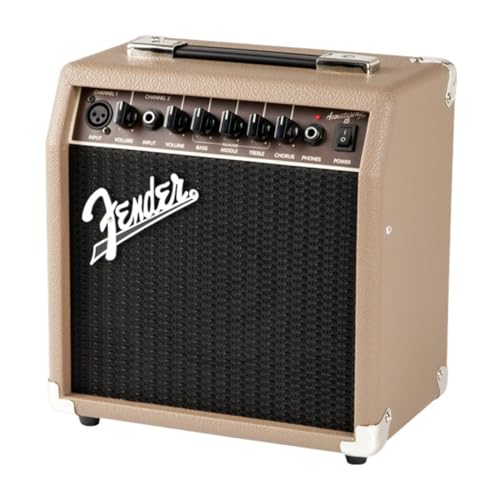
- 10–20 watts: Suitable for bedroom playing, quiet rehearsals, and close-range practice. It may sound strained when competing with a drummer.
- 30–60 watts: The practical range for busking, coffee shops, small churches, and intimate acoustic sets.
- 80–100 watts: Better for larger rooms, louder vocalists, or ensembles with percussion. You still may need a PA for a full venue.
The best acoustic guitar amps for most players are the Fishman Loudbox Mini for small venues, the Roland AC-33 for battery-powered busking, and a compact 15–40-watt acoustic combo for home practice where portability and low volume matter more than maximum headroom.
Our top picks



As an Amazon Associate we earn from qualifying purchases at no extra cost to you. Ratings are shown as listed on Amazon.
Best Acoustic Guitar Amps by Playing Situation
| Situation | Best fit | Useful target specifications | Typical market range |
|---|---|---|---|
| Home practice and songwriting | Small acoustic combo or compact acoustic modeling amp | 10–30 watts, 6–8-inch speaker, headphone output, auxiliary input | $150–$400 |
| Street performance | Battery-powered acoustic amp | 15–30 watts on battery, 5–8-inch speakers, 5–8 hours of practical runtime | $300–$600 |
| Coffee shops and small acoustic gigs | Fishman Loudbox Mini or similar compact combo | 50–60 watts, 6–8-inch woofer, two channels, anti-feedback controls | $350–$550 |
| Louder ensemble or medium room | Fishman Loudbox Artist, Fender Acoustic 100, or similar | 100 watts, two speakers or a larger woofer, balanced output, wider EQ | $500–$900 |
| Maximum natural clarity and portability | AER Compact 60 or another premium acoustic combo | 50–60 watts, compact cabinet, high-quality preamp, low coloration | $1,000–$1,800 |
What Wattage Do You Actually Need?
Wattage is a useful starting point, but it does not translate directly into loudness. Speaker efficiency, cabinet design, microphone use, and the room all affect how loud an amp feels. An acoustic guitar also needs clean headroom: once the amp runs out of headroom, a piezo pickup can become thin, brittle, or harsh.
- 10–20 watts: Suitable for bedroom playing, quiet rehearsals, and close-range practice. It may sound strained when competing with a drummer.
- 30–60 watts: The practical range for busking, coffee shops, small churches, and intimate acoustic sets.
- 80–100 watts: Better for larger rooms, louder vocalists, or ensembles with percussion. You still may need a PA for a full venue.
A 100-watt amp is not necessarily twice as loud as a 50-watt amp. Doubling amplifier power produces only a modest increase in maximum sound pressure. The bigger advantage is extra clean headroom, so the amp remains composed when you strum hard or use a microphone and guitar together.
Speaker Size: Warmth, Projection, and Portability
Most acoustic combos use a 6- to 8-inch woofer, sometimes paired with a small tweeter. A 6-inch speaker keeps the cabinet light and focused, while an 8-inch speaker usually produces more low-mid body and sounds less compressed at moderate volume. Two-way designs can provide more detailed treble, but excessive high-frequency output may emphasize piezo harshness.
For solo guitar and vocals, a single 6- or 8-inch speaker is often enough. If you use alternate tunings, a looper, or a percussion-heavy strumming style, choose a cabinet with more low-frequency headroom rather than simply turning up a smaller amp. Keep expectations realistic: a compact acoustic combo is not a substitute for a subwoofer in a large room.
Speaker and cabinet priorities
- 6-inch speaker: Light, compact, and suitable for practice or quiet performances.
- 8-inch speaker: A strong compromise between warmth, projection, and portability.
- Two-way speaker system: Useful for guitar-and-vocal detail, especially when the amp includes separate channels.
- Wooden cabinet: Often contributes a pleasant, resonant character but may add weight and vulnerability to knocks.
- Plastic or composite cabinet: Easier to carry and generally resistant to minor impacts, though the sound depends more on the design than the material alone.
EQ and Feedback Controls That Matter
An acoustic amp should give you enough control to correct the room and the pickup, not just add treble and bass. A three-band EQ is a useful minimum. Independent guitar and microphone channels are more important if you sing while playing.
High, mid, and low controls
- Low: Reduce it when the guitar sounds boomy, especially near a wall or corner. Adding low end can make a small cabinet sound larger, but too much reduces clarity.
- Mid: This is where much of the guitar’s body and vocal intelligibility lives. A small mid cut can reduce boxiness; a modest boost can help a solo guitar remain audible.
- High: Lower it if a piezo pickup sounds brittle or finger noise becomes distracting. Increase it carefully for definition in a carpeted or heavily furnished room.
Feedback control is equally important. A phase switch can reduce low-frequency feedback caused by the relationship between the pickup and speaker. A notch filter targets a narrower problem frequency. Anti-feedback systems that automatically identify and reduce a resonant frequency can be convenient for live use, but they work best after sensible placement and gain adjustment.
Three Strong Choices for Different Buyers
Fishman Loudbox Mini: the small-venue default
The Fishman Loudbox Mini is a sensible choice for guitarists who need more than practice volume without carrying a large PA. Its approximately 60-watt class, 6.5-inch woofer, separate instrument and microphone channels, reverb, and feedback-oriented controls suit coffee shops and small acoustic performances.
Its main limitation is coverage. A single compact speaker may not fill a noisy room, and the guitar channel’s character will still depend heavily on the quality of your pickup. Choose it when you value a familiar, practical feature set over battery operation or ultra-low weight.
Roland AC-33: the battery-powered busking option
The Roland AC-33 is designed around portability, with battery operation, stereo amplification, effects, and looping features. It is particularly useful for street performance or locations where mains power is inconvenient. The stereo layout can make chorus and delay effects feel spacious at close range.
Battery runtime depends on volume, battery condition, and whether you use all channels and effects. Treat the published runtime as an upper estimate rather than a guarantee. Carry fresh batteries or a backup power plan for important performances.
Fender Acoustic 100: more room and feature headroom
The Fender Acoustic 100 provides substantially more power than a small practice combo and is aimed at players who need a larger acoustic presentation. Its two-channel format, effects, balanced connectivity, and 8-inch speaker make it appropriate for guitar-and-vocal setups and louder small-room work.
It is less convenient for casual carrying than a mini combo, so it makes most sense when you regularly perform or rehearse at volumes that would push a smaller amplifier hard.
A Simple Decision Matrix
| Your priority | Choose | Avoid prioritizing |
|---|---|---|
| Lowest cost and occasional home use | 15–30 watts, 6–8-inch speaker, headphone output | Large 100-watt cabinets and premium touring features |
| Weekly small gigs | 50–60 watts, two channels, reverb, phase or notch control | A guitar-only amp if you also sing |
| Frequent busking | Battery operation, robust handle, replaceable power source | An amp that requires mains power |
| Pickup sounds harsh | Three-band EQ, notch filter, phase switch, tweeter control if available | Buying more wattage without better tone controls |
| Limited storage or transport | Under 15 kg, compact cabinet, protected controls | Large twin-speaker systems |
Setup Steps for a Warmer, Cleaner Sound
- Start with the amp flat. Set bass, mid, and treble at their center positions. Keep reverb low until the basic sound is balanced.
- Set the guitar gain first. Play your hardest normal strum and raise the input level until it is strong but not clipping.
- Position the cabinet carefully. Keep it off a corner and avoid pointing it directly at the guitar’s soundhole or pickup area. Raising it slightly can improve monitoring without increasing volume.
- Use the phase switch if low-end feedback appears. Select the quieter position, then reduce bass before cutting large amounts of midrange.
- Make small EQ changes. A cut of a few decibels often sounds more natural than boosting several frequencies.
- Add reverb last. Too much reverb can make a small room sound distant and can hide timing problems during practice.
As a practical example, suppose a busker uses an amp for two 90-minute sets and a 30-minute soundcheck each week. That is 3.5 hours per outing, or about 14 hours per month. An amp advertised at eight hours of battery life may cover the day only if the batteries are fresh and the volume is moderate; a spare set is inexpensive insurance. For a mains-powered setup, a 60-watt amp running for 14 hours consumes at most about 0.84 kilowatt-hours at its rated output, though real consumption varies and is usually lower during normal playing.
Durability and Ownership Costs
The parts most likely to cause trouble are input jacks, potentiometers, switches, power cables, and battery compartments—not usually the speaker itself. Repeatedly carrying an amp by a loose handle, storing it in a damp vehicle, or wrapping the cable tightly around the controls can shorten its life.
- Use a padded cover when transporting the amp and keep drinks away from the control panel.
- Clean dusty grilles with a soft brush or low-pressure air; avoid spraying cleaner into switches or jacks.
- Replace noisy cables before assuming the amplifier has failed.
- Remove disposable batteries during long-term storage to prevent leakage.
- Do not block ventilation openings, even on a compact solid-state amp.
For most players, the best acoustic guitar amps balance clean headroom, an 8-inch-class speaker, separate guitar and vocal channels, and practical feedback control. Choose a small 15–30-watt model for home use, a 50–60-watt combo for regular intimate gigs, or a battery-powered design when portability and independence from wall power come first.


Write Your Review
No reviews yet. Be the first to share your experience!