

Key takeaways
- Round seats: allow movement in every direction and work well when you shift between acoustic, electronic, and percussion setups. A 13–14-inch seat is compact; a 14–15-inch seat gives more support but can feel restrictive for smaller players.
- Motorcycle-style seats: provide a defined front and rear, often with more support beneath the sit bones. They can reduce pressure at the front of the thighs, but they may make side-to-side movement feel less natural.
- Flat seats: are often lighter and less expensive. They can work well for short sessions, but they provide less contouring and may require more active postural control during long practice.
The best drum thrones for long practice sessions are the Roc-N-Soc Nitro for adjustable comfort, the Gibraltar 9608HM for a stable round seat at a moderate price, and the Ahead Spinal G for players who prefer a motorcycle-style seat with pronounced back support.
A drum throne affects more than comfort: the seat shape changes how freely your hips move, the padding controls pressure over time, the height determines whether your knees and ankles stay in a workable position, and the base must remain stable when you play the kick drum repeatedly. The right choice depends on your posture, playing style, available space, and how many hours you sit each week.
Our top picks

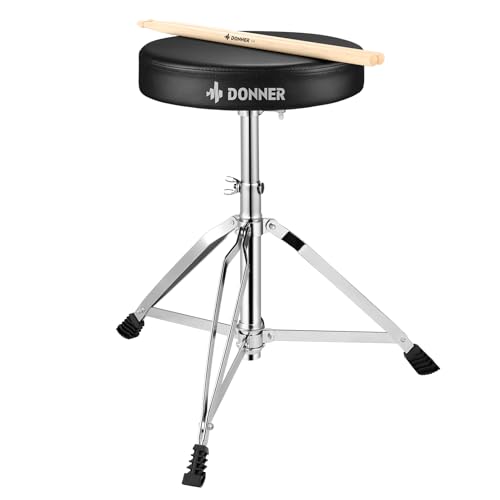


As an Amazon Associate we earn from qualifying purchases at no extra cost to you. Ratings are shown as listed on Amazon.
Best drum thrones at a glance
| Drum throne | Seat style | Approx. seat size | Height range | Base and adjustment | Best for |
|---|---|---|---|---|---|
| Roc-N-Soc Nitro | Round, contoured foam | Approx. 13–14 in. diameter | Approx. 18–24 in. | Hydraulic height adjustment; tripod base | Frequent practice and precise height changes |
| Gibraltar 9608HM | Round, thick padded seat | Approx. 14 in. diameter | Approx. 20–26 in. | Threaded spindle; double-braced tripod | Stability and value |
| Ahead Spinal G | Motorcycle-style split seat | Approx. 17 in. wide | Approx. 19–25 in. | Threaded height adjustment; double-braced base | Long sessions and players wanting more back clearance |
| Pearl D930 | Round, thickly padded seat | Approx. 14 in. diameter | Approx. 18.9–25.6 in. | Threaded spindle; double-braced tripod | General-purpose home and gig use |
| Tama HT230 | Compact round seat | Approx. 13 in. diameter | Approx. 18–24 in. | Threaded height adjustment; tripod base | Smaller rooms and budget-conscious players |
Dimensions can vary slightly by production version and retailer listing, so confirm the current manufacturer specification before ordering. The useful comparison is not simply the amount of foam: it is the relationship between seat width, height range, adjustment mechanism, and base footprint.
Our top picks by situation
Best overall for long sessions: Roc-N-Soc Nitro
The Roc-N-Soc Nitro is a strong choice when you practice frequently and change setups often. Its hydraulic adjustment lets you alter height quickly without repeatedly turning a threaded spindle. The round, contoured seat gives more hip support than a flat budget throne while still allowing the legs to move freely around the kit.
The main trade-off is ownership complexity. A hydraulic mechanism has more moving parts than a basic spindle, and replacing the mechanism can cost more than replacing a simple threaded post. It is also a relatively substantial throne, so it is less attractive if you regularly carry compact gear on public transport.
Best stable mid-priced option: Gibraltar 9608HM
The Gibraltar 9608HM prioritizes a familiar design: a thick round cushion, a threaded height adjustment, and a double-braced tripod. This is the type of throne that suits a player who wants dependable support without paying for a hydraulic system or an unusually shaped seat.
Threaded adjustment is slower, but it has an important advantage: once tightened, it is mechanically simple and easy to inspect. The throne is a good fit for home practice, rehearsals, and regular gigs where height normally stays fixed. Its broad base is reassuring for energetic kick playing, though it occupies more floor space than lightweight single-braced models.
Best motorcycle-style seat: Ahead Spinal G
The Ahead Spinal G uses a split motorcycle-style seat that is wider toward the rear and narrower toward the front. This shape can make it easier to keep the thighs from pressing against a wide round cushion, while the central gap gives the seat a less restrictive feel during longer sessions.
It is not automatically better for every player. Some drummers prefer a round seat because it permits easy movement in every direction; others find the front-to-back orientation of a motorcycle seat more supportive. The Spinal G also needs more storage room than a compact round throne, and its back contour should be checked against your kit position before buying.
Best straightforward all-rounder: Pearl D930
The Pearl D930 combines substantial padding with a conventional round seat and sturdy double-braced hardware. It makes sense for players who want a durable, familiar throne from an established drum-hardware range and do not need hydraulic adjustment.
Its thick cushion may feel luxurious at first, but maximum softness is not always ideal. Foam that compresses deeply can reduce effective seat height and leave the pelvis less consistently supported. When comparing the D930 with other round thrones, focus on how firmly the cushion supports your weight rather than judging comfort by softness alone.
Best for limited space and lower budgets: Tama HT230
The Tama HT230 is a practical compact throne for newer players, secondary kits, and smaller practice rooms. Its round seat and straightforward spindle adjustment keep the design uncomplicated. It is also easier to fold and store than many heavy-duty thrones.
Choose it when your sessions are moderate and you value portability. For several hours of daily practice, a wider seat, more substantial foam, and a stronger base may justify moving up the range. A budget throne can be perfectly usable, but thin padding and undersized hardware are usually the first limitations to appear.
How seat shape changes playing posture
- Round seats: allow movement in every direction and work well when you shift between acoustic, electronic, and percussion setups. A 13–14-inch seat is compact; a 14–15-inch seat gives more support but can feel restrictive for smaller players.
- Motorcycle-style seats: provide a defined front and rear, often with more support beneath the sit bones. They can reduce pressure at the front of the thighs, but they may make side-to-side movement feel less natural.
- Flat seats: are often lighter and less expensive. They can work well for short sessions, but they provide less contouring and may require more active postural control during long practice.
For most players, start with the seat that lets you sit centered without bracing against the rim. If you frequently slide forward, the cushion may be too soft, the seat may be tilted incorrectly, or the throne may be too high.
Height adjustment: the number matters less than the result
A useful starting point is to set the throne so your thighs slope slightly downward from the hips toward the knees. Your feet should reach the pedals without stretching, and your knees should not rise sharply above your hips. Adjust in small increments, because a change of only 0.5 inch can noticeably alter pedal control and hip angle.
For example, suppose a player practices four days per week for two hours per session. That is:
4 sessions × 2 hours × 52 weeks = 416 sitting hours per year.
If a $150 throne lasts five years, its approximate equipment cost is $150 ÷ 2,080 hours, or about 7 cents per sitting hour. A $70 throne that needs replacement after two years costs approximately 8 cents per hour under the same schedule. The cheaper purchase is not necessarily the cheaper long-term choice if the foam collapses or the hardware develops play.
Base stability and durability
Double-braced legs generally add weight and resistance to rocking, especially when the kick pedal is mounted aggressively or the drummer plays with pronounced body movement. However, a stable base also depends on the quality of the locking hardware, the condition of the rubber feet, and whether the floor is level.
Inspect the following before every intensive session:
- Confirm that the height collar or spindle lock is fully tightened.
- Check that all three legs open evenly and that no brace is bent.
- Replace worn rubber feet if the throne slides on a hard floor.
- Keep the adjustment threads free of grit; wipe them rather than flooding them with lubricant.
- Do not use the throne as a step or stand on it to reach equipment.
The foam and vinyl usually wear before the steel frame. Repeated compression creates a low spot, while sweat and transport can split the cover at seams. A removable throne cover or towel can reduce moisture exposure, but avoid storing a damp towel on the seat. Clean vinyl with a slightly damp cloth and a mild cleaner approved for synthetic upholstery; harsh solvents can make the cover brittle.
Decision matrix
| Your situation | Recommended direction | Why |
|---|---|---|
| Beginner, occasional practice, limited budget | Tama HT230 or similar compact round throne | Simple adjustment, modest footprint, lower purchase cost |
| Daily practice lasting two hours or more | Roc-N-Soc Nitro or a substantial motorcycle-style throne | Better long-session support and more usable adjustment |
| Frequent gigs and repeated setup changes | Hydraulic throne such as the Roc-N-Soc Nitro | Fast height changes and consistent setup between kits |
| Small practice room | Compact round throne with a single or narrow tripod | Leaves more clearance around the kick and hi-hat pedals |
| Strong kick technique or frequent rocking | Double-braced Gibraltar, Pearl, or Ahead model | Wider, heavier bases resist unwanted movement |
Final buying recommendation
Choose the Roc-N-Soc Nitro if adjustment speed and long-session comfort are your priorities. Choose the Gibraltar 9608HM or Pearl D930 for a conventional, stable round throne with fewer mechanical complications. Choose the Ahead Spinal G if a motorcycle-style seat fits your body and playing position, and choose the Tama HT230 when space, portability, and price matter most.
Before purchasing, measure the height of your current setup, compare the throne’s minimum and maximum settings, and check the folded footprint if you transport it. A throne that supports a neutral working posture and stays firmly planted is a better investment than one chosen solely for the thickest cushion.


Write Your Review
No reviews yet. Be the first to share your experience!