

Key takeaways
- Sediment filtration: catches grit, rust particles, and other visible debris.
- Activated carbon: reduces chlorine, odors, and some organic compounds. This stage also protects the RO membrane from chlorine damage.
- Reverse osmosis membrane: uses pressure to reduce dissolved salts, many metals, fluoride, and other contaminants. Performance depends on source-water quality, temperature, and pressure.
- Post-carbon filtration: polishes water stored in the internal tank or carafe before dispensing.
- Remineralization: optional on some systems. It adds a small amount of minerals for taste; it does not make the system a substitute for professional water testing.
- UV treatment: included on some products, but it should not be treated as a replacement for safe municipal or properly tested private-well water.
The best countertop reverse osmosis systems for apartments are usually tankless models for limited counter space, while a compact tank model is the better value when you want simpler operation, quieter dispensing, and lower purchase cost.
Our top picks

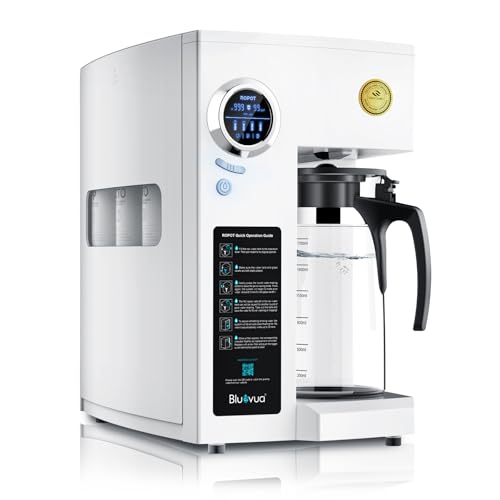

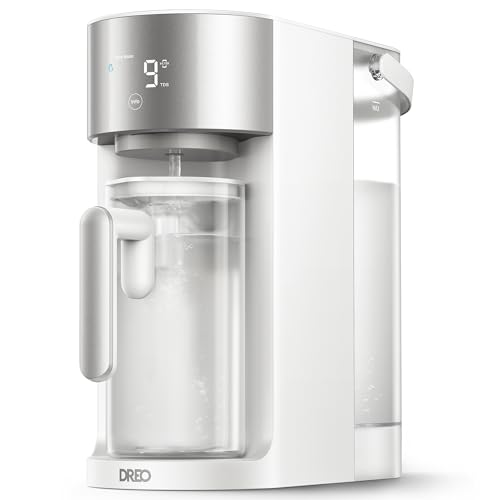
As an Amazon Associate we earn from qualifying purchases at no extra cost to you. Ratings are shown as listed on Amazon.
Best countertop reverse osmosis systems at a glance
| Best for | System | Stages | Tank or tankless | Approximate size | Published or typical water ratio | Typical price range |
|---|---|---|---|---|---|---|
| Small kitchens and frequent refills | Waterdrop K6 | 5–6 | Tankless | About 17 × 6 × 15 in. | Up to about 3:1 waste-to-pure, depending on configuration | $350–$550 |
| Simple carafe-style use | AquaTru Carafe | 4 | Removable tank/carafe | About 12 × 14 × 16 in. | Often around 4:1 | $350–$500 |
| Higher daily output | AquaTru Classic | 4 | Internal tanks | About 14 × 15 × 14 in. | Often around 4:1 | $450–$650 |
| Remineralized water and display controls | Bluevua countertop RO systems | 4–7 | Tank or tankless, depending on model | About 10–17 in. wide or deep | Commonly about 2:1 to 3:1 | $300–$600 |
Dimensions and water ratios vary by model and operating conditions, so measure the exact product before ordering. A countertop RO unit needs room above or beside it for filling, ventilation, and removing the clean-water or wastewater reservoir.
What countertop reverse osmosis actually removes
Most systems combine several filtration stages rather than relying on the RO membrane alone. The usual sequence is:
- Sediment filtration: catches grit, rust particles, and other visible debris.
- Activated carbon: reduces chlorine, odors, and some organic compounds. This stage also protects the RO membrane from chlorine damage.
- Reverse osmosis membrane: uses pressure to reduce dissolved salts, many metals, fluoride, and other contaminants. Performance depends on source-water quality, temperature, and pressure.
- Post-carbon filtration: polishes water stored in the internal tank or carafe before dispensing.
- Remineralization: optional on some systems. It adds a small amount of minerals for taste; it does not make the system a substitute for professional water testing.
- UV treatment: included on some products, but it should not be treated as a replacement for safe municipal or properly tested private-well water.
More stages do not automatically mean better filtration. The membrane, carbon capacity, replacement schedule, and quality of the incoming water matter more than a large stage number printed on the front of the machine.
Tank versus tankless: which fits an apartment?
Tank systems
A tank or removable carafe stores purified water so the system can dispense it immediately. This is useful when you fill several bottles in the morning or want a glass without waiting for a filtration cycle. Tank systems are often easier for first-time owners because the controls are simple and the clean-water reservoir provides a visible capacity limit.
The trade-off is counter space. A tank model can be deeper or taller, and the stored water should not be left indefinitely. Empty and rinse the clean-water tank regularly, particularly if the appliance is used only occasionally.
Tankless systems
A tankless unit generally has a slimmer water path and produces water when you request it. That can reduce standing water and is attractive in a studio apartment or a kitchen with limited worktop depth. However, tankless models may dispense more slowly, require a larger vertical clearance for filters, and make more pump noise during operation.
Tankless does not mean “no water storage” in every design. Some units still have a small internal reservoir or separate wastewater container, so check the manual rather than assuming the footprint tells the whole story.
Water waste is a running-cost decision
RO systems send part of the feed water to the wastewater reservoir so contaminants do not accumulate on the membrane. A ratio of 3:1 means approximately three parts wastewater for each part purified water. A 1:1 system uses less water, but its real-world ratio can change with water temperature, mineral content, filter age, and operating pressure.
Here is a practical calculation. If an apartment drinks and cooks with 2 gallons of purified water per day:
- At 4:1, the system uses about 10 gallons of feed water and produces about 8 gallons of wastewater.
- At 2:1, it uses about 6 gallons and produces about 4 gallons of wastewater.
- At 1:1, it uses about 4 gallons and produces about 2 gallons of wastewater.
Over 30 days, improving from 4:1 to 2:1 saves roughly 120 gallons of wastewater. The financial saving depends on local water and sewer rates, but the environmental and convenience benefit can be more important for renters who cannot modify plumbing.
Reuse wastewater for toilet flushing, cleaning floors, or watering suitable non-edible plants if the manufacturer allows it. Do not use it for drinking, cooking, ice, or sensitive plants, and do not store it long enough to become stagnant.
Filter replacement cost matters more than the purchase price
Typical countertop RO ownership costs include a sediment/carbon filter every 6–12 months, a post-carbon or remineralization filter every 6–12 months, and an RO membrane roughly every 18–36 months. Heavy use, hard water, and poor prefiltration can shorten those intervals.
| Replacement item | Typical interval | Approximate replacement cost | What shortens its life |
|---|---|---|---|
| Sediment and carbon cartridge | 6–12 months | $25–$70 | Cloudy water, sediment, high chlorine, heavy use |
| Post-carbon cartridge | 6–12 months | $20–$60 | Long storage, frequent dispensing, odor changes |
| Remineralization cartridge | 6–12 months | $20–$60 | High use and mineral buildup |
| RO membrane | 18–36 months | $40–$120 | Chlorine exposure, hard water, neglected prefilters |
A reasonable annual consumables budget is about $70–$180, depending on the model and household usage. Before buying, confirm that replacement filters are sold individually, not only in expensive multipacks, and check whether the system uses proprietary cartridges.
Decision matrix for apartment buyers
| Your situation | Most suitable choice | Why |
|---|---|---|
| Lowest upfront cost | Basic tank or carafe system | Usually cheaper and less dependent on a high-flow pump. |
| Very limited counter depth | Compact tankless system | Uses less standing space, although filter clearance still matters. |
| Several users or frequent bottle filling | Tank system with a larger clean-water reservoir | Less waiting between glasses and fewer filtration cycles. |
| Concern about water usage | Low-ratio model rated around 1:1 or 2:1 | Reduces wastewater, especially in areas with high sewer charges. |
| Infrequent use | Removable-carafe model | Easier to empty, rinse, and store than a permanently filled internal tank. |
| Hard or visibly sediment-filled water | RO system with affordable prefilters | Frequent prefilter changes protect the more expensive membrane. |
Setup and maintenance that prevent common problems
- Measure first. Include space for the lid, reservoirs, power adapter, and filter replacement. Do not place the unit where steam from a kettle or cooktop can enter the vents.
- Flush new cartridges. The first water may contain carbon dust or preservative solution. Follow the specified flush volume instead of judging readiness by taste alone.
- Use cold feed water. Hot water can damage filter materials and the membrane.
- Empty wastewater promptly. A full wastewater tank can stop the machine and may cause spills when moved.
- Clean reservoirs weekly or as directed. Use the manufacturer-approved method, rinse thoroughly, and avoid abrasive cleaners that scratch plastic.
- Replace filters on schedule. A slower flow, unusual taste, persistent odor, or rising dissolved-solids reading can indicate a cartridge problem, but a normal-looking reading does not prove every contaminant is absent.
The parts most likely to wear first are filter seals, reservoir lids, pump components, and the quick-connect fittings used during cartridge changes. Repeatedly forcing a cartridge into place or running the pump dry can create leaks and shorten the appliance’s life.
Final recommendation
Choose the Waterdrop K6 or a similar compact tankless model when counter space and wastewater efficiency are your priorities. Choose the AquaTru Carafe when you want a simple removable reservoir and do not mind a higher waste ratio. The AquaTru Classic or a larger Bluevua tank model makes more sense for multiple daily users who value stored purified water. In every case, compare the replacement-filter price, actual footprint, wastewater ratio, and cleaning routine—not just the number of filtration stages.




Write Your Review
No reviews yet. Be the first to share your experience!