

Key takeaways
- Best value: laminated engineered wood with a thick, sealed top and a rigid frame.
- Best for vibration control: heavy cabinet construction with a full back or reinforced crossbar.
- Best for frequent moving: locking casters with metal mounting plates, not small decorative wheels.
- Best for accessibility: drawers that open fully and shelves that do not require lifting the machine.
- Best for long projects: removable side extensions or matching modular units.
Best Sewing Tables for Organized Craft Rooms
The best sewing tables are the ones that give your machine a stable, correctly sized work surface without consuming more room than your sewing routine can justify. For most home sewists, a height-adjustable table with a machine lift, at least 36 inches of usable width, and locking casters is the most versatile choice; small rooms are better served by a folding table, while frequent quilters benefit from a larger cabinet or modular workstation.
Quick Picks by Sewing Situation
| Your situation | Best table type | What to prioritize | Practical target |
|---|---|---|---|
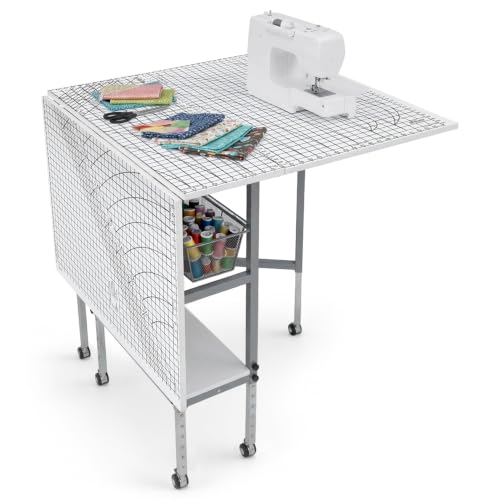
| Occasional sewing in a small room | Folding or drop-leaf table | Fast setup, compact storage, locking legs | 28–36 inches wide; folds to under 12 inches deep |
| Weekly garment sewing | Cabinet with machine lift | Ergonomic height, accessory storage, firm base | 36–48 inches wide; 20–24 inches deep |
| Frequent quilting | Large modular or quilting workstation | Support around the needle, extension area, cutting space | 48–60 inches wide; 24–30 inches deep |
| Heavy machine or multiple machines | Reinforced fixed cabinet | Weight capacity, low vibration, wide footprint | 75–150 lb supported load, depending on equipment |
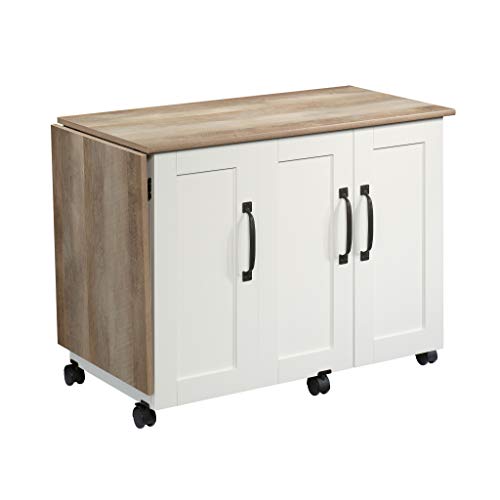
| Shared office, bedroom, or dining area | Rolling cabinet or compact folding station | Closed storage and maneuverable casters | At least 30-inch door clearance; 2-inch locking casters |
What Makes a Sewing Table Better Than an Ordinary Desk?
A regular desk can work for a lightweight machine, but a sewing-specific table solves several problems at once. Its surface may include a recessed platform or lift so the machine bed sits closer to the tabletop. This reduces the drop-off around the needle and gives fabric more consistent support, which is especially useful for quilting and large garments.
Our top picks


As an Amazon Associate we earn from qualifying purchases at no extra cost to you. Ratings are shown as listed on Amazon.
Sewing cabinets also put storage where it is needed: beside or below the machine rather than across the room. Useful capacity includes a drawer for presser feet and needles, a deeper compartment for fabric or thread, and a cable-management opening. Avoid confusing decorative storage with useful storage. A narrow drawer may look attractive but will not hold a rotary cutter, seam ripper, rulers, and spare bobbins together.
Best Sewing Tables by Design
Best all-around: a height-adjustable machine-lift table
This is the strongest choice for a dedicated sewing room. The lift lets you sew with the machine level with the work surface or raised for free-arm work. Height adjustment is valuable because the correct position depends on your chair, machine height, and whether you sew standing or seated.
Look at established sewing-furniture brands such as Horn, Arrow, and Kangaroo Kabinets for this category. Their product lines include cabinets and modular stations designed around domestic sewing machines. Compare the actual lift opening with your machine’s base, not just the advertised machine-size category. A modern embroidery machine can be much taller and deeper than a standard mechanical machine.
Best for small rooms: a folding sewing table
A folding table earns its place when the room serves several purposes. Models in this category commonly provide a 28- to 36-inch central work area and fold down to roughly 10–14 inches deep. Some include shelves or a machine platform; others are essentially sturdy folding desks.
Arrow’s Gidget-style portable sewing tables are a recognizable example of this design. Their appeal is not maximum storage but a relatively quick transition from sewing station to stored furniture. Before buying, measure the folded table, the machine’s carrying case, and the route between storage and the sewing area. A table that fits beside a closet may still be impractical if it cannot pass through the doorway.
Best for quilting: a large modular workstation
Quilting benefits from support on both sides of the needle. A 48-inch table can be adequate for many projects, but a 60-inch surface is more comfortable for bulky quilts, especially when paired with a side extension. Modular systems are useful because you can add a cutting table or side unit later instead of buying the largest configuration immediately.
Stability matters more than a glossy finish here. A wide cabinet with a solid back and adjustable levelers will usually control vibration better than a lightweight table on narrow legs. If the table has casters, make sure at least two lock securely and that the frame does not flex when you press fabric across it.
Key Buying Criteria
Work-surface size
Measure the machine’s width and depth, then add clearance. A practical minimum is 4 inches of free space on each side and 6 inches behind the machine for cables and ventilation. For example, a machine measuring 20 by 9 inches needs at least a 28-by-15-inch platform before adding space for fabric handling. That is a machine fit, not a comfortable sewing area; a 36-by-20-inch or larger top is more usable.
Quilters should think about fabric support rather than tabletop dimensions alone. A machine centered on a small surface may technically fit but allow the quilt to pull against the needle. Side leaves or a separate extension can be more useful than a deeper cabinet.
Machine storage and lift compatibility
A lift should move smoothly without forcing the machine sideways. Check three measurements: the opening’s length and width, the lift’s maximum load, and the clearance beneath the table when the machine is lowered. Include the machine’s hard case, power supply, foot controller, embroidery unit, and extension table in your storage plan.
A cabinet with a lift is not automatically compatible with every machine. Heavy embroidery machines may exceed the intended load or require more vertical clearance than the cabinet provides. When specifications are unclear, choose an open platform rather than guessing.
Adjustable height
For seated sewing, begin with the tabletop approximately level with your bent elbow while your shoulders remain relaxed. The exact position depends on chair height and machine design, so a useful table may offer several inches of adjustment rather than one fixed height.
Do not raise the table so far that your wrists bend upward toward the machine. If your chair cannot adjust, a lower table or a stable footrest may be more effective than purchasing a highly adjustable workstation.
Folding design and stability
Folding legs save space but introduce more joints, and joints are potential sources of movement. Inspect the locking mechanism, hinge thickness, and contact points between the legs and floor. A table that rocks during a straight stitch will be more frustrating than a slightly larger fixed table.
For a portable station, put a thin non-slip mat beneath the machine and lock the table before sewing. Do not use an unlocked rolling cabinet as a substitute for a fixed workstation.
Assembly and ownership
Cabinet-style sewing tables often require more assembly than their compact appearance suggests. Allow two adults for heavy panels and check that the package includes the correct screws, cam locks, hinges, and lift hardware. Assemble on a protected floor, square the cabinet before tightening every fastener, and recheck the lift after the first few sewing sessions.
The parts most likely to need attention are caster locks, folding hinges, lift springs, drawer runners, and particleboard edges exposed to moisture. Keep the table dry, avoid dragging it when loaded, and periodically tighten hardware. Vacuum lint from the lift cavity and storage compartments; loose lint can accumulate around hinges and cables.
How Much Table Do You Actually Need?
Use this simple room-fit calculation before shopping. Measure the available wall or floor width, then reserve at least 24 inches for the chair behind the table and 30 inches for a comfortable walkway in front or beside it. A 48-inch table therefore needs approximately 72 inches of clear depth if the chair sits directly behind it and someone must pass behind the chair.
For a compact room with 84 inches of usable wall width, a 36-inch table leaves 48 inches for a cutting cart, shelving, or clearance. A 60-inch workstation leaves only 24 inches, which may look efficient on paper but can make drawers and chair movement difficult. In a tight room, the smaller station may produce more usable sewing time because it does not require constant rearrangement.
Which Materials and Features Are Worth Paying For?
- Best value: laminated engineered wood with a thick, sealed top and a rigid frame.
- Best for vibration control: heavy cabinet construction with a full back or reinforced crossbar.
- Best for frequent moving: locking casters with metal mounting plates, not small decorative wheels.
- Best for accessibility: drawers that open fully and shelves that do not require lifting the machine.
- Best for long projects: removable side extensions or matching modular units.
Solid wood is not automatically superior. A well-braced laminated cabinet can be flatter, easier to clean, and less expensive than solid timber. The important factors are frame rigidity, edge sealing, hardware quality, and whether the surface remains level under the machine’s weight.
Final Recommendation
Choose a folding table if you sew occasionally and must reclaim the room after each session. Choose a cabinet with a compatible lift if you sew weekly and want the best balance of posture, storage, and organization. Choose a wide modular workstation if quilting or embroidery is a frequent activity and fabric support matters more than compact storage. Whichever design you select, prioritize dimensions, weight support, and stability before finishes or built-in extras—the table should make the machine easier to use, not merely easier to store.



Write Your Review
No reviews yet. Be the first to share your experience!