

Key takeaways
- Keep the tops for vocals, mids and high frequencies; add a compatible powered sub for low frequencies.
- Use the sub’s crossover or the system’s recommended DSP settings rather than sending full-range bass to every cabinet.
- Place the sub near the center front when practical. This often gives more consistent bass across the room than splitting two subs far apart.
- Set levels with a familiar track, then leave headroom for louder passages. If the sub’s limiter is working constantly, reduce the level or reassess the system.
Best DJ Speakers for Parties, Gigs and Home Setups
The best DJ speakers are powered speakers sized to your room and audience: a pair of 8- or 10-inch models suits home practice and small gatherings, while 12-inch speakers are a versatile choice for mobile gigs; for larger crowds or bass-heavy music, add a subwoofer rather than pushing tops into distortion.
Wattage alone doesn’t tell you how loud or clean a speaker will sound. Amplifier ratings are not standardized across every brand, and a bigger number does not guarantee more usable volume. Compare maximum SPL, frequency response, weight and connections where possible, then match them to the venue. The options below are established product lines; check the exact model’s current specifications before buying, as features can vary by generation.
Our top picks
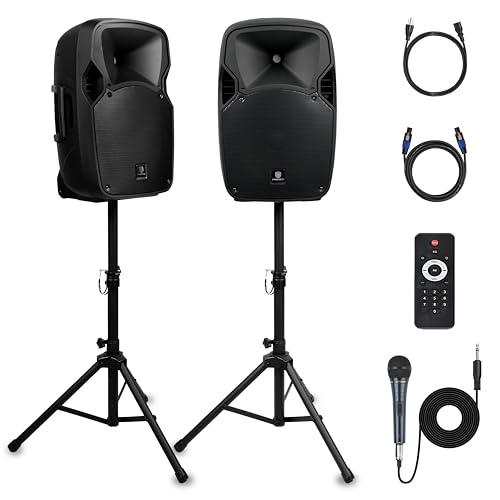


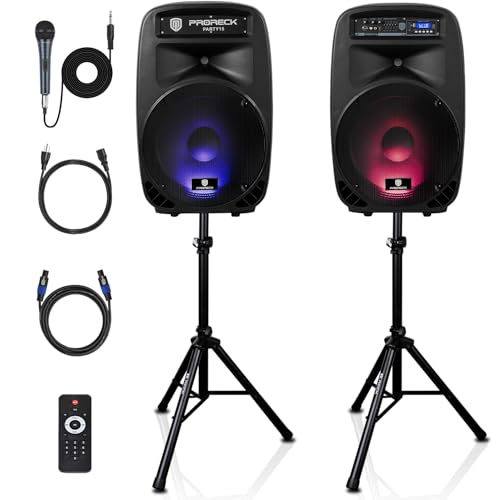
As an Amazon Associate we earn from qualifying purchases at no extra cost to you. Ratings are shown as listed on Amazon.
Quick comparison: speaker size and role
| Example model | Woofer | Published weight, approximately | Best fit |
|---|---|---|---|
| Yamaha DBR10 | 10 inches | 10.5 kg / 23 lb | Home setups, small rooms and portable monitors |
| Electro-Voice ZLX-12P | 12 inches | 15.6 kg / 34 lb | Mobile DJs and small-to-medium events |
| QSC K12.2 | 12 inches | 17.7 kg / 39 lb | Frequent gigs where flexible input and DSP options matter |
| JBL EON715 | 15 inches | 16.9 kg / 37 lb | One-box-per-side setups needing more low-mid output |
Weights are rounded manufacturer-published figures for the named models, without stands or cases. A 15-inch top can provide fuller low end than a smaller top, but it is not a substitute for a dedicated subwoofer when the set depends on strong, deep bass.
Choose by situation, not by the biggest number
| Your situation | Practical starting point | Why |
|---|---|---|
| Bedroom or apartment practice | One 8- or 10-inch powered speaker, or a compact pair | Lower output is easier to manage in a small room; stereo placement can matter more than extra bass. |
| Small house party, roughly 20–40 people | Pair of 10- or 12-inch powered tops | Stereo coverage helps distribute sound, while moderate speaker size stays manageable. |
| Regular mobile gigs, roughly 40–100 people | Pair of 12-inch tops; consider a sub for dance music | More headroom helps keep peaks clean. Audience size is only a guide—room shape, music and permitted level change the demand. |
| Large room or outdoor event | 12-inch tops with suitable subwoofers, or a properly designed PA | Open air and long distances reduce bass impact and demand more coverage. A larger system or rental may be safer than overdriving small tops. |
These are starting points, not promises of audience capacity. A crowded room absorbs sound, while an outdoor setup has no walls to reinforce bass. For a wide audience, speaker placement and coverage may matter more than adding a few hundred watts.
What to prioritize when comparing DJ speakers
Headroom and maximum SPL
Look for a published maximum SPL and compare it between models, while remembering that measurement methods can differ. Headroom means the speaker can reproduce short musical peaks without being driven constantly to its limit. A speaker clipping or limiting hard can sound harsh; turning up the mixer to compensate is not a fix.
Woofer size and bass expectations
Woofer diameter is a useful clue, not a complete bass specification. Cabinet design, tuning and processing also shape the sound. A 10-inch speaker can be a sensible choice for a small room, but deep kick and sub-bass at party levels usually call for a subwoofer. Crossing the tops and sub over at the manufacturer’s recommended setting lets each do a more suitable job.
Inputs, controls and portability
Check that the speaker accepts the outputs from your controller or mixer. Many powered PA speakers offer balanced XLR inputs; some also include combo jacks, Bluetooth or onboard mixing. Bluetooth can be convenient for casual playback, but wired connections are preferable for a dependable DJ signal. Consider handles, pole mounts, protective covers and whether you can lift the speaker safely without help.
Worked setup: estimate whether a subwoofer is worth it
Suppose you DJ a 50-person indoor party once a month and already own a pair of 12-inch tops. If the speakers sound clear at your usual level but lack the physical low end you want, a subwoofer may be a more useful upgrade than replacing the tops with larger ones.
- Keep the tops for vocals, mids and high frequencies; add a compatible powered sub for low frequencies.
- Use the sub’s crossover or the system’s recommended DSP settings rather than sending full-range bass to every cabinet.
- Place the sub near the center front when practical. This often gives more consistent bass across the room than splitting two subs far apart.
- Set levels with a familiar track, then leave headroom for louder passages. If the sub’s limiter is working constantly, reduce the level or reassess the system.
This is a system-matching example, not a guaranteed coverage formula: room dimensions, placement and local sound limits all affect the result.
Budget and ownership trade-offs
As broad market ranges, compact powered PA speakers commonly sit around $200–$500 each, capable midrange models around $400–$900, and premium touring-oriented tops often cost $800–$1,500 or more. Powered subwoofers can add several hundred dollars to well over $1,000. Prices vary by region and model; leave room in the budget for stands, cables, covers and transport.
For occasional home use, a lower-cost speaker with the right inputs and enough clean output may be the better buy. A working DJ who loads in weekly should weigh repair support, warranty terms, cabinet protection and weight more heavily. A light speaker that is easy to carry may get used more often; a heavy unit that needs a second person can make every gig harder.
Keep speakers sounding clean over time
- Transport powered speakers in padded covers or cases. Handles, grille edges and connectors are common points of wear during repeated load-ins.
- Keep drinks away from cabinets and connectors, and let equipment dry fully before powering it if it gets damp.
- Check cables and plugs periodically; intermittent connections can resemble speaker faults.
- Keep ventilation openings clear and avoid stacking gear where it blocks cooling.
- Don’t treat a limiter light as a normal operating target. Reduce the mixer or speaker level when it stays on, and avoid boosting bass excessively with EQ.
Bottom line
For home practice and small rooms, start with a compact 8- or 10-inch powered speaker. For the most flexible mobile-DJ setup, a matched pair of 12-inch tops is a strong starting point. Choose 15-inch tops when you want more low-mid output in a simple system, but choose a subwoofer when deep bass at party volume is the priority. The right best DJ speakers are the ones that cover your actual venues cleanly, connect to your gear, and are practical to transport—not simply the ones with the largest wattage claim.



Write Your Review
No reviews yet. Be the first to share your experience!