

Key takeaways
- Walk into any spare-room studio and the audio interface is the quiet box at the center of the desk: microphone cables go in one side.
Walk into any spare-room studio and the audio interface is the quiet box at the center of the desk: microphone cables go in one side, monitor speakers and headphones come off the other, and the computer sits behind it all. Choosing among the best audio interfaces for home studios is less about chasing spec-sheet bragging rights and more about deciding how many things must be plugged in at the same time, and how smoothly the box will fit into a room that also has to be a bedroom, an office, or a garage corner.
The eight models reviewed here start with compact single-input boxes and climb to two-input models and bundles with a microphone. They suit songwriters, home producers, voice-over artists, and small-project engineers who record one or two sources at a time. Judgments are drawn from the product titles, so details such as driver support and included software need confirmation on the listing before checkout. In 2026 most of these connect over USB-C, which keeps cabling simple.
Quick Picks
Our top picks






As an Amazon Associate we earn from qualifying purchases at no extra cost to you.
| Product | Best for | Key spec from the title |
|---|---|---|
| Focusrite Scarlett 2i2 4th Gen | Main interface for a growing studio | 2 mic preamps, 2 Hi-Z inputs, Auto Gain, Clip Safe |
| Focusrite Scarlett 2i2 Studio 4th Gen | Starting a studio from scratch | Bundle with CM25 MkIII mic, 2 preamps, 2 Hi-Z inputs |
| Focusrite Scarlett Solo 4th Gen | Solo vocalist or guitarist | 1 XLR preamp, 1 Hi-Z, 120dB dynamic range |
| Focusrite Scarlett Solo Studio 4th Gen | Single-source bundle | Includes CM25 MkIII mic, 1 preamp, 1 Hi-Z |
| Silver USB-C Interface (XLR/6.35mm) | Compact desk setups | Line in/Hi-Z switching, 3 monitoring modes, 24bit/48kHz |
| Purple USB-C Interface (Dual XLR) | Two-microphone work | Dual XLR, 3 monitoring modes, 24bit/48kHz, 48V phantom |
| Jolgoo 2×2 USB Interface | Phantom-powered condenser recording | 24-Bit/192kHz, +48V phantom, low latency |
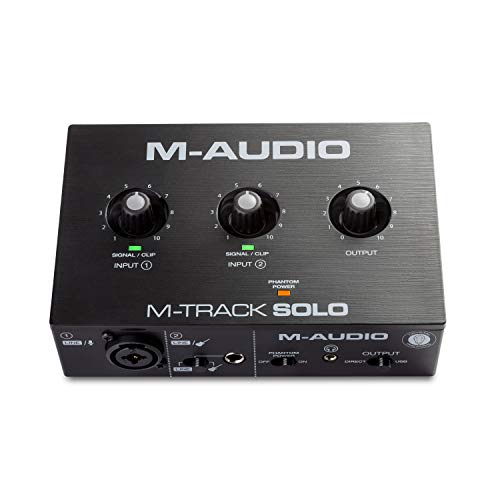
| M-Audio M-Track Solo | Software-included single input | XLR, line, and DI inputs |
How to Choose
Plan the signal chain on paper first
Sketch the studio: microphone, interface, computer, monitors, headphones. Count how many sources must be live at once. A producer working with a single vocal and a MIDI keyboard needs one microphone input. A band member tracking guitar and vocals together needs two. Remember that outputs matter too: a pair of studio monitors needs a stereo output, and titles that mention 2×2 describe two inputs and two outputs, the common minimum for a home setup.
Preamps, gain, and phantom power
Preamp quality is what the microphone feeds first. Spec lines like 120dB dynamic range describe the noise floor on paper, while Auto Gain and Clip Safe features on the Scarlett 4th Gen are designed to ease level setting. Condenser microphones need 48V phantom power, listed for the Jolgoo and the purple dual-XLR interface. Dynamic microphones used for loud sources may need extra gain, so look at the stated gain range when it is provided.
Sample rate, monitoring modes, and latency
Home studios rarely need more than 24-bit recording at a standard sample rate. The 24bit/48kHz spec on the unbranded USB-C boxes is adequate for songwriting and voice work; 192kHz appears on other titles but is not a deciding factor for most users. What matters more is low-latency monitoring, so a performer hears the signal without delay. The three monitoring modes on the silver and purple listings point to flexible direct monitoring, though buyers should read the manual links.
Bundles, brands, and long-term support
Brand-name interfaces tend to offer driver updates, software bundles, and widely shared setup tutorials, which saves time when something does not work. Unbranded boxes can be cheaper and are fine for simple jobs, but expect thinner documentation. Bundles with a microphone and cables are convenient, though a mic that ships with a bundle is frequently the first thing owners upgrade. Confirm that included items, such as headphones or cables, actually appear in the listing and not just the title.
Physical layout matters too, because a home studio interface lives within arm’s reach, so check the physical layout before buying. Front-panel gain knobs are easier to ride during a take than rear-panel controls, and a headphone jack on the side or front avoids a cable dangling across the keyboard. Leave room for XLR cables to bend without strain, keep USB cables away from power adapters to limit hum, and place monitors so they form an equilateral triangle with the listening position. None of this shows up in a title, but it affects daily use more than most numbers. Spending ten minutes with a tape measure and a sketch of the desk often prevents a return, and it helps to confirm that the box sits level and that the knobs are not hidden behind a monitor stand or a laptop screen.
The 8 Best Options
Focusrite Scarlett 2i2 4th Gen
Two microphone preamps, two Hi-Z instrument inputs, 24-bit/192kHz, Auto Gain, Clip Safe, and Air Modes make this the do-everything interface of the group. It is meant for a home studio that tracks vocals and guitar at the same time or records two voices. The brand pedigree and compact size make it a common first purchase for serious hobbyists.
- Strength: Two preamps cover most solo and duo recording sessions.
- Strength: Auto Gain and Clip Safe are designed to simplify level setting.
- Trade-off: Only two inputs, so full drum kits or band tracking need a larger interface.
Skip it if a single microphone is all the studio will ever need.
Focusrite Scarlett 2i2 Studio 4th Gen Bundle
The bundle pairs the 2i2 4th Gen with a CM25 MkIII microphone and additional accessories noted on the listing. It fits a first studio where nothing is owned yet. The interface stays the same as the standalone 2i2, with two preamps and two Hi-Z inputs.
- Strength: Everything needed for a first recording arrives together.
- Strength: The interface itself has two inputs, leaving room to add a second microphone.
- Trade-off: The included microphone may not suit every voice or instrument.
Skip it if quality microphones are already in the studio, since the standalone 2i2 costs less.
Focusrite Scarlett Solo 4th Gen
One XLR preamp, one Hi-Z input, 24-bit/192kHz, a 120dB dynamic range, and Air Modes. A good match for a singer-songwriter or a voice-over artist working alone in a small room, with the older Solo 3rd Gen listed alongside as a slightly earlier option with a 56dB gain range.
- Strength: Small enough for a crowded desk or a travel bag.
- Strength: Instrument and microphone inputs both present.
- Trade-off: Single-input design limits collaboration.
Skip it if guests or a second instrument are likely to join sessions.
Focusrite Scarlett Solo Studio 4th Gen Bundle
The Solo version of the bundle packs the one-input interface with a CM25 MkIII microphone. It is the entry ticket for a person who has a laptop and nothing else, aiming to record vocals or acoustic guitar with minimal fuss.
- Strength: Microphone included, simplifying the first purchase.
- Strength: Same interface features as the Solo 4th Gen.
- Trade-off: Outgrown quickly if a second input becomes necessary.
Skip it if two simultaneous inputs are expected within the year.
Silver USB-C Interface with XLR/6.35mm Jacks
An unbranded USB-C audio interface that lists XLR and 6.35mm jacks, line in and Hi-Z switching, three monitoring modes, and 24bit/48kHz resolution. It aims at the budget-minded home recorder who wants the basic features without a big name attached.
- Strength: Line/Hi-Z switching lets one input handle guitar or keyboard.
- Strength: Three monitoring modes allow flexible headphone setups.
- Trade-off: Limited brand support and no named software package in the title.
Skip it if driver updates and a large support community matter.
Purple USB-C Interface with Dual XLR
Same family of features as the silver unit, but with dual XLR inputs, line in and Hi-Z switching, three monitoring modes, 24bit/48kHz, and 48V phantom power. It makes sense for two-person recording on a smaller budget.
- Strength: Two XLR inputs plus phantom power cover condenser microphone pairs.
- Strength: Compact desktop form with USB-C connectivity.
- Trade-off: Sample rate tops out at 48kHz in the title, which is fine for most work but lower than some rivals.
Skip it if documentation and brand support are priorities.
Jolgoo 2×2 USB Audio Interface
A 2×2 interface that lists 24-Bit/192kHz resolution, +48V phantom power, and low latency for recording. It targets home recorders who want a condenser-friendly box without paying for a recognized brand name.
- Strength: 2×2 layout offers two inputs and two outputs.
- Strength: Phantom power is stated in the title.
- Trade-off: The title is short on details about included software and support.
Skip it if guaranteed driver updates are a requirement.
M-Audio M-Track Solo
One of the simpler options, with XLR, line, and DI inputs and a professional software suite for recording, streaming, and podcasting. It is a practical starting point for a single-source home studio that also needs a bit of streaming capability.
- Strength: Software suite included, so the first session needs nothing extra.
- Strength: Three input types give routing flexibility.
- Trade-off: No dynamic range or gain figures in the title.
Skip it if the studio needs two microphone inputs.
Which One Fits Your Situation
A producer who tracks vocals and guitar at once
The Focusrite Scarlett 2i2 4th Gen offers two preamps and two Hi-Z inputs, ready for both sources simultaneously.
A complete beginner with no microphone
The Focusrite Scarlett Solo Studio 4th Gen or the 2i2 Studio bundle includes a CM25 MkIII mic in the box, depending on whether one or two inputs are needed.
A tight budget with a condenser microphone already owned
The Jolgoo 2×2 or the purple dual-XLR interface provides phantom power at a modest cost, with the caveat of thinner support.
A streamer who also records the occasional song
The M-Audio M-Track Solo brings a software suite aimed at streaming and podcasting alongside basic recording.
Common Mistakes
- Placing the interface behind the computer, which makes gain and monitoring knobs hard to reach during a take.
- Buying a single-input unit for a project that clearly needs two microphones.
- Assuming 192kHz means better results, when well-recorded 48kHz audio is fine for most home projects.
- Ignoring headphone output quality, then struggling to judge the mix.
- Forgetting cables, stands, and pop filters in the overall budget.
Related guides
- Bluetooth Turntables For Vinyl Beginners
- Condenser Microphones For Home Studios
- Audio Interfaces For Beginners
Frequently Asked Questions
How many inputs does a home studio need?
Most solo producers get by with one or two. Count how many sources are played or sung at the same time, then add one more only if the plan includes frequent collaboration.
Do bundles save money?
They often cost less than buying each part individually, and they reduce compatibility guesswork. The included microphone is typically entry-level, so people who already own one should skip the bundle.
Is USB-C required?
Not strictly, but modern laptops commonly use it, and it keeps cabling tidy. Check the listing for the exact connector and whether a cable is included.
Can an interface power condenser microphones?
Interfaces that list 48V phantom power can. Dynamic microphones do not need it, and some ribbon microphones can be damaged by it, so read the microphone manual before switching it on.
More from Amazon
Programs that pair well with the guide above. Offers and eligibility are set by Amazon and may change.
Free shipping on eligible items, Prime Video and more. Eligible new members can start with a free trial.
Start a Prime free trialAudiobooks and podcasts to listen to on the go. Eligible new members can start with a free trial.
Try Audible freeAd-free music streaming. Eligible new subscribers can start with a free trial.
Try Music Unlimited freeA free business account with business pricing and bulk-buying tools for work, shop or home office.
Create a business accountAs an Amazon Associate we earn from qualifying purchases.
Write Your Review
No reviews yet. Be the first to share your experience!