

Key takeaways
- A condenser microphone is usually the first serious upgrade a home recordist makes, and the first surprise is how much of the room it hears.
A condenser microphone is usually the first serious upgrade a home recordist makes, and the first surprise is how much of the room it hears. Where a dynamic microphone ignores a noisy fan and a tiled wall, a condenser picks up every detail, including the parts of the room that were never meant to be on tape. For that reason, the question behind “best condenser microphones for home studios” is not only which microphone sounds richest but also which connection, which stand, and which accessories fit the space and the gear on hand.
This guide is for singers, voice-over artists, podcasters, and home producers choosing a first or second microphone. Eight options are compared from the listed specs, covering XLR models that need an audio interface and USB or hybrid models that plug straight into a computer. Two isolation-shield accessories that surfaced in the feed were left out because they are add-ons, not microphones. Titles drive every judgment, so confirm accessories, cable lengths, and compatibility on the listing before buying in 2026.
Quick Picks
Our top picks





As an Amazon Associate we earn from qualifying purchases at no extra cost to you.
| Product | Best for | Key spec from the title |
|---|---|---|
| FIFINE K669C | XLR starters with an interface | Cardioid condenser, metal build, tripod stand, XLR |
| FIFINE T669 | Plug-in USB recording kit | USB, adjustable boom arm stand, shock mount |
| RODE NT1 5th Gen | Flexible studio mic for XLR or USB-C | XLR + USB-C, ultra-low noise capsule, shock mount, pop filter |
| Mackie EM-91C | Simple large-diaphragm vocal recording | Large-diaphragm condenser microphone |
| MAONO PM320S | Desk streaming with a boom arm | XLR cable, boom arm, pop filter |
| MAONO A04 Gen2 | Choosing XLR or USB later | XLR/USB, 192kHz/24Bit, cardioid, metal, software |
| SUUNTOK XLR Condenser | Podcast and streaming kit | Cardioid, XLR, mic kit for PC, ASMR, YouTube |
| Dejasound Studio Mic | Untreated rooms needing extra isolation | Isolation shield and pop filter included |
How to Choose
XLR, USB, or both
XLR condenser microphones need an audio interface or mixer that supplies 48V phantom power. They are the long-term choice because the interface can be upgraded independently. USB models, like the FIFINE T669, plug directly into a computer, which keeps cost and cable clutter down. Hybrid models such as the RODE NT1 5th Gen and MAONO A04 Gen2 list both connection types, allowing a start with USB and a later move to an interface. Check what is in the box, since a USB-C or XLR cable is not always included.
Pickup pattern and room noise
Most home studio condensers use a cardioid pattern, which favors sound from the front and rejects some from the sides and rear. That helps in a bedroom or office but does not eliminate reflections. Placing the microphone away from bare walls, using a reflection shield or blankets, and recording close to the capsule all matter more than small differences in microphone models. The Dejasound listing, with an included isolation shield, aims at exactly this issue, though a shield is no substitute for a quiet room.
Capsule, noise floor, and sample rate
Large-diaphragm condensers are popular for vocals because they capture detail and warmth. The RODE title mentions an ultra-low noise capsule, and the Mackie title names a large-diaphragm design. USB listings sometimes advertise 192kHz and 24-bit resolution, as the MAONO A04 does, but sample rate alone does not define quality. Self-noise, capsule design, and the preamp that follows matter more. Treat headline numbers as a starting point and look for details on noise levels where provided.
Accessories and where budget kits cut corners
Many kits add a shock mount, pop filter, boom arm, or tripod, as noted across these titles. Those extras are useful, but cheap stands can droop, and cheap shock mounts can rattle. Budget microphones often cut corners on build quality, internal electronics, and quality control, so expect some unit-to-unit variation. Pop filters and boom arms are inexpensive to replace if they disappoint, which makes bundles a low-risk way to start.
The 8 Best Options
FIFINE K669C XLR Condenser Microphone
A cardioid condenser with a metal build, tripod stand, and XLR connection, positioned for home studio recording with an audio interface or mixer. It is for buyers who already own or plan to buy an interface and want a simple, wired microphone to start.
- Strength: Metal build and cardioid pattern are stated in the title.
- Strength: Includes a tripod stand for immediate desktop use.
- Trade-off: Requires an interface with phantom power, which is an added purchase.
The tripod stand sits on a desk, though a boom arm or a floor stand can be added later to move the microphone closer to the mouth and away from keyboard noise. It is a logical first XLR microphone for vocals and podcasts. Skip it if there is no interface and the goal is plug-and-play USB recording.
FIFINE T669 USB Condenser Microphone Kit
A studio condenser USB microphone for recording and podcasting, packaged with an adjustable boom arm stand and shock mount. It is for people who want to plug a microphone into a laptop and start talking or singing right away.
- Strength: Boom arm and shock mount are part of the kit.
- Strength: USB connection removes the need for an interface.
- Trade-off: USB-only means limited upgrade paths compared with XLR.
Because everything arrives in one kit, setup is mostly a matter of mounting the microphone and choosing it as the input in the recording software. It suits voice-over beginners and streamers. Skip it if future growth toward a full interface-based setup is likely.
RODE NT1 5th Gen
A studio condenser microphone with both XLR and USB-C outputs, an ultra-low noise capsule, shock mount, pop filter, and both cables included in silver. It targets serious home recordists who want a flexible, long-term microphone that can change with the setup.
- Strength: Dual XLR and USB-C connectivity covers computer and interface use.
- Strength: Shock mount, pop filter, and cables come in the box.
- Trade-off: Likely the higher-cost choice in this group, so it asks for a bigger commitment.
Having a USB-C route means a first session can start without any extra hardware, while the XLR output keeps a door open to a better interface. It suits buyers who expect to keep one microphone for years. Skip it if budget is the top constraint.
Mackie EM-Series EM-91C
A large-diaphragm condenser microphone from Mackie’s EM series. The title is short, so details on accessories and connection should be verified, but the large-diaphragm design points to vocal and acoustic instrument recording.
- Strength: Large-diaphragm design is stated.
- Strength: Part of a named microphone series, which makes the model easy to research.
- Trade-off: The title offers no accessory list, so mounts and filters may be separate purchases.
A large-diaphragm microphone is typically placed a few inches from the singer, so a good pop filter and a sturdy stand are worth adding to the cart. It suits users who already own a stand and pop filter. Skip it if an all-in-one kit is wanted.
MAONO PM320S
A condenser PC microphone with an XLR cable, boom arm, and pop filter, compatible with audio interfaces and mixers, aimed at podcast and recording uses. The boom arm and pop filter make it a quick desk setup.
- Strength: Boom arm and pop filter included.
- Strength: XLR connection works with interfaces and mixers.
- Trade-off: Needs an interface, so USB-only users should look elsewhere.
A boom arm lets the microphone swing out of the way when not in use, which keeps the desk clear for notes and a keyboard. It suits podcasters with an interface. Skip it if direct computer connection is required.
MAONO A04 Gen2 XLR/USB Condenser Kit
A hybrid condenser kit with XLR and USB connections, 192kHz/24Bit resolution, a cardioid metal microphone, and software for PC podcast recording. The flexibility of two connections is the main selling point.
- Strength: Both XLR and USB connect to different setups.
- Strength: Metal cardioid microphone with included software is noted.
- Trade-off: Hybrid designs can bring compromises, so listing details should be read.
Included software, as noted in the title, can help with setup and level control, though its features should be reviewed on the listing. It suits creators who start on USB and may move to XLR later. Skip it if a single dedicated connection is preferred.
SUUNTOK XLR Condenser Microphone Kit
A cardioid XLR condenser kit for PC, home studio, podcast, streaming, ASMR, YouTube, and voice-over. It is described as a flexible all-purpose microphone with an accessory kit.
- Strength: Broad use cases are listed, from podcast to ASMR.
- Strength: Cardioid XLR design suits interface-based setups.
- Trade-off: Lesser-known brand, so support and quality should be researched.
The broad list of uses in the title, from ASMR to voice-over, suggests a general-purpose microphone, so expect to experiment with distance and angle to find a pleasant sound. It suits budget-minded creators with an interface. Skip it if a recognized brand is a priority.
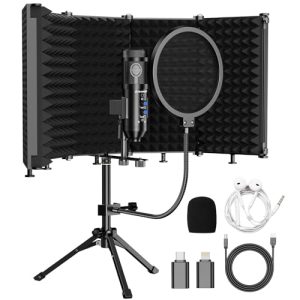
Dejasound Studio Recording Microphone
A music condenser microphone bundled with an isolation shield and pop filter, aimed at podcasting, singing, and home studio use. The shield is the distinguishing feature.
- Strength: Isolation shield and pop filter included.
- Strength: Positioned for singing and podcasting.
- Trade-off: Connection and other specs are not visible in the title.
Shields of this type surround the back and sides of the microphone, which reduces some reflected sound but also makes the setup bulkier on a small desk. It suits recording in untreated rooms as a partial fix. Skip it if the connection type must be confirmed from the title.
Which One Fits Your Situation
A podcaster with a laptop and no interface
The FIFINE T669 USB Kit includes a boom arm and shock mount, so one cable runs to the computer.
A singer building a long-term home studio
The RODE NT1 5th Gen offers XLR and USB-C, so it can grow with the setup.
A creator who owns a mixer or interface and wants a kit
The MAONO PM320S or the FIFINE K669C bundle XLR microphones with stands or arms.
A bedroom recorder fighting a noisy room
The Dejasound Studio Microphone pairs a condenser with an isolation shield, which can reduce some room sound.
Common Mistakes
- Buying an XLR condenser without an interface or phantom power.
- Recording in an echoey room and blaming the microphone.
- Speaking too far from the capsule, which raises room noise in the recording.
- Skipping a pop filter, leading to plosive bursts on p and b sounds.
- Choosing by sample rate headline numbers instead of capsule and noise performance.
Related guides
- Bluetooth Turntables For Vinyl Beginners
- Audio Interfaces For Home Studios
- Audio Interfaces For Beginners
Frequently Asked Questions
Is a condenser better than a dynamic microphone?
Not universally. Condensers capture more detail but also more room noise, while dynamic microphones are more forgiving in untreated spaces.
What is phantom power?
It is a 48V supply sent through the XLR cable by an interface or mixer to power condenser microphones. USB condensers do not need it.
Is a shock mount necessary?
It reduces vibration noise from the desk or stand. Several kits here include one, which is useful for sensitive microphones.
Is an isolation shield worth it?
It can reduce some reflections around the microphone, but it will not replace a quiet room. Treat it as a modest improvement.
More from Amazon
Programs that pair well with the guide above. Offers and eligibility are set by Amazon and may change.
Free shipping on eligible items, Prime Video and more. Eligible new members can start with a free trial.
Start a Prime free trialAudiobooks and podcasts to listen to on the go. Eligible new members can start with a free trial.
Try Audible freeAd-free music streaming. Eligible new subscribers can start with a free trial.
Try Music Unlimited freeA free business account with business pricing and bulk-buying tools for work, shop or home office.
Create a business accountAs an Amazon Associate we earn from qualifying purchases.
Write Your Review
No reviews yet. Be the first to share your experience!