

Key takeaways
- Up to 15 people indoors: 50–100 watts claimed output is commonly adequate.
- 15–30 people or a noisy living room: 100–200 watts gives useful headroom.
- 30 or more people, a hall or outdoor use: 200 watts and above, or two coordinated speakers, is more appropriate.
Best Karaoke Speakers for Powerful Party Sound
The best karaoke speakers for most home parties are portable party speakers with at least 100 watts of claimed output, a dedicated microphone input, adjustable vocal volume and enough battery for the full event; larger rooms benefit more from a 200-watt class speaker or two-speaker setup than from simply turning up a small unit.
The right choice depends on three competing factors: wattage for headroom, bass response for excitement without distortion, and portability for moving, storing and positioning the speaker. A bedroom karaoke speaker does not need the same output as a backyard system, while a very large battery speaker may be unnecessary if it will spend most of its life beside a television.
Our top picks


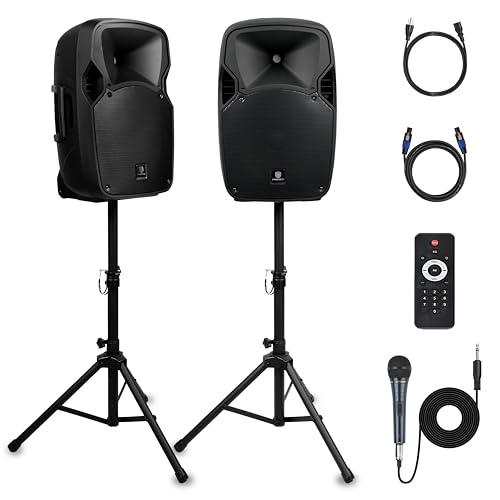

As an Amazon Associate we earn from qualifying purchases at no extra cost to you. Ratings are shown as listed on Amazon.
Quick Picks by Party Situation
| Situation | Best fit | Useful target | Why |
|---|---|---|---|
| Bedroom or small living room | Compact all-in-one karaoke speaker | 50–100 W claimed output, 6–10 kg | Enough volume without excessive bass or storage space |
| Family room or medium party | JBL PartyBox Club 120 | 160 W, about 11 kg, up to 12 hours | Good balance of volume, battery life and portability |
| Large indoor room or backyard | JBL PartyBox 320 | 240 W, about 18.5 kg, up to 18 hours | More headroom, larger drivers and wheels for transport |
| Very loud outdoor party | Soundboks 4 | 126 dB maximum stated output, about 16.1 kg | Built for high-output outdoor use and replaceable batteries |
| Premium small-event setup | Bose S1 Pro+ | About 6.5 kg, rechargeable battery, mixer inputs | More control over microphones and instruments than typical party speakers |
Wattage figures in this table are not directly comparable. Manufacturers use different amplifier ratings and measurement conditions, and maximum decibel figures do not describe sound quality. Use the numbers as a rough class indicator, then prioritize inputs, speaker size and placement.
Best Karaoke Speakers by Room Size
Small rooms: choose control over maximum volume
For a bedroom, office or compact living room, a 50–100 watt class speaker is usually sufficient. The bigger risk is not inadequate volume but excessive bass reflecting from walls and making vocals muddy. Look for a two-microphone input, microphone echo control, vocal volume adjustment and an easy way to connect a phone or television.
A compact party speaker is more convenient than a separate amplifier and passive speaker pair. It can sit on a sturdy table or stand, but do not place it directly in a corner: nearby walls reinforce low frequencies and can make sung words harder to understand. If the speaker includes bass and treble controls, reduce bass slightly before increasing volume.
Medium rooms: the practical sweet spot
The JBL PartyBox Club 120 is a strong middle-ground choice for family rooms, garages and moderate gatherings. Its stated 160-watt output, two-way design, microphone and guitar inputs, IPX4 splash resistance and claimed 12-hour battery place it comfortably above compact tabletop models without becoming difficult to move. Its roughly 11-kilogram weight is manageable for one adult, although it is not a speaker most people will carry long distances.
This class works well for roughly 15–30 people indoors, depending on room shape, background noise and how loudly guests expect to sing. A single speaker should face the audience, with the microphone user standing behind or to the side of it to reduce feedback.
Large rooms and outdoor use: buy headroom, not just loudness
For a large basement, hall or backyard, the JBL PartyBox 320 offers a meaningful step up. It is rated at 240 watts, weighs about 18.5 kilograms and claims up to 18 hours of battery life. Wheels and a telescoping handle matter here: once a speaker approaches 20 kilograms, carrying convenience becomes part of sound-system performance because it affects where you are willing to place it.
For outdoor parties where maximum output is the priority, Soundboks 4 is a different proposition. Its manufacturer states a maximum output of 126 dB, with a rugged enclosure and a replaceable battery system. It is heavier and less compact than a typical living-room party speaker, and its very high output is usually unnecessary indoors. It makes sense when the speaker must compete with open-air distance, wind or a noisy crowd.
Do not assume one loud speaker is always better than two. Two speakers placed apart can cover a wide audience more evenly at a lower level, but stereo pairing may introduce setup complexity and can create uneven sound if listeners stand close to only one unit.
Portability Versus Bass: the Trade-Off That Matters
Deep bass requires either a larger enclosure, a larger driver, substantial amplifier power or some combination of all three. Those ingredients add weight. A small speaker can sound punchy through electronic bass enhancement, but that processing may reduce battery life and cause compression at high volume.
For karaoke, bass should support the music rather than overpower the singer. A speaker with a 6.5-inch or larger woofer generally has more authority in a medium room than a tiny all-in-one unit, while a 10-inch class portable PA speaker can provide greater projection but may require a stand, mixer or separate microphone receiver.
Portability also includes battery behavior. A claim such as “up to 12 hours” normally assumes moderate volume and favorable content. Continuous loud karaoke can reduce runtime substantially. If a party needs six hours of singing, choose a speaker rated for at least 10–12 hours, or select a model with a replaceable battery or usable AC power mode.
Party Speaker or Portable PA?
| Feature | Party speaker | Portable PA speaker |
|---|---|---|
| Ease of setup | Usually plug in, pair a phone and connect microphones | May require gain, EQ and mixer adjustments |
| Music presentation | Often emphasizes bass and lighting | Usually prioritizes projection and vocal clarity |
| Microphone control | Basic echo and volume controls | More input, EQ and gain flexibility |
| Portability | Often includes a handle, wheels or both | Often lighter per watt but may need stands and cables |
| Best user | Casual home karaoke and parties | Performers, hosts and recurring events |
The Bose S1 Pro+ illustrates the portable PA approach. At about 6.5 kilograms, it is relatively easy to carry and provides a rechargeable battery, built-in mixing functions and microphone or instrument inputs. It is a better fit for a singer, acoustic performer or small host-led event than for someone seeking room-shaking bass and integrated party lighting.
How Much Output Do You Actually Need?
Use room size and crowd noise as practical guides rather than treating wattage as a guaranteed coverage rating:
- Up to 15 people indoors: 50–100 watts claimed output is commonly adequate.
- 15–30 people or a noisy living room: 100–200 watts gives useful headroom.
- 30 or more people, a hall or outdoor use: 200 watts and above, or two coordinated speakers, is more appropriate.
These are broad categories, not laboratory limits. A speaker with efficient drivers and good vocal tuning may sound louder and clearer than a higher-wattage model with aggressive bass processing. Avoid running any speaker at maximum volume continuously; vocals often become harsh before the music seems loud enough.
Setup Steps That Improve Karaoke Sound
- Place the speaker in front of the singers. The microphone should never point toward the speaker grille. This is the most effective way to prevent feedback.
- Raise the speaker toward ear level. A sturdy stand or stable platform helps vocals travel over seated guests instead of being absorbed by furniture.
- Set music volume first. Leave some headroom, then raise microphone volume until the singer is clear without shouting.
- Add only modest echo. Too much echo hides consonants and makes pitch harder to follow. Start near the minimum setting.
- Reduce bass if words sound muffled. Do this before increasing overall volume.
- Keep the phone or karaoke screen near the singer. Bluetooth range may be ample, but walls, crowded wireless environments and low battery can still interrupt playback.
Ownership Costs and Durability
The parts most likely to cause trouble are not usually the amplifier itself. Microphone cables, charging ports, battery capacity and grille or control-panel damage see the most abuse. Wireless microphones add convenience but introduce batteries and pairing issues; wired microphones are often the more dependable option for frequent use.
Keep drinks away from the top controls even when a speaker has splash resistance. IPX4 protection is designed for water splashes, not immersion, heavy rain or spilled liquid entering an open microphone socket. Wipe the grille and cabinet with a dry or slightly damp cloth, keep ventilation openings clear and store the speaker partly charged if the manufacturer recommends a storage level.
A simple cost-per-use check can clarify an expensive purchase. A $400 speaker used twice a month for three years provides 72 sessions, or about $5.56 per session before electricity and accessories. A $150 speaker used five times may cost $30 per use. If karaoke is a regular activity, replaceable batteries, stronger handles and readily available microphones can matter more than saving money at checkout.
Final Buying Advice
Choose a compact 50–100 watt class model for small rooms, the JBL PartyBox Club 120 for a balanced family-party option, the JBL PartyBox 320 when a larger room demands more headroom and easier transport, and Soundboks 4 when outdoor volume and battery replaceability are the priorities. Choose a portable PA such as the Bose S1 Pro+ when microphone control and vocal clarity matter more than bass-heavy party effects.
Before buying, confirm the number and type of microphone inputs, battery rating, charging method, splash protection and total carry weight. The best karaoke speaker is not the one with the biggest wattage printed on its box; it is the one that stays clear at the volume your room requires and is convenient enough to use every time people want to sing.

Write Your Review
No reviews yet. Be the first to share your experience!