
Key takeaways
- Looking for the best 6x8 door speakers 2 picks? We compare three 6x8-inch coaxial models on power, impedance and fit so the upgrade drops into your doors.
Many cars and trucks ship with 6×8-inch oval speakers in the doors, and the factory units are usually the first thing to wear out. The real decision is not which speaker has the highest peak number, but which one matches the oval opening, works with the power the car already makes, and keeps its sound clean when the volume climbs. An oval speaker that does not match the opening will need an adapter, and a low-impedance model can draw more from the radio than the radio is built to give. Check the numbers first.

This guide is for drivers replacing worn 6×8-inch door speakers, for owners who want a straight swap without cutting metal, and for anyone comparing coaxial designs before ordering. It suits readers running a factory head unit and readers planning a small amplifier later. The three speakers below come from the names and specifications on their Amazon product pages, so every claim in this guide can be checked against the listing. Read on.
Quick Picks
As an Amazon Associate we earn from qualifying purchases
| Product | Best for | Key spec from title |
|---|---|---|
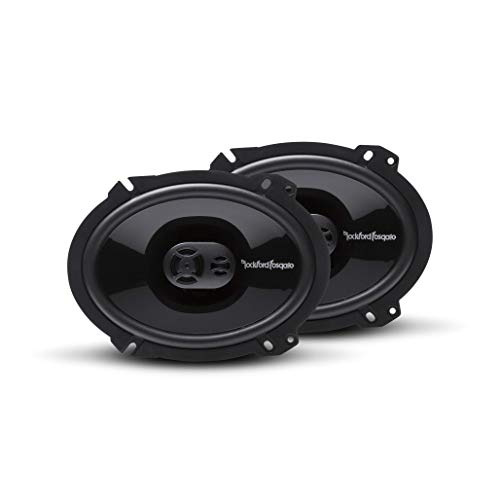
| Rockford Fosgate P1683 | Full-range sound with easy fit | 65-watt RMS, 3-way coaxial, FlexFit basket |
| JBL Club 8622F | Deep bass from a low-impedance design | 60-watt RMS, 3-ohm, edge-driven silk tweeters |
| Kicker 43DSC6804 | Simple upgrade with strong efficiency | 50-watt RMS, 90 dB sensitivity, 45 Hz to 20 kHz |
How to Choose
Confirm the oval opening
A 6×8-inch speaker fits an oval opening, but not every car with an oval hole takes the same speaker. Check the opening dimensions and the mounting depth on the listing, and look for a FlexFit basket or an included adapter plate that helps the frame seat in different openings. Some cars need a thin adapter ring even when the size matches, so check the bracket before ordering. Measure the door with the panel off and compare the depth against the window track. An adapter plate can save a speaker that is close but not exact, and the Rockford in this guide includes one in the box.
Read RMS power and impedance together
Power handling and impedance work together, and both matter on a factory radio. The RMS figure is the power the speaker carries all day, every day, and the peak figure is the brief burst it can survive once in a while. A three-ohm speaker draws more power from the radio than a four-ohm one, which can mean more volume, but the radio must be built to handle the lower load. Read the RMS figure and the impedance together, and check the head unit manual when the impedance is below four ohms. A four-ohm speaker is the safe default when the manual says nothing about impedance, and it will play well on almost any radio.
Sensitivity and bass from a small oval
Sensitivity tells you how loud a speaker plays from a given amount of power, and on a factory radio that number carries real weight. A speaker rated at 90 dB or higher will play noticeably louder than a lower-rated one on the same head unit. Bass from a 6×8-inch oval depends on the cone and the surround: a polypropylene cone with a rubber surround keeps its shape at volume, while a stiff cone can sound thin. Check the frequency response on the listing to see how low the speaker reaches. An oval cone moves more air than a round one of the same width, so a 6×8 reaches lower than its size suggests.
Tweeter design and the sound in the cabin
Coaxial speakers mount the tweeter on the same frame as the woofer, and the tweeter design shapes the highs. A silk dome tweeter sounds smooth and easy to listen to, while a PEI dome tweeter adds sparkle and detail. A three-way design splits the sound further, which can widen the sound but also adds complexity. Listen for the character that suits the cabin: a car with hard plastic panels favours a smoother tweeter, while a soft-trimmed cabin suits a brighter one. A silk dome is the safe choice for a bright cabin, while a PEI dome suits a cabin with soft trim that absorbs the highs.
The 3 Best Options
Rockford Fosgate P1683
The P1683 is the pick for a driver who wants full-range sound with a fit that adapts to the door. Its three-way coaxial layout covers the highs, mids and lows from one frame, and the FlexFit basket helps it seat in different 6×8-inch openings. The injection-moulded mineral-filled polypropylene cone resists moisture inside the door, and the butyl rubber surround keeps its shape through heat and cold. Mounting hardware and an OEM adapter plate are included, so the swap is straightforward. The included adapter plate is the part that saves the install, since it lets the frame seat in openings that are close but not exact.
Specs
- 6 by 8 inch 3-way coaxial speaker
- 65 watts RMS power handling
- 130 watts maximum power handling
- 4-ohm impedance
- FlexFit basket
- PEI dome tweeter
- Injection-moulded mineral-filled polypropylene cone
- Butyl rubber surround
- Mounting hardware and OEM adapter plate included
- 1-year warranty
Best for: Drivers who want a full-range upgrade that fits a range of 6×8-inch doors.
Watch out for: The three-way layout adds height to the frame, so check the mounting depth against the window track.
JBL Club 8622F
The Club 8622F is the pick for a driver who wants deep bass from a factory radio. Its three-ohm impedance draws more power than a standard four-ohm speaker, and the edge-driven silk dome tweeters keep the highs smooth while the woofer handles the low end. The 60-watt RMS rating suits a factory head unit or a small amplifier, and the 180-watt peak figure gives headroom for loud passages. It is the speaker for a listener who feels the factory bass is thin and wants more weight without adding a subwoofer. The silk dome tweeters keep the top end smooth even at high volume, which matters in a small cabin.
Specs
- 6 by 8 inch 2-way coaxial speaker
- 60 watts RMS power handling
- 180 watts peak power handling
- 3-ohm impedance
- Edge-driven silk dome tweeters
- Polypropylene woofer cone
Best for: Drivers who want stronger bass and smoother highs from the factory radio.
Watch out for: A 3-ohm load suits most modern head units, but confirm the lowest impedance your radio accepts before you wire a second pair in.
Kicker 43DSC6804
The 43DSC6804 is the pick for a simple, efficient upgrade that plays loud on modest power. Its 90 dB sensitivity turns factory power into real volume, and the 50-watt RMS rating with a 200-watt peak gives it room to breathe. The polypropylene cone and soft dome tweeter keep the sound clean and balanced, and the wide frequency response from 45 Hz to 20 kHz covers the range most music needs. It is an easy fit for owners who want one speaker that does everything well. The 45 Hz low end is genuinely low for a door speaker, giving bass guitar and kick drum real weight without a subwoofer.
Specs
- 6 by 8 inch 2-way coaxial speaker
- 50 watts RMS power handling
- 200 watts maximum power handling
- Frequency response 45 Hz to 20 kHz
- 90 dB sensitivity
- 4-ohm impedance
- Polypropylene cone
- Soft dome tweeter
Best for: Owners who want an efficient, balanced upgrade on factory power.
Watch out for: The 200-watt peak figure is a burst rating, so judge the speaker by its 50-watt RMS figure for daily listening.
Which One Fits Your Situation
Stronger bass from the factory radio
If the factory sound feels thin in the low end, the JBL Club 8622F is the pick. Its low impedance draws more from the radio, and its woofer is built for bass weight. Set the bass near flat first and adjust by ear, since a low-impedance speaker can sound boomy in a small cabin. The JBL draws more power than a four-ohm speaker, so the volume jump is real.
A full-range upgrade for mixed listening
If the car plays everything from podcasts to rock, the Rockford Fosgate P1683 covers the range with its three-way layout. Its FlexFit basket and included adapter plate make the install easy, and its full-range sound suits long drives where one speaker must do it all. Its three-way layout covers podcasts, rock and calls without a weak spot, and the included adapter plate makes the install easy in most doors.
The simplest efficient swap
If the goal is a straightforward upgrade that plays loud on the power already there, the Kicker 43DSC6804 is the pick. Its high sensitivity and balanced sound suit a daily driver, and its four-ohm impedance works with almost any head unit without a compatibility check. It needs no compatibility check and no amplifier, just a straight swap in the factory opening, and it plays loud on the power already there.
A truck with oval speakers in every door
If the truck has 6×8-inch speakers in all four doors, buy two pairs of the same model, since matching speakers keep the sound even from front to back. Check the head unit minimum impedance before wiring two pairs of three-ohm speakers, and consider a four-ohm model if the manual is silent. Fit the fronts first, listen for a week, and only then change the rears.
Common Mistakes
- Buying a round speaker for an oval opening, then finding it needs an adapter or will not fit at all.
- Judging a speaker by its peak wattage instead of the RMS figure that governs daily listening.
- Fitting a 3-ohm speaker without checking the head unit minimum impedance first.
- Forgetting to measure the mounting depth, then finding the frame hits the window track when the glass rolls down.
- Expecting deep subwoofer bass from a door speaker, which is built for mid-bass and above.
Frequently Asked Questions
What cars use 6×8-inch door speakers?
Many Ford, Mazda and other vehicles use 6×8-inch oval speakers in the front and rear doors, but the exact fit varies by model and year. Check the opening dimensions and the mounting depth on the listing, and look for a FlexFit basket or adapter plate. A speaker that matches the size label may still need an adapter ring for a clean fit.
Is a 3-ohm speaker safe on a factory radio?
A 3-ohm speaker draws more power than a 4-ohm one, which can mean more volume, but the head unit must be built to handle the lower load. Most modern factory radios accept 3-ohm speakers, but check the manual for the minimum impedance before wiring two pairs together. If the manual is silent, a 4-ohm speaker is the safer choice.
What does RMS power mean on a car speaker?
RMS power is the amount of power a speaker can handle continuously, hour after hour, without damage. Peak power is a short burst it survives for a moment. Judge a speaker by its RMS figure for daily listening, and treat the peak figure as a footnote that describes headroom rather than normal use.
Do I need an amplifier for 6×8-inch speakers?
Not always. Speakers with high sensitivity and a low impedance play louder on a factory head unit than the speakers they replace. An amplifier adds headroom for high-RMS speakers and for listeners who want more control, yet a good swap on factory power already transforms the sound.
More from Amazon
Programs that pair well with the guide above. Offers and eligibility are set by Amazon and may change.
Free shipping on eligible items, Prime Video and more. Eligible new members can start with a free trial.
Start a Prime free trialAudiobooks and podcasts to listen to on the go. Eligible new members can start with a free trial.
Try Audible freeAd-free music streaming. Eligible new subscribers can start with a free trial.
Try Music Unlimited freeA free business account with business pricing and bulk-buying tools for work, shop or home office.
Create a business accountAs an Amazon Associate we earn from qualifying purchases.
Write Your Review
No reviews yet. Be the first to share your experience!