

Key takeaways
- Jaw opening: Look for 2 to 3 inches. This fits standard wire shelving (about 0.75 inch), IKEA-style wood shelves (0.6-1 inch), and desk edges (1-1.5 inches).
- Clamp style: Spring-loaded C-clamps with rubber pads grip better than twist-screw clamps, which loosen over time. Gooseneck lights exert leverage — a weak clip will droop within days.
- Surface protection: Silicone or rubber pads prevent denting soft wood and keep the light from rotating. If you use wire racks, choose a clip with a flat inner channel rather than a narrow point.
- Weight balance: A 12-inch bar light weighs less than a single-head bulb on a gooseneck. Single-head adjustable arms over 20 inches need a heavier clamp head or they will tip forward.
The best clip on grow lights for most indoor plants is a full-spectrum LED with a 15 to 24-inch gooseneck, a clamp that opens to at least 2 inches, PPFD of 150-300 μmol/m²/s at 12 inches, and built-in 8/12/16-hour timer with dimming — the Barrina T10 Vertical, Lordem Gooseneck, and GE Grow Light BR30 Clip styles cover most shelf and desk setups without the bulk of panel lights.
Our top picks
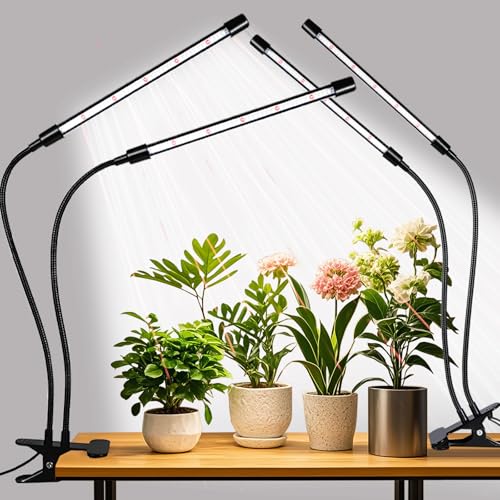

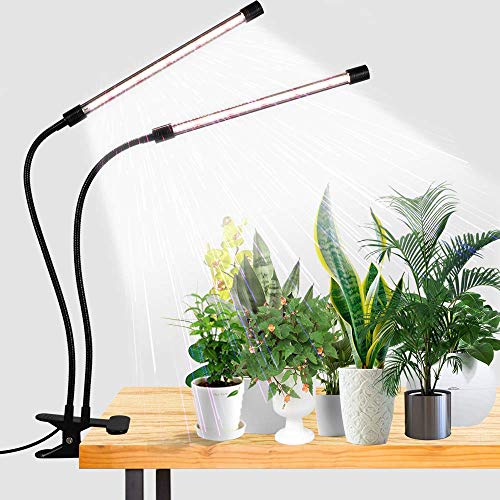

As an Amazon Associate we earn from qualifying purchases at no extra cost to you. Ratings are shown as listed on Amazon.
What Makes a Clip On Grow Light Actually Work
Clip on lights fail for two reasons: they don’t hold, or they don’t deliver usable light to the canopy. Ignore wattage claims and total lumens. For plants, the four specs that matter are clip mechanics, gooseneck geometry, photosynthetic photon flux density (PPFD), and timer reliability.
1. Clip Strength and Shelf Compatibility
A good clip needs three things: wide jaw opening, strong spring tension, and a non-slip liner. Many cheap clips open to only 1.25 inches and slip on wire shelves or thick particle board.
- Jaw opening: Look for 2 to 3 inches. This fits standard wire shelving (about 0.75 inch), IKEA-style wood shelves (0.6-1 inch), and desk edges (1-1.5 inches).
- Clamp style: Spring-loaded C-clamps with rubber pads grip better than twist-screw clamps, which loosen over time. Gooseneck lights exert leverage — a weak clip will droop within days.
- Surface protection: Silicone or rubber pads prevent denting soft wood and keep the light from rotating. If you use wire racks, choose a clip with a flat inner channel rather than a narrow point.
- Weight balance: A 12-inch bar light weighs less than a single-head bulb on a gooseneck. Single-head adjustable arms over 20 inches need a heavier clamp head or they will tip forward.
2. Gooseneck Reach and Coverage Pattern
Reach determines whether you can light a 12-inch herb pot or a 36-inch shelf tray without re-clamping. Most clip lights offer 13 to 26 inches of gooseneck.
- Under 15 inches: Best for single small pots on a desk or windowsill. Too short to arch over a shelf tier.
- 15 to 24 inches: The sweet spot for shelf growing. Lets you position the head 10-14 inches above the canopy and angle it to cover 12×12 to 18×18 inches.
- Over 24 inches / Dual or Triple Heads: Covers wider trays (24-36 inches) without adding a second light. Each head can be aimed separately, but the extra weight requires a stronger clamp and the cable management is bulkier.
- Flexibility vs. hold: Fully flexible silicone goosenecks are easy to aim but sag under heat. Metal interlocked goosenecks with internal memory wire hold position better for months.
3. PAR Output, Not Wattage
Wattage tells you power draw, not plant-usable light. PAR (photosynthetically active radiation) is measured as PPFD in μmol/m²/s. For clip on lights, sellers often list watt-equivalent numbers that are meaningless. Ask for PPFD at a stated distance.
- Low-light plants (pothos, snake plant, philodendron): 75-150 μmol/m²/s at leaf level
- Medium-light plants (herbs, peonies, pilea, begonias): 150-300 μmol/m²/s
- High-light plants (vegetables, succulents, flowering houseplants): 300-600+ μmol/m²/s — most single clip lights cannot sustain this without being 6-8 inches away
Full-spectrum white LEDs (3500K-5000K with added red) are easier to live with than blurple red/blue arrays and render leaf color accurately. Red/blue only lights can grow, but they distort how you see pests and deficiencies.
4. Timer and Dimming Modes
Manual on/off leads to inconsistent photoperiods, which stresses plants. A built-in timer is essential if you don’t want a separate outlet timer.
- Common presets: 8H / 12H / 16H. 12-14 hours is ideal for most tropical houseplants in winter. Seedlings often need 14-16 hours.
- Memory function: Better lights restart automatically at the same time daily after a power flicker. Without it, you have to reset the timer each time.
- Dimming: 3 to 10 levels or 10% to 100% stepless. Dimming lets you run closer for seedlings without burning, then increase for mature growth, and it reduces heat on shelves with low clearance.
Spec Comparison: Popular Clip On Types in 2026
Market ranges in 2026 put most quality clip on grow lights between $19 and $65. Bar-style and triple-head lights cost more than single-head goosenecks but cover more area per clamp.
| Type / Example Model Family | Jaw Opening | Gooseneck Reach | Power Draw | PPFD at 12″ (Center) | Coverage at 12″ Height | Timer / Dimming |
|---|---|---|---|---|---|---|
| Single-Head Bulb Gooseneck (GooingTop style) | 2.0 in (52mm) | 15 in | 12-15W | 180-220 μmol/m²/s | 10 x 10 in | 8/12/16H, 5 dim levels |
| Single-Bar Vertical (Barrina T10 style) | 2.5 in (64mm) | 19 in | 20-24W | 210-260 μmol/m²/s | 14 x 18 in (strip) | 8/12/16H, 10 dim levels |
| Dual-Head Gooseneck (Lordem style) | 2.3 in (58mm) | 18 in per head | 24-30W total | 150-190 per head | 18 x 14 in combined | 6/12/16H, 3 color modes, 5 dim |
| Triple-Head Halo / Ring (iPower, Lordem Trio) | 3.0 in (76mm) | 22-24 in per head | 30-36W total | 130-170 per head | 24 x 16 in combined | 4/8/12H, 6 dim, display |
| Bulb + Clip Adapter (GE BR30 Grow Bulb + clamp) | 2.1 in (54mm) | 16 in | 9-11W | 120-150 μmol/m²/s | 12 x 12 in | No built-in timer (needs outlet timer) |
Numbers are typical for white full-spectrum LEDs measured at center beam. Edge PPFD drops 40-60% from center, which is why bar lights cover shelves more evenly than round bulbs.
How Much Light Do You Actually Have? A Quick DLI Calculation
PPFD tells you instant intensity. DLI (daily light integral) tells you total light per day — what plants use to grow. You can estimate DLI without a meter.
Formula: DLI (mol/m²/day) = PPFD x Light Hours x 0.0036
Worked example: A Barrina-style bar light delivering 220 μmol/m²/s at 12 inches, run for 12 hours:
220 x 12 x 0.0036 = 9.5 mol/m²/day
That is sufficient for herbs, lettuce, and most houseplants (which want 6-12 mol). If you raise the same light to 18 inches, PPFD may fall to ~130, so DLI becomes 130 x 12 x 0.0036 = 5.6 mol — too low for basil or succulents unless you run 16 hours (130 x 16 x 0.0036 = 7.5 mol).
Use this to decide distance and runtime before buying a stronger light. Every 6 inches of added distance cuts PPFD roughly 30-45% for clip optics.
Decision Matrix: Which Clip Light Fits Your Situation
| Your Situation | Best Choice | Why |
|---|---|---|
| One or two small pots on a desk, low-light plants | Single-head gooseneck, 12-15W, white spectrum | Compact, low heat, easy to aim without blinding your workspace |
| Wire shelving unit with 2-3 tiers, mixed houseplants | Single-bar vertical or dual-head, 20-30W with dimming | Bar spreads light along the shelf; dimming prevents burn on upper shelf with 12-inch clearance |
| Seed starting or herbs that need even coverage | Dual or triple-head, 24-36W, 16H timer | Multiple heads eliminate center hot spots; longer photoperiod compensates for lower per-head PPFD |
| Thick reclaimed wood shelves or glass terrarium rim | Light with 2.5-3.0 inch clamp and rubber pads, or bulb + separate heavy-duty clamp | Standard narrow clips will not grip or will crack glass |
| Living room where light appearance matters | Full-spectrum white 4000K-5000K bar or GE-style bulb | Blurple lights discolor a room and make it hard to monitor plant health |
Setup for Even Coverage Without Damaging Shelves
Most clip light damage and leggy growth come from wrong height and angle, not from the light itself.
- Mount to the vertical pole, not the shelf edge, if using wire racks. This distributes weight and lets you angle down across the tray. Use a small piece of felt between clamp and pole to stop sliding.
- Target 10-14 inches above the canopy for medium-light plants. Measure from the light face to the top leaves, not to the soil. Adjust weekly as plants grow.
- Angle heads 15-30 degrees off vertical for rectangular trays. Two heads facing slightly outward cover 30% more area than both pointing straight down.
- Do not daisy-chain power strips with timers. Use the built-in timer or a single grounded outlet timer rated for LED loads. Cheap splitters can reset timers after power fluctuations.
- Add a reflective backdrop — a white wall or matte white board behind the shelf bounces 15-25% more light back to lower leaves without adding wattage.
Durability and Ownership Realities
Clip on grow lights are simple LEDs, but three components wear first:
- Gooseneck fatigue: After 6-12 months of daily re-aiming, thin necks droop 1-2 inches. Metal goosenecks last longer than silicone-coated ones. Avoid bending at the base joint — bend in the middle third instead.
- Clip spring and pads: Rubber pads compress and harden under grow-light heat. Clean pads with isopropyl alcohol monthly and replace if they glaze. If the clip loosens, add a binder clip behind it as a stop rather than overtightening the screw.
- Driver and timer board: The most common failure point. Signs are flicker, timer not holding, or dimming stuck on one level. Lights with external inline controllers are easier to replace than button-on-head designs. Keep vents dust-free — a soft brush monthly prevents overheating.
LED diodes themselves are rated for 25,000-50,000 hours, but output fades 10-15% after 2-3 years of 14-hour days. Clean the lens with a dry microfiber cloth when dust is visible; a dusty lens can cut PPFD 8-12%. Avoid misting leaves while the light is on — water spots on warm lenses bake on and etch the diffuser.
Common mistakes: clamping to a shelf lip that is too thin so the light vibrates when you water, running blurple lights 24 hours (plants need a dark period), and placing the light 4-6 inches away to chase high PPFD — this scalds top leaves while shading lower ones. Distance plus duration beats extreme closeness.
FAQ
Can a clip on grow light replace a window?
For low to medium-light houseplants, yes if you provide 12-14 hours of consistent light at the PPFD levels above. For fruiting vegetables, a single clip light is supplemental, not a full replacement — you would need multiple bars or a panel to reach the DLI fruiting crops require.
How many clip lights per shelf?
One bar or dual-head per 24 inches of shelf length is a practical minimum. A 36-inch wide shelf typically needs two single-head units or one triple-head to keep edge PPFD above 80 μmol/m²/s.
Are red/blue or white LEDs better for houseplants?
Both grow plants, but white full-spectrum LEDs (3000K-5000K) with a mix of warm white and red diodes provide more balanced growth and let you see true leaf color for diagnosing issues. Red/blue only lights often claim higher PAR per watt but are less pleasant to live under.
Do clip on lights damage shelves or paint?
They can if clamped directly to finished wood and left for months. Always use rubber-padded clamps and add a thin felt strip. On painted metal, check for condensation behind the pad to prevent rust.


Write Your Review
No reviews yet. Be the first to share your experience!