

Key takeaways
- For one beginner guitar: choose a padded tripod if it will remain at home, or an A-frame if lessons and rehearsals are frequent.
- For a small apartment: choose a wall hanger if you can install it securely; otherwise, select the narrowest stable tripod.
- For a gigging musician: choose an A-frame for minimal luggage or a locking tripod for a busy performance area.
- For several frequently used guitars: choose a padded multi-guitar rack rather than lining up separate stands.
- For children, pets, or crowded rooms: favor a wide base, a locking neck support, and a position away from walkways.
Best Guitar Stands for Home and Stage
The best guitar stand depends on where it will live: choose an A-frame for low-cost portability, a tripod stand for general-purpose stability, a multi-guitar rack for a collection, or a wall-mounted hanger when floor space matters most.
Quick picks by situation
| Situation | Best stand type | Typical price range | Why it fits | Main compromise |
|---|---|---|---|---|
| One guitar at home or rehearsals | Tripod | $25–$60 | Stable, padded, and usually folds flat | Larger footprint than an A-frame |
| Frequent transport and limited budget | A-frame | $15–$40 | Light, compact, and quick to pack | Less resistant to sideways knocks |
| Three or more guitars in one room | Multi-guitar rack | $60–$180 | Stores several instruments in a defined footprint | Heavier and less convenient to transport |
| Small room or permanent display | Wall-mounted hanger | $20–$70 per hanger | Uses wall space and keeps the floor clear | Requires correct installation into suitable structure |
| Expensive instrument on a busy stage | Locking tripod or yoke stand | $45–$120 | Extra retention helps prevent accidental lifts or bumps | Costs more and may take longer to set up |
A-frame stands: the portable minimalist
An A-frame stand supports the guitar at two lower contact points and folds into a thin package. It is often the best guitar stand for musicians who carry their instrument between lessons, rehearsals, open mics, and gigs. Many weigh roughly 1–2.5 lb and fold to around 18–24 inches long, although exact dimensions vary.
Our top picks


As an Amazon Associate we earn from qualifying purchases at no extra cost to you. Ratings are shown as listed on Amazon.
Look for broad, rubberized feet, a positive locking mechanism, and padding on every surface that touches the instrument. A-frame stands with two or three width positions are more versatile than fixed-width designs. The narrow setting may suit an electric guitar, while an acoustic guitar usually needs the wider setting.
Their weakness is lateral stability. A light sideways impact can fold or shift a narrow A-frame more easily than a tripod. They also provide little protection if someone catches the guitar neck while walking past. For a quiet bedroom or a carefully managed stage, that may not matter. For a crowded venue, a locking tripod is safer.
Tripod stands: the best all-rounder
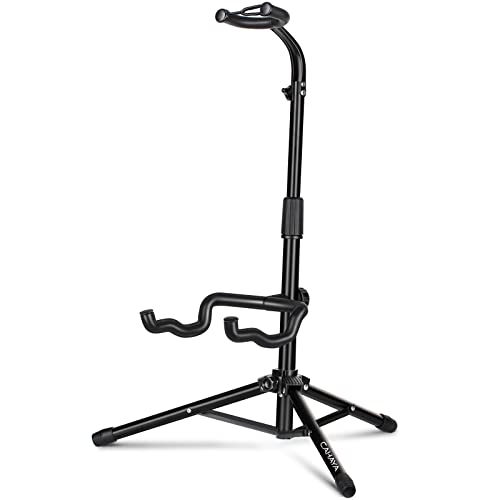
Tripod stands are the default choice for many home players because they balance stability, price, and portability. Three legs create a wider base, and a neck yoke or upper support keeps the instrument from tipping forward. Typical models weigh 2–4 lb, occupy approximately 18–24 inches of floor width when open, and fold for transport.
Prioritize a locking neck support rather than a simple open cradle if the stand will be used on stage. A locking yoke does not make the guitar immune to a fall, but it reduces the chance that a cable, sleeve, or passing leg will lift the neck from the stand. Check that the locking mechanism can be operated without scraping the headstock.
Tripods usually accommodate acoustic guitars, electric guitars, basses, and some ukuleles, but “universal” does not mean every instrument fits equally well. A deep-bodied jumbo acoustic may sit awkwardly in a narrow cradle, while a long-scale bass can make a lightweight stand top-heavy. If possible, compare the stand’s stated body-width range with your instrument’s lower-bout width.
Multi-guitar racks: efficient storage with trade-offs
A multi-guitar rack is usually the best guitar stand for a household that regularly keeps several instruments ready to play. Common capacities are three, five, or seven instruments. A three-guitar rack may occupy about 24–30 inches of width; a five-guitar rack can require 36–45 inches, depending on spacing and whether guitars are stored in alternating orientations.
Racks are more stable when their base is wide and their support bars are connected into one frame. They also reduce the risk of individual stands being kicked out of position. However, guitars can touch one another if the spaces are narrow. That is a serious consideration for instruments with delicate finishes, protruding controls, or unusual body shapes.
Choose a rack with thick, non-abrasive padding and enough clearance around bridges, knobs, strap buttons, and input jacks. Some racks use removable dividers, which make it easier to separate an acoustic guitar from a wide-body electric or bass. A folding rack is more transportable, but a fixed-frame rack is often more rigid for permanent studio use.
Wall-mounted hangers: the smallest floor footprint
Wall-mounted hangers are ideal when floor space is scarce or you want guitars accessible and visible. A typical single hanger projects 4–8 inches from the wall, compared with roughly 18–24 inches for a floor stand. The instrument is suspended by the headstock, so the mounting hardware and wall structure matter more than they do with a portable stand.
Install the hanger into a wall stud or use an appropriate load-rated anchor for the wall type. Do not rely on a small drywall plug simply because the guitar feels light; repeated lifting and replacing can loosen poorly supported hardware. Leave enough horizontal clearance that the guitar does not strike a door, shelf, ceiling, or neighboring instrument.
Check the hanger’s yoke material and finish compatibility. Some hangers use rubber or foam padding designed for common guitar finishes, while others may not be suitable for every lacquer or vintage finish. If the manufacturer gives a finish-compatibility warning, follow it rather than assuming all padding is interchangeable.
Head-to-head comparison
| Factor | A-frame | Tripod | Multi-guitar rack | Wall-mounted hanger |
|---|---|---|---|---|
| Typical capacity | 1 guitar | 1 guitar | 3–7 guitars | 1 guitar per hanger |
| Approximate weight | 1–2.5 lb | 2–4 lb | 5–15 lb | 0.5–2 lb |
| Open footprint | 12–18 in wide | 18–24 in wide | 24–45 in wide | 4–8 in projection |
| Best portability | Excellent | Good | Fair | None after installation |
| Side-impact resistance | Fair | Good | Good to very good | Very good when correctly installed |
| Setup work | None | None | Usually none | Drilling and wall assessment required |
How to choose the right stand for your guitar
Start with the instrument, not just the room. A standard electric guitar fits most single-instrument stands, but basses need adequate neck height and a base that will not tip under their longer scale. Acoustic guitars need enough cradle width for the lower bout. Classical guitars may require especially careful padding and a stable cradle because their bodies and finishes can differ from steel-string designs.
- For one beginner guitar: choose a padded tripod if it will remain at home, or an A-frame if lessons and rehearsals are frequent.
- For a small apartment: choose a wall hanger if you can install it securely; otherwise, select the narrowest stable tripod.
- For a gigging musician: choose an A-frame for minimal luggage or a locking tripod for a busy performance area.
- For several frequently used guitars: choose a padded multi-guitar rack rather than lining up separate stands.
- For children, pets, or crowded rooms: favor a wide base, a locking neck support, and a position away from walkways.
Padding, finish safety, and durability
Padding is not merely comfort. It prevents pressure points and reduces scratches when the guitar is placed down repeatedly. Inspect the foam or rubber where it contacts the body, neck, and headstock. The first parts to wear are commonly the lower cradle covering, hinge joints, non-slip feet, and neck-yoke padding.
Keep the stand away from direct heat, radiators, and prolonged sunlight. Heat can accelerate foam deterioration and may expose hard plastic or metal edges. Wipe dust and sweat from contact surfaces with a dry or slightly damp cloth, then let the stand dry before placing the instrument on it. Avoid household solvents unless the stand manufacturer specifically approves them.
For a portable stand, open every hinge before a performance and confirm that the locking buttons engage. Replace a stand if a leg no longer locks, a yoke rotates under light pressure, or padding has split enough to expose the frame. A cheap stand that must be replaced every year can cost more than a sturdier stand used for five years.
Common buying mistakes
- Choosing by price alone and overlooking a narrow base or weak hinge.
- Assuming a “universal” stand automatically fits a jumbo acoustic or long-scale bass.
- Placing a guitar stand beside a doorway, chair path, or amplifier cable.
- Using a wall hanger without verifying the stud, anchor rating, and wall clearance.
- Allowing guitars in a rack to touch one another or rub against metal hardware.
- Leaving a guitar in a stand for long-term storage when a suitable case would provide better protection from dust, impacts, and environmental changes.
Final recommendation
For most players, a padded tripod is the safest starting point because it handles home practice, rehearsals, and modest stage use without taking excessive space. Choose an A-frame when transport weight and folded size are the priority. Choose a multi-guitar rack when several instruments stay ready in one room. Choose a wall-mounted hanger only when you can install it into appropriate structure and have confirmed that its padding is suitable for your guitar’s finish. The best guitar stands are not necessarily the cheapest or most heavily padded; they are the ones whose base, retention system, dimensions, and installation match the instrument and the way you use it.

Write Your Review
No reviews yet. Be the first to share your experience!