

Key takeaways
- Type I: Designed for offshore or rough-water situations where rescue may take time. It provides substantial flotation and is designed to turn some unconscious wearers face-up, though fit and individual circumstances matter.
- Type II: Intended for calmer inland water and potentially faster rescue. It generally offers more turning support than a typical Type III vest, but may be bulkier.
- Type III: Common for boating, paddling, and watersports in calm or inland conditions. It is designed for comfort and mobility; do not rely on it to turn an unconscious wearer face-up.
- Type IV: A throwable device, such as a ring buoy or cushion, for a person already in the water. It does not replace required wearable jackets.
- Type V: Special-purpose equipment, such as certain inflatable or work vests. It counts as an approved life jacket only when used as labeled and, where required, worn.
Best Life Jackets for Boating and Water Safety: Choose by Activity, Fit, and Approval
The best life jackets are U.S. Coast Guard–approved, fit snugly without restricting movement, and match the water activity: a conventional Type III vest for most calm-water boating and paddling, a Type II or Type I jacket when greater flotation or rough-water performance matters, and a purpose-built impact vest only when its label and local rules make it suitable.
Start by checking the approval label inside the jacket—not just the product name or color. Approval, buoyancy, fit, and intended use are separate questions. A jacket can feel comfortable yet be unsuitable for a particular activity, and a watersports impact vest may not count as a legally required life jacket.
Our top picks


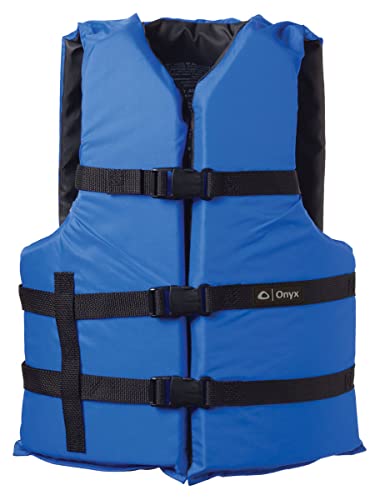

As an Amazon Associate we earn from qualifying purchases at no extra cost to you. Ratings are shown as listed on Amazon.
What the flotation numbers and labels mean
Modern U.S. Coast Guard labels identify a device’s approved use and performance. Older jackets may display Type I through Type V; newer labels commonly describe the device as wearable or throwable and state its intended use. Follow the actual label and your state’s boating rules rather than assuming that every jacket marked “Type III” has the same approval or performance.
- Type I: Designed for offshore or rough-water situations where rescue may take time. It provides substantial flotation and is designed to turn some unconscious wearers face-up, though fit and individual circumstances matter.
- Type II: Intended for calmer inland water and potentially faster rescue. It generally offers more turning support than a typical Type III vest, but may be bulkier.
- Type III: Common for boating, paddling, and watersports in calm or inland conditions. It is designed for comfort and mobility; do not rely on it to turn an unconscious wearer face-up.
- Type IV: A throwable device, such as a ring buoy or cushion, for a person already in the water. It does not replace required wearable jackets.
- Type V: Special-purpose equipment, such as certain inflatable or work vests. It counts as an approved life jacket only when used as labeled and, where required, worn.
Buoyancy ratings may be given in pounds or newtons. A higher number indicates more force keeping a wearer afloat, but is not a simple measure of how much weight the jacket can carry. Body size, clothing, waves, and the jacket’s design all affect real-world performance. Compare the label’s intended use, size range, and approval—not buoyancy alone.
Quick comparison: match the jacket to the day
| Situation | What to look for | Typical trade-off |
|---|---|---|
| Recreational boating or paddling on calm inland water | Approved wearable Type III or equivalent; movement-friendly fit | Comfort and mobility, with less face-up turning support than some bulkier designs |
| Offshore trips or conditions where rescue could be delayed | Approved Type I; secure closures and a size suited to clothing layers | More coverage and flotation, usually bulkier and warmer |
| Small children or a child who cannot swim | Child-sized approved jacket with a crotch strap and grab handle; test fit in controlled, shallow water with close adult supervision | Extra security features can help with handling but never replace supervision |
| Water skiing, wakeboarding, or personal watercraft | Approved jacket explicitly suitable for the activity; secure fit and adequate coverage | Purpose-built designs allow movement, but impact protection does not guarantee Coast Guard approval |
| Frequent paddling in hot weather | Approved Type III with breathable panels or open sides, sized to avoid ride-up | Cooler and easier to move in; check that straps and closures still secure the jacket |
These are selection guides, not substitutes for the device label or regulations. Rules vary by location, vessel, age, and activity. Check the applicable requirements before departure.
Best life jackets by use case
For everyday boating: a conventional Type III vest
For many adults cruising, fishing, or paddling on protected water, a Coast Guard–approved Type III vest is a practical starting point. Look for adjustable shoulder and waist straps, a front zipper or secure buckle system, and arm openings that leave room to paddle. Choose a cut that stays in place when you raise your arms and lean forward. A roomy jacket that rides up is not a comfortable bargain; it is the wrong size or shape.
For offshore or unpredictable conditions: Type I
When a trip takes you far from quick assistance, prioritize a Type I jacket designed for offshore use. Its added flotation and turning support can be valuable, but the greater bulk may discourage wear if the fit is poor. Try it over the layers you expect to wear, secure every closure, and confirm you can move and reach essential controls. Inflatable models can be compact for adults, but they require maintenance and may have restrictions, including who may wear them and where.
For children: fit first, then features
Buy by the child’s current weight range and the jacket’s stated size—not by age or the hope that they will grow into it. A properly sized child’s jacket should have a snug torso fit; many designs add a crotch strap and a lifting handle. With the jacket fastened, lift gently at the shoulders: it should not slide up over the child’s chin or ears. Do this check with the child wearing typical boating clothes. A life jacket is not permission for unsupervised swimming; keep children within reach near water and follow the jacket’s label and local rules.
For high-movement watersports: distinguish impact vests from life jackets
Wake and ski vests are cut to stay close to the body and allow movement. Some provide impact padding but are not Coast Guard–approved flotation devices. If you need a legally compliant life jacket, verify explicit approval on the label and that the approval covers your activity. Do not assume that “floatation,” “competition,” or “impact vest” means the same thing as an approved life jacket.
How to get the fit right
- Check the label: Confirm approval, activity, size or weight range, and any wearing restrictions.
- Try it over real clothing: Seasonal layers change how a jacket fits. Tighten every strap and fasten every buckle.
- Move naturally: Reach overhead, twist, sit, and mimic paddling. The jacket should not obstruct breathing or essential movement.
- Check for ride-up: Lift gently at the shoulders. If the jacket rises toward the face, adjust it or try another size or cut.
- Test unfamiliar equipment safely: A supervised, controlled water check can reveal fit or comfort problems before a trip. It is not a substitute for training or proof of performance in an emergency.
Ownership: what wears out and what to maintain
Foam jackets are comparatively simple, but fabric, stitching, buckles, zippers, and straps can degrade from sun, salt, abrasion, and repeated compression. Rinse off salt or lake residue with fresh water, air-dry fully in shade, and store in a cool, dry place away from fuel, chemicals, and prolonged sunlight. Do not leave a wet jacket packed away or use it as a cushion; crushing the foam can reduce its usefulness.
Inspect the jacket before each outing for torn seams, damaged closures, frayed webbing, missing parts, hardened or waterlogged foam, and a label that is no longer legible. Replace a damaged or questionable jacket rather than trying to repair its flotation with household materials. Inflatable jackets need additional attention: follow the manufacturer’s inspection schedule, check the inflation mechanism and cylinder, and replace consumables as specified. A jacket that has not been maintained or is not worn when needed offers little practical protection.
Bottom line
For most calm-water recreational use, begin with a comfortable, properly fitted, Coast Guard–approved Type III vest. Choose Type I for trips where offshore conditions or delayed rescue make added flotation important, and select children’s or watersports jackets by their specific size and approval label. The best choice is the one that is appropriate for the conditions, maintained, and worn—not simply the one with the biggest buoyancy number or the most convenient design.


Write Your Review
No reviews yet. Be the first to share your experience!