

Our Top Picks


A tremolo pedal does one thing: it pulses your volume in rhythm, from a slow swell to a hard chop. The decision is not whether you need one, but which kind of pulse fits your playing. Classic optical tremolo gives you the warm throb of a vintage amp, harmonic tremolo adds a phase-like shimmer, and multi-mode units pack several voices into one box. Pick the wrong type and the pedal sits unused; pick the right one and it becomes the effect you reach for on every clean passage.
This guide is for guitarists buying their first tremolo pedal, players replacing a worn unit, and pedalboard builders who want one tremolo that covers several styles. Every pedal below was chosen from its name and specifications on its Amazon product page, and each one covers a different corner of the tremolo world: a budget optical pedal, the long-running standard, two compact JHS designs with different voices, and a stereo multi-mode unit for players who want it all.
Quick Picks
As an Amazon Associate we earn from qualifying purchases
| Product | Best for | Key spec from title |
|---|---|---|
| BOSS TR-2 | Classic amp-style tremolo with simple controls | Vintage tremolo effects in a compact pedal |
| JHS Tidewater | Warm amp-like pulse on a crowded board | Volume, Mix and Speed controls |
| JHS 3 Series Harmonic Trem | Harmonic tremolo shimmer in a small box | Harmonic tremolo with amp-trem toggle |
| MXR M305 Tremolo | Six tremolo voices with tap tempo and stereo | Six tremolo modes, stereo output |
| JOYO JF-09 Tremolo | Budget optical tremolo for a first board | Optical photoelectric circuit, true bypass |
How to Choose
Tremolo type shapes the sound
Optical tremolo, the sound of a vintage amp, pulses the volume smoothly and warmly. Harmonic tremolo splits the signal into high and low bands and moves them in opposite directions, which sounds like a phaser crossed with a tremolo. Bias tremolo, borrowed from old tube amps, has a softer, breathing feel. Multi-mode pedals such as the MXR M305 pack several of these voices into one box, which suits players who use tremolo across different songs. If you play mostly surf, country, or blues, start with optical. If you want a shimmering, psychedelic pulse, look for harmonic.
Controls: knobs, toggles, and tap tempo
Three knobs cover the basics on most tremolo pedals: rate sets the pulse speed, depth sets how hard the volume swings, and a wave or shape control sets how smooth or choppy the pulse feels. A toggle that switches between tremolo types, like the one on the JHS 3 Series Harmonic Trem, adds a second voice without adding knobs. Tap tempo matters if you play live, because it locks the pulse to the song instead of forcing you to dial the rate by ear between songs. The MXR M305 covers tap tempo through its multiuse jack, while simpler pedals such as the BOSS TR-2 leave the rate on a knob, which is fine for studio and home use.
Stereo, bypass, and pedalboard fit
Mono tremolo is enough for most rigs, but stereo output spreads the pulse across two amps or a stereo rig, which sounds wider and more alive. The MXR M305 offers stereo output, while the BOSS TR-2, the JHS Tidewater, and the JOYO JF-09 are mono. Bypass type matters too: true bypass, found on the JOYO JF-09, leaves your tone untouched when the pedal is off, while buffered bypass, used by BOSS, keeps your signal strong over long cable runs. Size is the last fit check. Mini pedals such as the Tidewater and the JF-09 save space on a crowded board, while the M305 needs room for its wider enclosure.
Power draw and build
Every tremolo pedal here runs on 9-volt DC power, but the current each one draws varies a lot. The JHS Tidewater sips 3 milliamps, so it runs happily on almost any power supply output. The MXR M305 draws 190 milliamps, which needs a dedicated high-current output on your supply or the included adapter. Daisy-chaining a high-draw digital pedal with the rest of your board can starve it and add noise, so check the draw before you buy. Build is the other half of the decision: metal enclosures such as the BOSS compact casing and the JOYO aluminium-alloy housing survive gigging, while plastic housings do not.
The 5 Best Options
BOSS TR-2
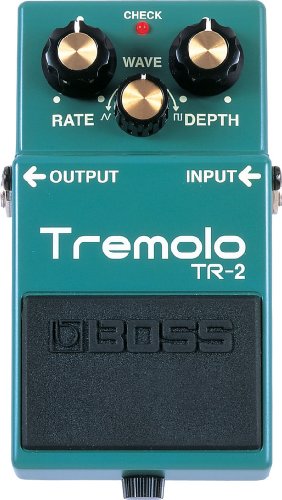
The TR-2 has been the default tremolo pedal for decades, and it earns that spot with simplicity. Three knobs — Rate, Depth, and Wave — cover the whole classic tremolo range, and the Wave knob morphs the low-frequency oscillator from a smooth triangle wave to a hard square wave, which changes the pulse from a gentle swell to a choppy chop. The analog circuit keeps the tone warm, and the rugged compact casing is the same enclosure BOSS has used for years. It does the vintage amp tremolo sound with no menu, no tap tempo, and nothing to learn.
Specs
- Wave, Rate, and Depth knobs for precise effect tailoring
- Wave control morphs the LFO waveform from triangle to square
- Analog circuit for warm, vintage tremolo tones
- LFO rate from 90 to 900 ms
- Current draw 20 mA; runs on a 9V battery or optional PSA adapter
- Dimensions 73 x 129 x 59 mm; weight 400 g
- BOSS five-year warranty
Best for: Players who want the classic tremolo sound with three knobs and nothing to learn.
Watch out for: No tap tempo, so the rate is set by ear; older units are known for a slight volume drop when engaged, while post-2013 models reportedly fixed it.
JHS Tidewater

The Tidewater recreates the tremolo of a vintage Fender or Vox amplifier in a mini pedal that fits anywhere on a crowded board. Three knobs — Volume, Mix, and Speed — do all the work: Volume sets the output at unity, below it, or above it for a boost, Mix controls the depth of the pulse, and Speed sets how fast it moves. Turn Mix all the way down and the pedal doubles as a warm preamp boost. Three small DIP switches inside the pedal change the speed range, which is a thoughtful touch for players who live at very slow or very fast rates.
Specs
- Volume, Mix, and Speed controls
- Mix turned all the way down works as a warm preamp boost
- Three internal DIP switches adjust the speed range
- Small footprint: 3.6 x 1.5 x 1 in
- Runs on standard 9V DC negative power; draws 3 mA
Best for: Players who want warm amp-style tremolo on a small board.
Watch out for: No battery operation, so a power supply is required; the DIP switches sit inside the pedal, so changing the speed range means opening it up.
JHS 3 Series Harmonic Trem
The 3 Series Harmonic Trem is the simplest way into harmonic tremolo, the shimmering, phase-like pulse found in early-sixties Fender amps. A toggle switch gives you two voices: up is a great-sounding amp trem, and down is JHS’s take on harmonic trem, which splits the highs and lows and moves them against each other for a lush, swirling groove. The controls stay minimal, so you can dial in a usable sound in seconds and get back to playing. It is made in Kansas City, USA, and it runs on standard 9-volt DC power.
Specs
- Toggle switch selects amp trem or harmonic trem
- Harmonic tremolo splits highs and lows for a lush, swirling pulse
- Runs on 9V DC negative center power; draws 65 mA
- Made in Kansas City, USA
Best for: Players who want harmonic tremolo shimmer without a complicated pedal.
Watch out for: The toggle gives two voices only, with no continuous wave-shape control; check your power supply has a spare 65 mA output.
MXR M305 Tremolo

The M305 is the do-it-all tremolo in this lineup. Six masterfully tuned modes cover the classic voices — MXR, Bias, Reverse Optic, Optic, Square Wave, and Harmonic — so one pedal can sound like a vintage amp, a photocell tremolo, or a psychedelic harmonic pulse. Speed, Gain, and Depth knobs handle the basics, while a multiuse jack adds tap tempo, expression control, envelope control, or stereo output. It is the pedal to buy when you use tremolo across many songs and want a different voice for each one, without filling your board with five pedals.
Specs
- Six tremolo modes: MXR, Bias, Reverse Optic, Optic, Square Wave, and Harmonic
- Speed, Gain, and Depth controls
- Multiuse jack for tap tempo, expression control, envelope control, or stereo output
- Purple enclosure
- 9V DC power supply included; draws 190 mA
- UPC 0710137117600
Best for: Players who want six tremolo voices, tap tempo, and stereo in one pedal.
Watch out for: The 190 mA draw needs a dedicated high-current power output; tap tempo and stereo output share the multiuse jack, so you cannot use both at once.
JOYO JF-09 Tremolo
The JF-09 is the budget pick that sounds far more expensive than it is. It uses the same photoelectric tube circuitry as the tremolo in old tube amplifiers, which gives it a smooth, classic pulse with a warm depth control. Two knobs — Intensity and Rate — make it easy to dial in, and true bypass keeps your tone untouched when the pedal is off. The aluminium-alloy housing is sturdy for the price, and the compact size fits easily on a first pedalboard. It is the right first tremolo for players who want the vintage sound without spending much.
Specs
- Optical photoelectric circuit for classic tube-amp-style tremolo
- Intensity and Rate knobs
- True bypass for transparent tone when off
- Aluminium-alloy housing with a classic stoving varnish finish
- Power adapter and audio cable not included
Best for: First-time tremolo buyers who want vintage tone on a tight budget.
Watch out for: The power adapter and audio cable are not included, so budget for a 9V adapter; check the footswitch and jacks on arrival, as with any budget pedal.
Which One Fits Your Situation
You want the classic sound with the least fuss
Buy the BOSS TR-2. Three knobs cover the whole classic tremolo range, the Wave control moves from smooth triangle to hard square, and the rugged casing survives years of gigging. There is no tap tempo and no menu to learn, so you can plug in and play. It is the pedal for players who want one dependable tremolo and never want to think about it again.
You play surf, country, or vintage rock
Buy the JHS Tidewater. Its amp-style pulse is the sound of vintage Fender and Vox tremolo, and the Volume, Mix, and Speed controls make it easy to sit the effect exactly where you want it in the mix. The small footprint leaves room for the rest of your board, and turning Mix down gives you a warm preamp boost for clean passages.
You need tremolo synced to the song
Buy the MXR M305 Tremolo. Its multiuse jack gives you tap tempo, so the pulse locks to the song instead of drifting, and the six modes mean you can switch from a smooth optical pulse to a psychedelic harmonic tremolo between songs. Stereo output spreads the effect across two amps, which suits live players with a stereo rig.
You are building a first pedalboard on a tight budget
Buy the JOYO JF-09 Tremolo. Its photoelectric circuit delivers the classic tube-amp pulse, true bypass keeps your tone clean when it is off, and two knobs make it impossible to get lost. Remember to budget for a 9V power adapter, since one is not included. It is the cheapest way to find out whether tremolo belongs on your board.
Common Mistakes
- Buying a tremolo pedal when you actually want vibrato: tremolo pulses volume, while vibrato bends pitch, so check which effect the song uses.
- Ignoring current draw: the MXR M305 needs 190 mA, and a daisy chain that cannot supply it will starve the pedal and add noise.
- Putting tremolo before heavy drive: the pulse gets buried, so try it after your drive pedals or in the effects loop first.
- Skipping tap tempo for live use: dialing the rate by ear between songs is slow, so gigging players should pick a pedal with tap tempo.
- Buying a tremolo-and-reverb combo when you only need tremolo: you pay for a second effect you may never use.
Frequently Asked Questions
What does a tremolo pedal do?
A tremolo pedal pulses the volume of your guitar signal up and down in rhythm. The rate knob sets how fast the pulse moves, and the depth knob sets how far the volume swings. At slow settings it sounds like a swell, and at fast settings it chops the notes into a rhythmic stutter. It is the effect behind the shimmering clean tones in surf, country, and vintage rock.
Is tremolo the same as vibrato?
No. Tremolo changes volume, while vibrato changes pitch. A tremolo pedal makes your notes louder and quieter in rhythm, and a vibrato pedal bends the pitch up and down. Guitar amplifiers often label their volume-pulsing effect as vibrato, which causes the confusion. If the sound you want is a pulsing volume, buy a tremolo pedal; if you want a wobbling pitch, buy vibrato.
Where should a tremolo pedal go in the signal chain?
Put tremolo after your drive pedals and before delay and reverb in most cases. That order keeps the pulse clear, because the drive has already shaped the tone and the delay and reverb then wash over the pulsing signal. Some players put tremolo in the amplifier effects loop for the same reason. Try both spots and keep the one where the pulse stays audible.
Do tremolo pedals need a power supply?
Most tremolo pedals run on a standard 9-volt DC power supply, and some also accept a 9-volt battery. The BOSS TR-2 runs on a battery or an optional adapter, while the JHS Tidewater needs a power supply and has no battery option. Check the current draw too: the MXR M305 needs 190 milliamps, so it needs a high-current output on your supply.
More from Amazon
Programs that pair well with the guide above. Offers and eligibility are set by Amazon and may change.
Free shipping on eligible items, Prime Video and more. Eligible new members can start with a free trial.
Start a Prime free trialAudiobooks and podcasts to listen to on the go. Eligible new members can start with a free trial.
Try Audible freeAd-free music streaming. Eligible new subscribers can start with a free trial.
Try Music Unlimited freeA free business account with business pricing and bulk-buying tools for work, shop or home office.
Create a business accountAs an Amazon Associate we earn from qualifying purchases.
Write Your Review
No reviews yet. Be the first to share your experience!