
Our Short List of 3

- Best for: Listeners who want a balanced DAC and amplifier in one box.

- Best for: DAC owners who want maximum clean power in a pure amplifier.

- Best for: Listeners who want balanced power plus XBass and soundstage features.
All 4 Picks at a Glance
| Product | Specs | Action |
|---|---|---|
| 1. FiiO K11 Desktop DAC and Headphone Amplifier |
| Check price on Amazon |
| 2. Schiit Magni Heresy Headphone Amp and Preamp |
| Check price on Amazon |
| 3. iFi ZEN CAN Balanced Headphone Amplifier |
| Check price on Amazon |
 4. FiiO K5 Pro Desktop DAC and Headphone Amplifier |
| Check price on Amazon |
Key takeaways
- Find the best headphone amp under 200 dollars. Compare four desktop amps for high-impedance and planar headphones, with power, inputs, and buying tips.
Introduction
A good headphone amp under 200 dollars can transform headphones that sound thin and quiet straight from a laptop or phone. Many popular studio and audiophile headphones need more voltage and current than a built-in headphone jack can deliver, and a dedicated amplifier supplies exactly that. The result is fuller bass, cleaner dynamics at higher volume, and a soundstage that finally opens up.
This guide compares four desktop headphone amplifiers that all sit under the 200-dollar mark: the FiiO K11, the Schiit Magni Heresy, the iFi ZEN CAN, and the FiiO K5 Pro. Each one takes a different approach. The K11 and K5 Pro are all-in-one DAC and amplifier combos that connect straight to a computer, while the Magni Heresy and ZEN CAN are pure amplifiers designed for listeners who already own a DAC or another analog source. Between them, they cover high-impedance dynamics, planar magnetics, sensitive in-ear monitors, and balanced headphones.
Every pick below is a current, widely sold model from an established audio brand. Use the buying advice first to work out what your headphones actually need, then match the amplifier to that need rather than chasing the biggest power number on the box.
How to Choose a Headphone Amp Under 200 Dollars
Match power to your headphones
Headphone impedance and sensitivity decide how much power you need. High-impedance dynamic headphones, such as 250-ohm and 300-ohm studio models, need voltage swing more than raw current. Planar magnetic headphones are usually low impedance but low sensitivity, so they need current. Sensitive in-ear monitors need very little power but punish noisy amplifiers, so a low noise floor and a low gain setting matter more than watts.
Check your headphone’s impedance and sensitivity, then look for an amplifier that delivers comfortable power into that load with headroom to spare. An amp that is only just adequate will sound strained at listening volume; one with generous headroom stays clean and relaxed.
Decide whether you need a DAC
A DAC converts digital audio from a computer into the analog signal an amplifier can use. If your only source is a computer, an all-in-one DAC and amplifier such as the FiiO K11 or K5 Pro is the simplest route: one box, one USB cable, and you are listening. If you already own a DAC, an audio interface, or a turntable with a phono stage, a pure amplifier such as the Magni Heresy or ZEN CAN gives you more amplifier for the money, since you are not paying for a second converter.
Check the inputs and outputs
Look at the connections on the back of each amplifier before buying. RCA inputs suit DACs and interfaces, while a 3.5 mm input suits phones and portable players. On the output side, a standard 6.35 mm jack covers most full-size headphones, and a 4.4 mm balanced output suits headphones with balanced cables. A preamp output or RCA line-out is useful if you also want to drive powered desktop speakers from the same box.
Gain settings matter
A gain switch lets one amplifier serve both sensitive earphones and demanding full-size headphones. Low gain keeps the volume control in its useful range with efficient headphones and avoids hiss, while high gain gives hard-to-drive headphones the voltage they need. Amplifiers with two or three gain levels, like the picks below, are far more flexible than fixed-gain designs.
Sound character and features
Most amplifiers in this price range aim for a neutral, transparent sound, and that is usually the right choice: the amplifier should reveal the recording and the headphones, not add its own flavor. A few models add useful tone features, such as the iFi ZEN CAN’s XBass and XSpace circuits, which can warm up lean headphones or widen narrow recordings. Treat those as bonuses, not as the main reason to buy.
Build, warranty, and desk space
Desktop amplifiers live on a desk for years, so a metal chassis, a smooth volume knob, and a sensible footprint all matter. Check the warranty too: most of the amplifiers in this guide carry at least a one-year warranty, and some offer two years. Finally, remember that a pure amplifier needs a separate power supply and a source, while a DAC and amplifier combo needs only a USB connection and a wall outlet.
Top Picks
1. FiiO K11 Desktop DAC and Headphone Amplifier
- Best for: Listeners who want a balanced DAC and amplifier in one box.
Listeners who want a balanced DAC and amplifier in one box.
The FiiO K11 is the most complete single-box solution in this group. It pairs a Cirrus Logic CS43198 DAC with a balanced headphone amplifier that delivers up to 1400 mW per channel into 32 ohms through its 4.4 mm balanced output, with a 6.35 mm single-ended jack alongside it. It decodes PCM up to 384 kHz at 24 bit and DSD256 over USB, and it accepts USB, optical, and coaxial digital inputs, so a computer, a console, and a television can all share one box.
A small VA display shows the sample rate, volume, gain, and output mode at a glance, which is genuinely useful when switching between sources. The RCA line-out feeds powered speakers at up to 2 Vrms, so the K11 can serve as the center of a small desktop system rather than just a headphone amp. Three gain levels cover everything from sensitive in-ear monitors to 350-ohm headphones, and the aluminum chassis feels solid for the size.
The trade-offs are modest: there is no Bluetooth input, no tone controls, and the single-knob menu takes a little learning. For a listener who wants one box that does everything and drives almost any headphone, the K11 is the easiest recommendation here.
2. Schiit Magni Heresy Headphone Amp and Preamp
- Best for: DAC owners who want maximum clean power in a pure amplifier.
DAC owners who want maximum clean power in a pure amplifier.
The Schiit Magni Heresy is the purest amplifier in this guide: no DAC, no display, no menus, just clean power. Its op-amp-based design delivers 2.4 watts into 32 ohms, the highest output in its class, with vanishingly low distortion and noise. That combination makes it equally at home with sensitive in-ear monitors and power-hungry planar magnetics.
The front panel keeps things simple, with a volume knob, a gain switch, and a 6.35 mm headphone jack, plus a 3.5 mm input for portable sources. Around the back, RCA inputs take a DAC or interface, and RCA preamp outputs let the Heresy double as a volume control for powered monitors. The compact metal chassis is made in the USA and covered by a two-year warranty.
The Heresy needs a separate DAC or analog source, which adds cost if you do not already own one, and it runs warm during long sessions. It also has no balanced output and no tone controls. For listeners who already have a good DAC and want maximum clean power for the money, it remains one of the best values in desktop audio.
Check the Schiit Magni Heresy on Amazon
3. iFi ZEN CAN Balanced Headphone Amplifier
- Best for: Listeners who want balanced power plus XBass and soundstage features.
Listeners who want balanced power plus XBass and soundstage features.
The iFi ZEN CAN takes a different path from the measurement-focused amplifiers in this group. It uses Class A discrete balanced circuitry trickled down from iFi’s flagship Pro iCAN, and it adds two analog features that no other pick here offers: XBass, a bass boost that adds weight to lean-sounding headphones, and XSpace, a crossfeed-style circuit that widens narrow recordings. Both are switchable, so the amplifier can be completely neutral when you want it to be.
Power is generous, with up to 1890 mW per channel from the balanced output into 64 ohms and 1600 mW into 32 ohms single-ended. Four gain stages, from 0 dB to 18 dB, make it easy to match the amplifier to anything from efficient earphones to 600-ohm studio headphones. Inputs cover RCA, 3.5 mm, and balanced 4.4 mm, and the front panel offers both 6.35 mm and 4.4 mm headphone outputs plus a balanced preamp output.
The ZEN CAN has no built-in DAC, so it needs an analog source, and its warm, musical character will not suit listeners who want absolute neutrality above all else. For everyone else, its combination of power, flexibility, and genuinely useful sound-shaping features makes it the most characterful amplifier in this guide.
Check the iFi ZEN CAN on Amazon
4. FiiO K5 Pro Desktop DAC and Headphone Amplifier
- Best for: Single-ended headphone owners who want a powerful desktop DAC and amp combo.
Single-ended headphone owners who want a powerful desktop DAC and amp combo.
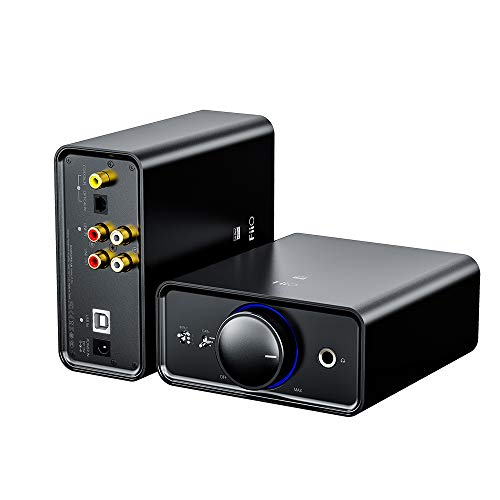
The FiiO K5 Pro is the heavyweight all-in-one of this group, built around an AKM AK4493EQ DAC and a desktop-class amplifier stage that delivers up to 1.5 watts into 32 ohms and 20 volts peak-to-peak into 300 ohms. It supports PCM up to 768 kHz at 32 bit and native DSD512 over USB, with coaxial, optical, and RCA line inputs for other sources. A 6.35 mm headphone jack and an adjustable RCA line-out cover headphones and powered speakers alike.
What sets the K5 Pro apart is its control layout: three gain levels, input and gain toggle switches, and an ADC-based volume control that avoids the channel imbalance cheaper volume pots can show at low levels. An RGB ring around the volume knob changes color with the sample rate, which is a small but genuinely handy touch. The all-aluminum body is heavier and more substantial than the K11, and it feels built to stay on a desk for years.
The K5 Pro is larger than the other DAC and amplifier combo here, and it has no balanced headphone output, so owners of balanced cables should look at the K11 instead. For listeners with single-ended headphones who want a powerful, flexible, and beautifully built desktop unit, it is a strong alternative.
Check the FiiO K5 Pro on Amazon
Comparison Table
| Amplifier | Type | Max Power (32 ohms) | Balanced Output | Gain Settings | Built-in DAC |
|---|---|---|---|---|---|
| FiiO K11 | DAC and amp combo | 1400 mW balanced | Yes, 4.4 mm | 3 levels | Yes |
| Schiit Magni Heresy | Pure amplifier | 2400 mW | No | 2 levels | No |
| iFi ZEN CAN | Pure amplifier | 1600 mW | Yes, 4.4 mm | 4 stages | No |
| FiiO K5 Pro | DAC and amp combo | 1500 mW | No | 3 levels | Yes |
Frequently Asked Questions
Do I really need a headphone amp under 200 dollars?
It depends on your headphones. Efficient headphones under 80 ohms usually sound fine straight from a phone or laptop. High-impedance headphones above 150 ohms, planar magnetics, and many studio models benefit clearly from a dedicated amplifier, gaining volume headroom, tighter bass, and cleaner dynamics. If your headphones sound quiet even at maximum volume, an amplifier is the fix.
Should I buy a DAC and amp combo or a separate amplifier?
Buy a combo if your only source is a computer and you want the simplest setup with the fewest cables. Buy a separate amplifier if you already own a DAC, an audio interface, or another good analog source, because you get more amplifier performance for the same money. Either route works well; the deciding factor is what gear you already own.
Can one amp drive both in-ear monitors and full-size headphones?
Yes, if it has a low noise floor and a low gain setting. All four amplifiers in this guide offer switchable gain, so they can run sensitive in-ear monitors quietly on low gain and still drive demanding full-size headphones on high gain. Avoid fixed high-gain amplifiers if you mainly use efficient earphones.
What is the difference between balanced and single-ended headphone outputs?
A balanced output uses separate signal paths for each channel and can deliver more power with better channel separation, which helps demanding headphones. A single-ended output uses a shared ground and is the standard on most headphones. Balanced only helps if your headphones have a balanced cable; otherwise the standard 6.35 mm jack is all you need.
Will a headphone amp make cheap headphones sound better?
A little, but not dramatically. An amplifier removes the power bottleneck, so it helps most with headphones that are hard to drive. With easy-to-drive budget headphones, the improvement is smaller, and upgrading the headphones themselves usually makes a bigger difference than upgrading the amplifier.
Conclusion
The best headphone amp under 200 dollars depends on what you already own and what your headphones need. The FiiO K11 is the best all-rounder: a balanced DAC and amplifier in one compact box that drives almost anything. The Schiit Magni Heresy is the best pure amplifier for listeners who already have a DAC and want maximum clean power. The iFi ZEN CAN is the most flexible and characterful choice, with balanced power and genuinely useful XBass and XSpace features. The FiiO K5 Pro is the best single-ended desktop combo, with a powerful amplifier stage and a control layout that is a pleasure to use.
Whichever you choose, match the amplifier to your headphones first, check that the inputs suit your sources, and make sure there is a gain setting low enough for your most sensitive pair. Get those three things right and any of these four will be a clear upgrade over a laptop headphone jack.
Disclosure: As an Amazon Associate, we earn from qualifying purchases.
More from Amazon
Programs that pair well with the guide above. Offers and eligibility are set by Amazon and may change.
Free shipping on eligible items, Prime Video and more. Eligible new members can start with a free trial.
Start a Prime free trialAudiobooks and podcasts to listen to on the go. Eligible new members can start with a free trial.
Try Audible freeAd-free music streaming. Eligible new subscribers can start with a free trial.
Try Music Unlimited freeA free business account with business pricing and bulk-buying tools for work, shop or home office.
Create a business accountAs an Amazon Associate we earn from qualifying purchases.


Write Your Review
No reviews yet. Be the first to share your experience!