

Key takeaways
- Best all-around deck choice: JL Audio M6 6.5-inch coaxial. It combines a marine-oriented build, strong UV resistance, a synthetic mica-filled polypropylene cone, and a 75-watt RMS rating at 4 ohms. It is a sensible choice for an open bow or cockpit where spray, sunlight, and engine noise demand more than a basic car speaker.
- Best for a high-output system: Wet Sounds REVO 6 or REVO 6 HD. These speakers are designed for loud wake-boat and powersports systems, with robust grilles, high power handling, and versions intended for amplified outdoor listening. Their larger baskets and deeper installation requirements matter in tight cabin panels.
- Best value for a mixed deck-and-cabin system: Fusion XS Series 6.5-inch coaxial. Fusion’s marine range offers UV-stable materials, sealed construction, and practical power ratings without moving into the highest price tier. It suits recreational boats using a moderate four-channel amplifier.
- Best budget replacement: Kicker KM Series 6.5-inch coaxial. KM speakers are widely available in marine configurations and offer a useful balance of price, output, and weather resistance. They are appropriate when replacing factory speakers without redesigning the entire audio system.
The best marine speakers for most boats are 6.5-inch coaxial speakers with an IP-rated enclosure, UV-resistant materials, stainless hardware, and an RMS power rating that matches your amplifier; choose a sealed, higher-output model for an exposed deck and a lower-cost coaxial pair for a protected cabin.
Our top picks


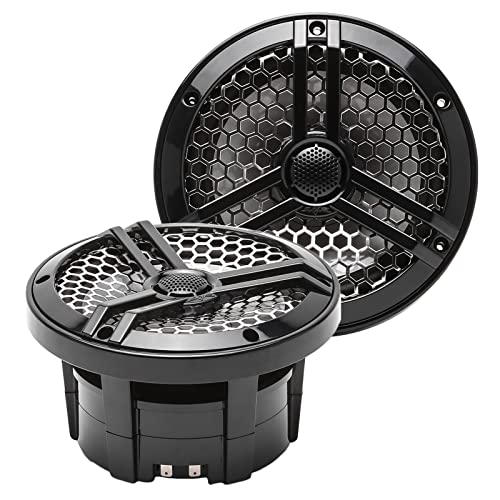
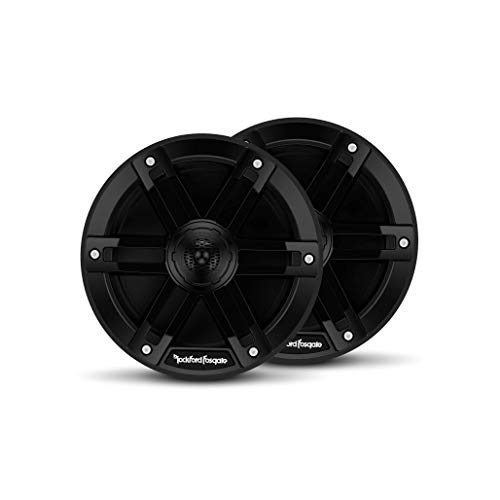
As an Amazon Associate we earn from qualifying purchases at no extra cost to you. Ratings are shown as listed on Amazon.
Best marine speakers by installation
- Best all-around deck choice: JL Audio M6 6.5-inch coaxial. It combines a marine-oriented build, strong UV resistance, a synthetic mica-filled polypropylene cone, and a 75-watt RMS rating at 4 ohms. It is a sensible choice for an open bow or cockpit where spray, sunlight, and engine noise demand more than a basic car speaker.
- Best for a high-output system: Wet Sounds REVO 6 or REVO 6 HD. These speakers are designed for loud wake-boat and powersports systems, with robust grilles, high power handling, and versions intended for amplified outdoor listening. Their larger baskets and deeper installation requirements matter in tight cabin panels.
- Best value for a mixed deck-and-cabin system: Fusion XS Series 6.5-inch coaxial. Fusion’s marine range offers UV-stable materials, sealed construction, and practical power ratings without moving into the highest price tier. It suits recreational boats using a moderate four-channel amplifier.
- Best budget replacement: Kicker KM Series 6.5-inch coaxial. KM speakers are widely available in marine configurations and offer a useful balance of price, output, and weather resistance. They are appropriate when replacing factory speakers without redesigning the entire audio system.
What separates a marine speaker from a car speaker?
Water resistance is only one part of marine durability. A boat speaker must tolerate salt residue, repeated heating and cooling, ultraviolet exposure, vibration, and water trapped behind the grille. A car speaker installed on a boat may sound acceptable initially but can develop swollen cones, corroded terminals, brittle surrounds, or seized tweeter hardware.
Look for a documented water-resistance or marine certification rather than the vague phrase “weather resistant.” An IP rating describes resistance to solids and water under defined test conditions. IPX6 generally indicates resistance to powerful water jets, while IPX7 indicates temporary immersion testing. Neither rating means the speaker should be left submerged indefinitely, and the rating may apply to a particular enclosure configuration rather than every installation condition.
UV resistance is equally important. Polypropylene cones, synthetic surrounds, UV-stabilized grilles, and corrosion-resistant fasteners generally last longer in direct sun than untreated paper cones, foam surrounds, and ordinary plated steel. A white grille may stay cooler than a black one, but color alone does not prove UV protection.
Head-to-head comparison
| Speaker or type | Nominal size | Typical RMS handling | Impedance | Best location | Approximate pair price |
|---|---|---|---|---|---|
| JL Audio M6 6.5-inch coaxial | 6.5 in | 75 W | 4 ohms | Exposed deck or cockpit | $350–$500 |
| Wet Sounds REVO 6 / REVO 6 HD | 6.5 in | About 100–150 W, depending on version | Usually 4 ohms | High-output deck system | $450–$700 |
| Fusion XS 6.5-inch coaxial | 6.5 in | About 50–80 W, depending on version | 4 ohms | Protected deck or cabin | $180–$300 |
| Kicker KM 6.5-inch coaxial | 6.5 in | About 65–75 W, depending on version | 4 ohms | Cabin or moderate deck use | $160–$280 |
| Basic marine-rated 6.5-inch coaxial | 6.5 in | 40–60 W | 4 ohms | Dry cabin and occasional use | $80–$160 |
Prices are broad market ranges because grille color, lighting, component versions, and seasonal availability change the cost. Confirm the exact current specifications before buying: manufacturers sometimes offer several speakers under one family name with different depth, sensitivity, and power ratings.
Deck versus cabin: choose for the acoustic problem
Open deck, bow, or swim platform
An exposed location needs the strongest protection and usually benefits from higher sensitivity and power handling. Water-resistant construction prevents immediate damage, but placement still matters: speakers mounted under a hardtop are easier to protect than speakers facing upward on a bow. Avoid installing a speaker where water can pool in the grille or drain directly into the cutout.
For a deck system, prioritize UV-stable grilles, sealed terminals, stainless or polymer mounting hardware, and at least 50–75 watts RMS per speaker if the boat is frequently used underway. A higher-output model is useful when the engine and wind are loud, but it does not compensate for poor placement or an undersized amplifier.
Cabin, cuddy, or enclosed seating area
A cabin is less demanding acoustically and environmentally. A 40–60-watt marine coaxial can be sufficient, particularly when the speakers are near the listeners. The enclosure is still exposed to condensation, so marine construction remains preferable to ordinary home or car speakers. Use a model with a shallower mounting depth if the panel backs onto a berth, locker, or wiring channel.
Do not select a speaker solely because its peak rating is large. RMS handling is the useful comparison. A speaker advertised at 300 watts peak may be designed for roughly 75–100 watts of continuous power, while a 75-watt RMS speaker can play cleanly with a properly adjusted 75-watt amplifier.
Decision matrix for common boat owners
| Your situation | Recommended direction | Why |
|---|---|---|
| Small boat, occasional weekends, limited budget | Basic marine-rated 6.5-inch coaxial | Spend on correct installation and sealed wiring rather than excess power. |
| Frequent sun and salt exposure | JL Audio M6 or comparable premium marine coaxial | Better materials and hardware justify the additional cost over several seasons. |
| Loud wake-boat or engine noise | Wet Sounds REVO or another high-sensitivity, high-power model | Designed to maintain output with a capable amplifier. |
| Cabin installation with shallow space | Fusion XS, Kicker KM, or a shallow marine coaxial | Moderate power and depth are easier to accommodate. |
| Replacing factory speakers without a new amplifier | 4-ohm coaxial with roughly 40–60 W RMS handling | Matches the typical output of a marine head unit better than a large competition speaker. |
Check fit before comparing sound quality
Measure the existing cutout, outside grille diameter, mounting depth, and screw-hole pattern. A “6.5-inch” speaker is not a universal size: cutout diameters commonly fall around 5.0–5.6 inches, while mounting depth may range from about 2.5 to more than 3.5 inches. A speaker that fits the hole can still strike a bulkhead or prevent a locker door from closing.
As a practical example, suppose a replacement speaker requires a 5.25-inch cutout and your boat has a 5.00-inch opening. The diameter difference is 0.25 inch, so only 0.125 inch of material must be removed around the entire radius. That can be feasible in fiberglass or plastic, but not if the surrounding panel is structural or already weakened. Make a cardboard template first and inspect the rear clearance before cutting.
Amplifier matching and wiring
For four 4-ohm speakers rated at 75 watts RMS each, a four-channel amplifier producing approximately 50–75 watts RMS per channel is an appropriate target. A 300-watt total amplifier output is therefore a reasonable system match. More power is not automatically dangerous; clipped, distorted power from an overloaded amplifier is often more damaging than clean power within the speaker’s rating.
Use tinned marine-grade copper cable where possible, waterproof connectors or adhesive-lined heat-shrink terminals, and a fuse sized for the amplifier and cable. Keep speaker connections above likely bilge-water level. Do not rely on the speaker grille or mounting screws to provide an electrical ground; marine speakers use separate positive and negative conductors.
Ownership realities: what wears out first
- Surrounds and gaskets: Sun, salt, and repeated drying can make flexible materials crack or lose their seal before the cone fails.
- Terminals: Bare or poorly crimped connections corrode quickly. A speaker may appear dead when the real problem is an open terminal or cable.
- Grilles: Salt crystals can block openings and create a raspy sound. Rinse with fresh water and dry with a soft cloth.
- Mounting holes: Overtightening can warp a basket or crush a gasket. Tighten screws evenly until sealed, not until the frame bends.
- Drainage: Never seal a speaker into a pocket that traps water. Follow the manufacturer’s mounting orientation and preserve any drainage path.
After saltwater use, lightly rinse exposed speakers with fresh water without directing a high-pressure jet at the cone or grille. Do not use solvents, abrasive cleaners, or silicone sprays unless the manufacturer specifically approves them. Inspect the gasket and wiring at the start of each season, and remove the grille only when necessary.
Bottom line
Choose a premium 6.5-inch marine coaxial such as JL Audio M6 for an exposed deck that sees regular sun and spray. Choose Wet Sounds REVO when maximum outdoor output matters and the installation has enough depth and amplifier power. For a cabin, protected cockpit, or sensible replacement system, Fusion XS or Kicker KM models provide a better balance of cost, fit, and performance. Whichever model you select, correct cutout measurements, sealed tinned wiring, fresh-water rinsing, and realistic RMS amplifier matching will have more influence on long-term results than a large peak-wattage number.

Write Your Review
No reviews yet. Be the first to share your experience!