

Key takeaways
- Shopping for a first harmonica? Compare five beginner-friendly key of C diatonic harmonicas, with plain guidance on combs, reeds, tuning, and care basics.
- Top Pick: Fender Blues Deluxe Harmonica, Key of C
- Runner-up: Final Verdict
- Also consider: Final Verdict
A first harmonica sets the tone for everything that follows. A leaky, poorly tuned instrument makes single notes hard to isolate and bends almost impossible, which leads many new players to blame themselves for problems that actually come from the harp. The good news is that the standard beginner format is simple: a 10-hole diatonic harmonica in the key of C matches the layout used by most free lessons, songbooks, and online tutorials.
The five harmonicas below all follow that format, but they differ in comb material, construction, and how easy they are to maintain over time. One is a long-running favorite from Hohner, one uses a modular design with replaceable reed plates, one is a low-commitment starter from Fender, one is a budget option sold with a case, and one is a premium Japanese model for buyers who would rather start with a step-up instrument.
As an Amazon Associate, we earn from qualifying purchases.
Quick Answer
For most beginners, the Hohner Special 20 in the key of C is the safest first harmonica: its plastic comb needs no special care, the recessed reed plates feel smooth, and it stays useful long after the basics click. The Lee Oskar Major Diatonic is the top alternative, the Fender Blues Deluxe and EastRock suit tight budgets, and the Suzuki HA-20 is the premium pick.
1. Hohner Special 20, Key of C
The Special 20 is the harmonica many teachers point to first, and the design explains why. Its reed plates are recessed into an injection-molded plastic comb, which creates a smooth, projecting mouthpiece with no sharp edges against the lips. Plastic also ignores moisture, so the comb will not swell after long practice sessions the way wooden combs can. For a beginner still building embouchure and breath control, that consistency matters more than vintage character.
The tuning is standard Richter, the layout nearly every beginner method assumes, and the 20 brass reeds respond evenly across all ten holes. Notes bend predictably once a player starts working on draw bends in the lower holes. Because the Special 20 has been a gigging instrument for decades, it does not become a throwaway once skills improve; it simply moves into rotation as a dependable everyday harp.
Specs
- Type: 10-hole diatonic harmonica
- Key: C
- Tuning: Richter
- Reeds: 20, brass
- Comb: Injection-molded plastic, with reed plates recessed into the comb
- Model: 560PBX-C
- Length: 10.2 cm, per listing details
- Case: Confirm on the listing
2. Lee Oskar Major Diatonic 1910, Key of C
Lee Oskar built this line around a practical idea: harmonicas wear out, so the parts that wear should be replaceable. The Major Diatonic uses a modular system in which the reed plates can be swapped when they eventually tire, instead of replacing the whole instrument. For a beginner planning to practice daily, that turns a first harmonica into a long-term platform rather than a disposable starter.
The Major Diatonic tuning is aimed at single-note melody playing across blues, rock, country, folk, and jazz, and the brand tunes its harmonicas slightly bright, to 441 hertz or higher, for a sound that carries in a mix. The key of C version, model 1910-C, matches standard lesson material. The covers are shaped with wide openings that help the sound project, and the whole design favors airtightness, which makes clean single notes easier for new players to find.
Specs
- Type: Major Diatonic harmonica
- Key: C
- Model: 1910-C
- Reed plates: Replaceable, part of a modular component system
- Tuning: Equal tuning by octaves, per brand materials
- Number of holes: Confirm on the listing
- Comb material: Confirm on the listing
- Case: Confirm on the listing
3. Fender Blues Deluxe Harmonica, Key of C
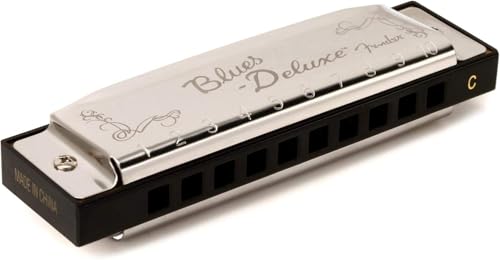
Fender’s Blues Deluxe is the low-risk way to find out whether harmonica practice sticks. It is a 10-hole diatonic in the key of C with a moisture-resistant ABS comb, so it shrugs off the heavy use and imperfect storage that first instruments usually get. Chromed metal covers give it a classic look, and a case is included to keep dust and pocket lint away from the reeds.
Expectations should match the format. This is a starter instrument for learning hole numbers, basic tongue blocking, and first melodies, not a harp built for demanding overblow technique. Many players start here, learn the fundamentals over a few months, and then move up knowing exactly which features matter to them. As a gift for a curious beginner, or a spare harp for the car or practice room, it fills the role well.
Specs
- Type: 10-hole diatonic harmonica
- Key: C
- Comb: ABS, moisture resistant
- Covers: Chromed metal
- Case: Included, per listing details
- Reed material: Confirm on the listing
- Tuning: Confirm on the listing
4. EastRock Blues Harmonica 10 Hole, Key of C
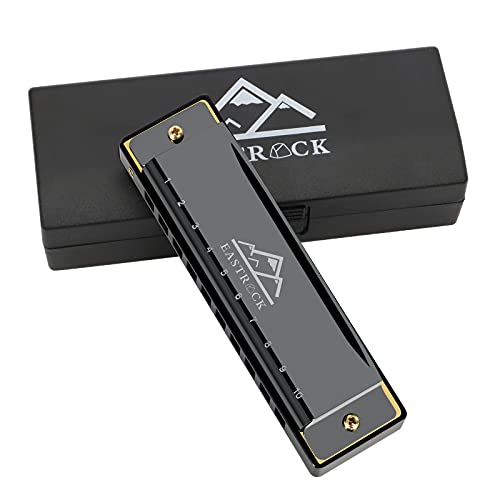
The EastRock is the budget end of this roundup: a 10-hole diatonic harmonica in the key of C, described by its maker as a beginner and middle level instrument, and sold with a case. For someone who wants to try harmonica alongside guitar at home, or a parent buying for a student, that simple package covers the essentials without a big commitment.
Budget harmonicas vary more from unit to unit than the bigger brands, so a new player should check that every hole blows and draws cleanly as soon as it arrives, while a return is still easy. If the instrument plays evenly, it is perfectly serviceable for learning songs, practicing scales, and getting comfortable with hand effects. Players who catch the bug can upgrade later and keep the EastRock as a knock-around backup.
Specs
- Type: 10-hole diatonic harmonica
- Key: C
- Level: Beginner and middle level, per the listing
- Case: Included
- Comb material: Confirm on the listing
- Reed material: Confirm on the listing
- Color options: Confirm on the listing
5. Suzuki Promaster Hammond HA-20, Key of C
The HA-20 is the step-up option in this group, part of Suzuki’s Promaster line and sold under the Hammond name. It is a 10-hole diatonic harmonica in the key of C, built in Japan to the tighter tolerances Suzuki is known for. Beginners do not need this level of instrument, but buyers who dislike buying twice sometimes prefer to start with a harp that will not hold them back as technique develops.
The trade-off is commitment. A premium harmonica rewards careful handling: it should live in its case, stay out of steamy bathrooms and hot cars, and be warmed in the hands before hard playing. For a motivated adult learner focused on blues and rock, the HA-20 offers a refined feel from day one. For a young student or an uncertain beginner, one of the plastic-comb models above is the more sensible first step.
Specs
- Type: 10-hole diatonic harmonica, Promaster Hammond series
- Key: C
- Model: HA-20-C
- Country of manufacture: Japan, per brand materials
- Comb material: Confirm on the listing
- Reed material: Confirm on the listing
- Case: Confirm on the listing
How to Choose
Start with the key. Nearly all beginner lessons, tabs, and play-along tracks assume a harmonica in the key of C, so that is the right first purchase even for blues fans; a C harp plays blues in G when used in second position, which is where most beginner blues material lives anyway.
Next, look at the comb. Plastic and ABS combs, like those on the Special 20 and Blues Deluxe, are the easiest for beginners because they do not swell, crack, or need drying time between sessions. Wooden combs offer a traditional feel but demand more care, and metal combs usually appear on step-up models such as the Suzuki.
Airtightness is the third factor. A harmonica that leaks air forces a beginner to blow harder, which wrecks breath control habits. Established brands hold tighter tolerances, and modular designs like the Lee Oskar add the option of fresh reed plates later. Finally, decide how the harmonica will be treated. A case, a safe storage spot, and a habit of tapping out moisture after playing will extend the life of any model on this list.
Who Should Skip
Skip this entire category if the goal is to play fully chromatic music, jazz standards in every key, or classical repertoire from day one; that calls for a chromatic harmonica with a slide, which is a different instrument. Also skip the premium Suzuki if the harmonica is for a small child, since reeds are delicate and harmonicas are not toys. Players who already own a decent key of C harp do not need a second beginner model either; the smarter next purchase is a second key, such as A or G, for playing along with guitar-based songs.
FAQ
Which key should a beginner harmonica be in?
The key of C. Most beginner books, video lessons, and free tabs are written for a C harmonica, and a C diatonic also covers blues in G through second position playing, so one instrument handles the majority of early material.
Is a plastic comb better than a wooden comb for a first harmonica?
For most beginners, yes. Plastic and ABS combs resist moisture, need no breaking in, and feel smoother against the lips. Wooden combs are traditional and many experienced players love them, but they swell with moisture and ask for gentler handling.
How long does a beginner harmonica last?
It depends on use and care. Gentle daily practice can keep a quality harmonica playing well for years, while hard blowing shortens reed life. Storing the harmonica in its case, tapping out moisture after playing, and never eating or drinking sugary drinks right before playing all help.
When should a beginner buy a second harmonica?
Once the basics feel comfortable, usually after a few months of regular practice. The usual second purchase is a different key rather than a fancier version of the same key, with A and G being the most useful additions for playing along with guitar players.
Final Verdict
The Hohner Special 20 is the default recommendation for a first harmonica: comfortable, consistent, and good enough to keep for years. The Lee Oskar Major Diatonic is the smart alternative for players who like the idea of replacing reed plates instead of instruments. The Fender Blues Deluxe and EastRock keep the cost of trying low, and the Suzuki HA-20 is there for beginners who prefer to start with a premium Japanese harp.



More from Amazon
Programs that pair well with the guide above. Offers and eligibility are set by Amazon and may change.
Free shipping on eligible items, Prime Video and more. Eligible new members can start with a free trial.
Start a Prime free trialAudiobooks and podcasts to listen to on the go. Eligible new members can start with a free trial.
Try Audible freeAd-free music streaming. Eligible new subscribers can start with a free trial.
Try Music Unlimited freeA free business account with business pricing and bulk-buying tools for work, shop or home office.
Create a business accountAs an Amazon Associate we earn from qualifying purchases.
Write Your Review
No reviews yet. Be the first to share your experience!