

Key takeaways
- The best guitar humidifiers compared: two-way case packs from Boveda and D'Addario, plus refillable soundhole picks from Oasis and MusicNomad.
- Top Pick: Boveda Music Large Starter Kit
- Runner-up: D'Addario Acoustic Guitar Humidifier (GH)
- Also consider: Final Verdict
An acoustic guitar is happiest in the same air its owner is: guitar makers generally recommend keeping wooden instruments at roughly 45 to 55 percent relative humidity. Heating, desert climates and air conditioning dry the air out, and dry wood shrinks. The visible results are sunken tops, sharp fret ends, lifted bridges and, in the worst cases, cracks along the grain. A guitar humidifier is a small, inexpensive way to hold the air inside the case closer to that safe band.
The five picks below fall into two families. Two-way packs, represented here by Boveda and D’Addario Humidipak, release moisture when the air is dry and absorb it when the air is damp, with no water to pour. Refillable designs from Oasis, MusicNomad and D’Addario use a sponge or membrane and distilled water, cost little to keep running, and ask for a quick check every week or two. Which family suits you depends on your climate, how many guitars you own and how much routine you will keep.
As an Amazon Associate, we earn from qualifying purchases.
Quick Answer
For set-and-forget two-way control in a closed case, the Boveda Music Large Starter Kit is the simplest route. Players who prefer a refillable soundhole tube should look at the Oasis OH-1, while the MusicNomad MN300 Humitar makes sponge checks easy with its flip-top holder. The D’Addario GH is the basic string-suspended sponge design, and the Humidipak replacement packets keep an existing D’Addario two-way system running.
1. Boveda Music Large Starter Kit

Boveda built its name on two-way humidity control, and this starter kit packages that system for large wooden instruments. Each pack holds a saltwater solution sealed in a vapor-permeable membrane, pre-set to keep the surrounding air at 49 percent relative humidity. When the case air dries out, the pack releases moisture; when the air turns muggy, it absorbs the excess. There is nothing to fill and no sponge to squeeze out.
The kit is sized for guitars and other large instruments, so one kit outfits one case. The packs sit inside fabric holders rather than loose against the finish, and the system works as intended only inside a closed, reasonably sealed case. When a pack turns firm and crunchy, it is spent and gets replaced. Players with several acoustics should budget for a kit per case rather than rotating one kit between guitars.
Specs
- Type: Two-way humidity control starter kit
- Target level: 49 percent relative humidity, per the listing
- Pack size: 60 grams, per the listing
- Contents: 3 standard packs for large instruments; holder count and layout: confirm on the listing
- Placement: Inside an instrument case
- Instruments: Guitars and other large wooden instruments, per the listing title
- Power or refills: None; packs are replaced when they harden
2. Oasis OH-1 Guitar Humidifier
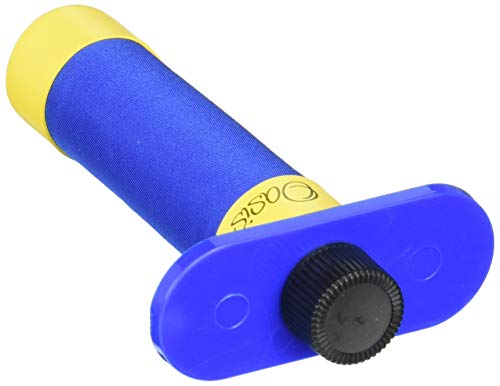
The OH-1 is the classic refillable soundhole humidifier. It is a slim tube that hangs between the strings into the body of the guitar, held by a stabilizer bar across the soundhole. The tube body is made from a fabric that lets water vapor pass through while keeping liquid water in, and absorbent crystals inside turn the fill water into a gel, so no free liquid sloshes against the wood.
The reservoir visibly shrinks as water leaves it, so a glance shows when a refill is due. The listing includes a 10 cc syringe for controlled filling with distilled water, which the maker recommends because mineral-heavy tap water can clog the liner over time. The OH-1 only adds moisture, so it suits dry homes and dry seasons; it cannot pull humidity down in a swampy summer.
Specs
- Type: Refillable soundhole humidifier
- Capacity: 10 milliliters, per the listing
- Includes: Stabilizer bar and 10 cc filling syringe, per the listing
- Body: Fabric that passes water vapor but not liquid water, per the listing
- Placement: Suspended in the soundhole between the strings
- Water: Distilled water recommended by the maker
- Direction: Adds moisture only
3. MusicNomad MN300 The Humitar
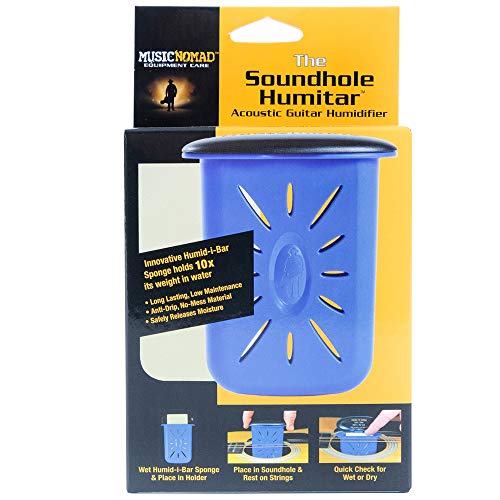
The Humitar fixes the sponge soundhole design’s most annoying trait: checking the sponge. The holder hangs between the strings like its rivals, but the top flips open so the sponge inside can be checked without pulling the unit out of the guitar. The sponge is reusable and, per the maker, holds ten times its weight in water, which stretches the interval between top-ups compared with a plain foam insert.
The anti-drip material is designed to release moisture evenly rather than weep, and the routine is simple: soak the sponge with distilled water, blot the excess, close the lid and hang the unit in the soundhole. Like the Oasis, the Humitar adds moisture only, so pairing it with an inexpensive case hygrometer is a sensible habit.
Specs
- Type: Soundhole humidifier with reusable sponge
- Sponge: Humid-i-Bar, holds ten times its weight in water, per the maker
- Design: Flip-top holder for checking the sponge in place; anti-drip material
- Model: MN300
- Placement: Suspended in the soundhole between the strings
- Water: Distilled water recommended by the maker
- Direction: Adds moisture only
4. D’Addario Acoustic Guitar Humidifier (GH)

The GH is the long-running budget version of the string-suspended sponge humidifier. A small housing holds a sponge, the housing hangs in the soundhole suspended by the strings, and the design keeps the unit from touching the body of the instrument at all. Moisten the sponge, set it in the housing, and the foam releases moisture slowly and evenly into the body cavity.
There is very little to go wrong here, and very little to adjust: no settings, no membrane, no packets to track. The trade-off is capacity and feedback. The small sponge needs rewetting more often than the larger designs in this guide, and nothing about the unit reports the humidity inside the case, so it rewards a regular checking rhythm, ideally with a case hygrometer alongside.
Specs
- Type: Soundhole humidifier with sponge
- Design: Suspends from the strings and never touches the guitar body, per the listing title
- Release: Non-drip sponge releases moisture slowly and evenly, per the listing
- Model: GH
- Placement: Soundhole of an acoustic guitar, used inside the case
- Water: Confirm on the listing
- Direction: Adds moisture only
5. D’Addario Humidipak Replacement Packets, 3-Pack
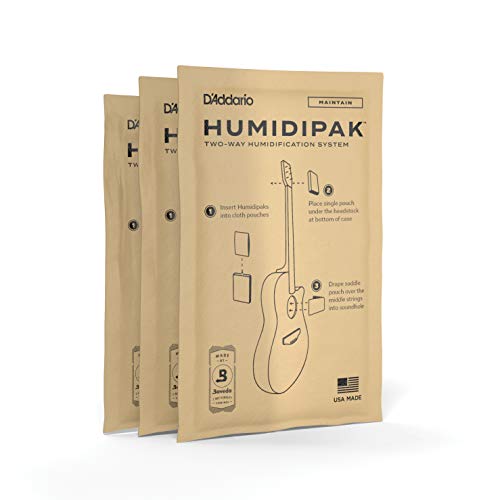
Humidipak is D’Addario’s two-way system, built on the same membrane technology as the Boveda packs: the packets add or remove moisture automatically to hold the case at an optimal 45 to 50 percent relative humidity, with no water, no refills and no settings. This listing is the consumable half of that system, a three-pack of Maintain replacement packets, and it belongs here because every Humidipak owner needs them on a recurring basis.
The packets work inside the reusable pouches from the Humidipak Maintain kit, one in the soundhole and one near the headstock, so buyers without the kit should start with the kit itself rather than this refill. Per the listing, a set of packets lasts between two and six months depending on climate and case seal; when they turn firm, they are done and this three-pack is the replacement.
Specs
- Type: Two-way humidification replacement packets
- Pack count: 3 Maintain packets
- Model: PW-HPRP-03
- Target level: Maintains 45 to 50 percent relative humidity, per the listing
- Lifespan: 2 to 6 months per set, per the listing
- Requires: Humidipak system pouches from the Maintain kit, sold separately
- Placement: Inside a sealed instrument case
How to Choose
Start with your climate. In a home that is dry all winter and reasonable the rest of the year, a refillable soundhole humidifier such as the Oasis OH-1, the MusicNomad Humitar or the D’Addario GH covers the dry season at very low running cost. In a climate that swings both ways, a two-way system from Boveda or D’Addario is the safer match because it absorbs excess moisture as well as releasing it.
Next, be honest about routine. Sponge and membrane humidifiers only work while they hold water, so they need a check every one to two weeks in heating season. Two-way packs need no attention until they harden, but they are consumables with a recurring replacement cost, and they only regulate inside a closed case. Whichever route you choose, add a small digital hygrometer to the case: none of the refillable picks reports the actual humidity, and guessing is how guitars end up cracked.
Finally, match the device to the guitar. Soundhole models need a standard round soundhole; case packs need a case that seals well enough to hold a microclimate. A guitar already badly dried out, with a sunken top or cracks started, needs a luthier before any of these products can help.
Who Should Skip
Solid-body electric players with no acoustic or hollow-body instruments can skip this category entirely; a solid body has no thin soundboard to protect. Players whose homes sit naturally between 45 and 55 percent relative humidity all year, verified with a hygrometer rather than assumed, gain little from a case device. Anyone hoping to humidify a whole room of guitars with one small case product should look at room humidification instead, because every product here works in the sealed space of a single case. Owners of gig bags should also note that two-way packs depend on a reasonably sealed hard case to hold their target level.
FAQ
What humidity level should an acoustic guitar be kept at?
Most guitar makers recommend roughly 45 to 55 percent relative humidity for wooden instruments. Below that band, wood shrinks and tops can sink or crack; well above it, guitars can swell and sound dull. A small hygrometer in the case is the only reliable way to know where your guitar actually sits.
Do these humidifiers work for electric guitars?
The two-way pack systems work for any wooden instrument stored in a case, including hollow and semi-hollow electrics. Soundhole models are acoustic-only, since they need a soundhole to hang in. A solid-body electric is far less sensitive to humidity than an acoustic, so most solid-body owners skip humidification.
How often do refillable soundhole humidifiers need topping up?
In a heated winter home, expect to check a sponge or membrane humidifier every one to two weeks; in milder weather the same fill lasts much longer. The Oasis tube visibly shrinks as it empties, and the Humitar sponge can be checked by touch through its flip top, so build the check into a regular practice routine.
Can I use tap water in a sponge or membrane humidifier?
Makers of these products recommend distilled water. Tap and bottled water carry dissolved minerals that can clog the Oasis liner, stiffen sponges and shorten the working life of the unit. Distilled water is cheap and widely available, and one bottle lasts a long time at the small volumes these humidifiers use.
Final Verdict
For most acoustic owners, the Boveda Music Large Starter Kit is the easiest recommendation: true two-way control, no water to handle, and nothing to remember until a pack hardens. Players who prefer a refillable device should choose between the Oasis OH-1 for its leak-resistant tube and the MusicNomad MN300 Humitar for its check-in-place sponge; the D’Addario GH covers the simple, low-cost end. Existing Humidipak owners should keep the replacement three-pack on hand so the system never lapses.
More from Amazon
Programs that pair well with the guide above. Offers and eligibility are set by Amazon and may change.
Free shipping on eligible items, Prime Video and more. Eligible new members can start with a free trial.
Start a Prime free trialAudiobooks and podcasts to listen to on the go. Eligible new members can start with a free trial.
Try Audible freeAd-free music streaming. Eligible new subscribers can start with a free trial.
Try Music Unlimited freeA free business account with business pricing and bulk-buying tools for work, shop or home office.
Create a business accountAs an Amazon Associate we earn from qualifying purchases.






Write Your Review
No reviews yet. Be the first to share your experience!