

Key takeaways
- Line of sight: Hills, concrete buildings, metal structures, and thick vegetation block or weaken UHF signals.
- Antenna height: Raising the antenna often improves coverage more effectively than increasing power.
- Antenna quality: A properly tuned external antenna can outperform a longer-looking but poorly matched antenna.
- Receiver location: Holding a handheld vertically and keeping it away from your body or vehicle frame can improve the signal.
The best GMRS radios for most families are the Midland MXT275 for vehicle-to-vehicle communication, the BTECH GMRS-PRO for a feature-rich handheld, and the Motorola T600 H2O for simple waterproof use around camp, trails, and the water.
GMRS performance depends less on the advertised “miles” number than on antenna height, terrain, battery condition, and whether you are using a handheld or a vehicle-mounted radio. The choices below focus on practical range, clear audio, weather resistance, operating time, and controls that family members can use without a steep learning curve.
Our top picks

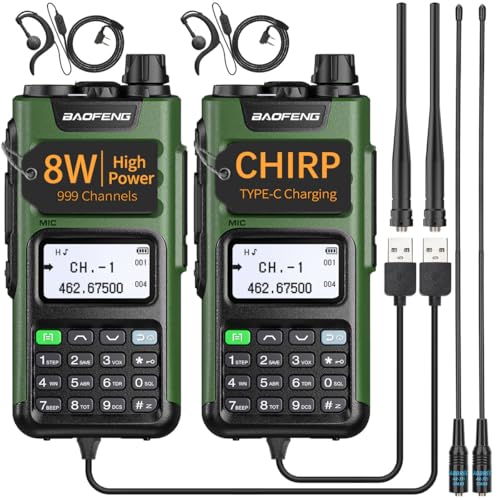


As an Amazon Associate we earn from qualifying purchases at no extra cost to you. Ratings are shown as listed on Amazon.
Best GMRS radios by situation
| Situation | Best fit | Why it makes sense | Typical market range |
|---|---|---|---|
| Family outings and water activities | Motorola T600 H2O | Floating, waterproof design, simple controls, weather-channel access | $70–$110 per pair |
| Vehicle convoys and road trips | Midland MXT275 | 50-watt mobile radio, external antenna support, compact front-facing controls | $150–$220 for the radio |
| Experienced handheld users | BTECH GMRS-PRO | Rechargeable battery, Bluetooth/app features, GPS and messaging functions | $130–$180 per radio |
| Low-cost home, campground, or neighborhood use | GMRS handheld radio pair | Affordable entry point with privacy-code and repeater support | $35–$90 per pair |
| Longer handheld battery life | GMRS handheld with a 2,000–2,800 mAh pack | More operating time than small alkaline-compatible units | $60–$160 per radio |
Head-to-head: handheld versus mobile GMRS radios
Handheld radios: portable, convenient, and terrain-limited
A handheld GMRS radio is the easiest choice for hiking groups, families at a campground, and keeping in contact around a property. Its built-in antenna and battery make it self-contained, but those same limitations reduce range. A person holding a radio at chest height may have only a few miles of reliable communication in open country, and much less through dense trees, hills, buildings, or vehicles.
Advertised ranges of 20, 30, or more miles generally assume unusually favorable line-of-sight conditions, with both radios elevated and little obstruction. In a typical neighborhood, a dependable range may be closer to one-half to two miles. From a hilltop to another clear location, it can be substantially greater.
Mobile radios: the practical range upgrade
A vehicle-mounted GMRS radio uses the vehicle battery, a more efficient external antenna, and often higher transmit power. The Midland MXT275 is a compact 15-watt mobile unit; the Midland MXT500 provides up to 50 watts and is better suited to demanding vehicle-to-vehicle work. A properly installed roof- or hood-mounted antenna usually improves communication more than simply buying a handheld with a larger advertised range.
Mobile radios are less convenient outside the vehicle. They also require careful installation: the antenna needs a suitable ground plane, the coaxial cable should be routed away from crushing and sharp bends, and the radio must be fused close to the power source. Poor installation can create weak transmission, electrical noise, or damage to the equipment.
Range depends on four things
- Line of sight: Hills, concrete buildings, metal structures, and thick vegetation block or weaken UHF signals.
- Antenna height: Raising the antenna often improves coverage more effectively than increasing power.
- Antenna quality: A properly tuned external antenna can outperform a longer-looking but poorly matched antenna.
- Receiver location: Holding a handheld vertically and keeping it away from your body or vehicle frame can improve the signal.
As a useful planning example, suppose a family needs communication across a two-mile campground with trees and gentle slopes. Two handheld radios may work at some points but fail behind a hill or dense stand of trees. A mobile radio with a roof-mounted antenna in each vehicle gives a better margin, while a GMRS repeater can extend coverage across a larger area if the radios and repeater are configured correctly.
Waterproofing, battery life, and everyday durability
For boating, rain, kayaking, or children who may drop equipment near water, look for an explicit IP rating rather than a vague statement such as “weather resistant.” The Motorola T600 H2O is designed to float and is rated IP67, meaning it is protected against dust and temporary immersion under the rating’s test conditions. Waterproofing is valuable, but it does not make a radio indestructible: seals, battery doors, charging covers, and gaskets can wear or collect grit.
Many handheld GMRS radios provide roughly 8–16 hours of practical intermittent use per charge. That estimate changes sharply with transmit time, power setting, temperature, scanning, display brightness, and battery age. A radio rated for 2,600 mAh may last longer than a 1,000 mAh model, but capacity alone does not predict exact runtime because transmit power and circuit efficiency differ.
For a weekend trip, calculate conservatively. If a radio averages 120 mA during standby and 1,500 mA while transmitting, with 10 percent of the time spent transmitting, the approximate average draw is:
(0.9 × 120 mA) + (0.1 × 1,500 mA) = 258 mA.
A 2,600 mAh battery would theoretically last about 10 hours under that pattern, before cold-weather losses and battery aging. Carry a spare battery or a USB power bank rather than relying on the manufacturer’s best-case figure.
Controls that work for families
The most family-friendly radio is not necessarily the one with the most features. Large channel buttons, a physical volume knob, a bright display, a strong belt clip, and a clear battery indicator matter when users are wearing gloves or helping children.
Privacy codes are often misunderstood. CTCSS and DCS codes do not encrypt a conversation or prevent other users from hearing it. They simply keep the speaker quiet unless a matching tone is detected. Anyone using the same channel without the code may still hear transmissions, and a user with the correct code can still hear interference from other sources.
Radios with programmable channels, repeater offsets, scanning, and app control can be excellent for experienced users. They can also create mistakes: a family member may change the channel, disable the tone, or select a repeater channel without understanding it. For mixed-experience groups, program a small set of clearly labeled channels and lock the keypad when possible.
Licensing and legal basics in the United States
GMRS requires an FCC license for eligible users in the United States. There is no examination requirement, and one license generally covers the licensee and immediate family members as defined by FCC rules. The license term is 10 years, and the FCC application fee is commonly listed as $35, though fees can change.
Use radios that are certified for GMRS operation, follow the radio’s permitted power levels, and use only antennas and configurations allowed by FCC rules. Do not assume that a “privacy” setting makes a channel private, and do not transmit on emergency or public-safety frequencies. If you plan to use a repeater, confirm its access tone and permission requirements before transmitting.
Ownership realities: what wears out first
- Battery packs: Rechargeable batteries gradually lose capacity. Replacement availability matters as much as the original runtime.
- Charging ports: Repeatedly pulling a cable sideways can loosen USB connectors. A charging dock or careful cable routing helps.
- Seals and covers: Rinse dirt from waterproof radios with fresh water and dry them before opening the battery compartment.
- Belt clips: Clips and attachment screws take repeated impact. Check them before climbing, boating, or working near machinery.
- Antennas: Do not use a damaged or sharply bent antenna. On mobile systems, inspect the coax connector and cable after off-road driving.
Store lithium-ion batteries partly charged in a cool, dry place when the radios will not be used for months. Avoid charging visibly swollen, cracked, or overheated packs. For radios used by children, set the channel and volume before handing them over and explain the push-to-talk delay: press the button, pause briefly, then speak.
Bottom line
Choose the Motorola T600 H2O when waterproofing, floating, and simple family operation matter most. Choose the Midland MXT275 or MXT500 when the main goal is dependable vehicle-to-vehicle range and you can install an external antenna. Choose the BTECH GMRS-PRO when you want a more advanced handheld with rechargeable power and app-based features. For occasional neighborhood or campground use, a basic GMRS pair is sufficient, provided you accept realistic range and obtain the required FCC license.



Write Your Review
No reviews yet. Be the first to share your experience!