

Key takeaways
- Compare the best violin shoulder rests from Kun, Everest, Fiddlerman and Bonmusica, with sizing, adjustability and fit checks for students and players.
- Top Pick: Kun Original 4/4 Violin Shoulder Rest
- Runner-up: EVEREST ES4G ES Series Violin Shoulder Rest
- Also consider: Fiddlerman Wood Violin Shoulder Rest
A shoulder rest looks like a small accessory, but it decides how the violin balances between your jaw and shoulder for every minute you play. The right one fills the gap under the instrument so your head stays level, your left hand stays free to shift and vibrate, and you are not clamping down with your chin just to keep the violin from sliding toward the floor.
The wrong one causes just as much trouble: feet that slip off the bouts mid-piece, a curve that digs into your collarbone, or a height that forces your neck into a tilt. This guide compares five well-known rests across the main design families — pre-shaped plastic, collapsible, wood, hardwood and fully bendable metal — so you can match the shape and adjustment range to your body and your instrument size before you order.
As an Amazon Associate, we earn from qualifying purchases.
Quick answer
For most 4/4 players, the Kun Original is the safe starting point: it adjusts in three directions, locks its feet so they cannot swing into the varnish, and suits students and teachers alike. Players who want a rest they can shape by hand should look at the Bonmusica, while the Fiddlerman Wood suits anyone who prefers a wooden body with collapsible feet for case storage.
Kun Original 4/4 Violin Shoulder Rest

The Kun Original is the rest most teachers reach for first, and its design has barely changed in decades because the basics work. The curved bar is pre-shaped to sit across the shoulder, and the end members carry a patented locking device so the feet cannot rotate loose and touch the instrument while you play.
Adjustment runs in three directions — height, width and tilt — which covers most of what a student or advancing player needs to dial in. The T-shaped feet grip the edges of the back plate, and because the feet do not fold, the rest keeps its settings between sessions instead of needing to be set up again each time.
Specs
- Size: 4/4, and the listing also covers 3/4 instruments
- Body material: plastic, per the listing
- Adjustment: three directions, with locking end members
- Feet: T-shaped, non-folding
- Item weight: 0.15 pounds, per the listing
- Item dimensions: 7 x 2 x 3 inches, per the listing
- Model number: 830300
Choose this one if you want the widely recommended default and your case has room for a non-folding rest.
EVEREST ES4G ES Series Violin Shoulder Rest
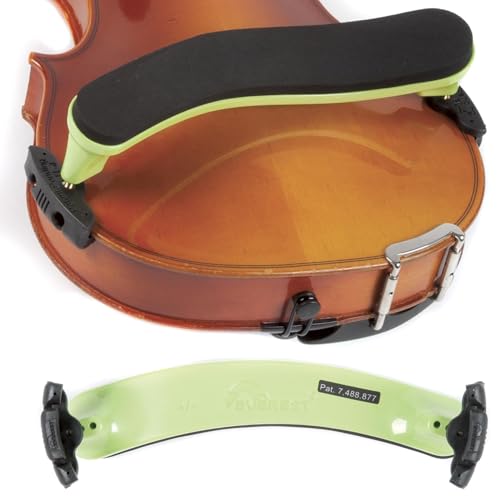
Everest built its name on pre-shaped rests with thicker padding than the classic designs, and the ES series follows that pattern. The one-piece body has a fixed ergonomic curve intended to promote a natural playing angle, with a foam pad that gives the shoulder a softer landing than thinly padded bars.
The feet screw into different positions along the body, which changes both the grip width and the height, so one rest can be set up for a growing student or shared between similar-sized instruments. Because the curve is fixed, the fit depends on how well that molded shape matches your own shoulder, which is the main trade-off against fully adjustable designs.
Specs
- Size: 4/4 violin
- Body: one-piece pre-shaped design with foam padding
- Adjustment: feet reposition along the body for width and height
- Curve: fixed ergonomic shape, not bendable
- Exact weight and foot thread size: confirm on the listing
Choose this one if you want generous padding and a simple setup with no separate parts to lose.
Fiddlerman Wood Violin Shoulder Rest
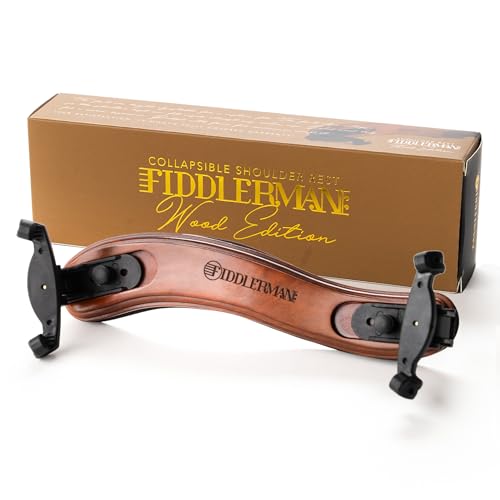
The Fiddlerman rest takes the familiar bar shape and builds it from solid wood instead of plastic, which gives it a traditional look that sits naturally next to a wooden instrument. Foam padding runs along the top surface, so the contact feel stays soft even though the body itself is rigid.
Its feet are both height adjustable and collapsible, so the rest folds flatter for storage inside a case accessory pocket — a practical detail for students carrying a shaped case with limited room. The same frame fits full-size and 3/4 violins, and the maker also lists it for smaller violas, which makes it a flexible pick for households with more than one instrument.
Specs
- Size: 4/4 and 3/4 violins, plus 13 and 14 inch violas, per the maker
- Body material: solid wood with foam padding
- Feet: height adjustable and collapsible
- Warranty: 12 months through Fiddlershop, per the maker
- Exact weight: confirm on the listing
Choose this one if you prefer the look and feel of wood and need feet that fold away for the case.
Kun Bravo 4/4 Violin Shoulder Rest

The Kun Bravo is the step up inside the Kun range: the same proven geometry as the Original, but built with a hardwood bar and brass fittings instead of an all-plastic body. Players who like the Kun fit but want a warmer look and a more substantial feel tend to land here.
It keeps the height, width and tilt adjustment of the standard design, so setup follows the same process of setting the feet to the bouts and then fine-tuning the angle. The foam padding and the locking-style end members carry over as well, which means a player moving up from an Original will find the Bravo immediately familiar.
Specs
- Size: 4/4 violin
- Body material: hardwood with brass fittings, per the maker
- Adjustment: height, width and tilt
- Padding: foam
- Exact weight and dimensions: confirm on the listing
Choose this one if the standard Kun shape already fits you and you want the hardwood version of it.
Bonmusica 4/4 Violin Shoulder Rest

The Bonmusica takes the opposite approach to a fixed curve: its metal frame is meant to be bent by hand until it matches your shoulder. The padded bar extends into a hook shape that wraps over the shoulder, which holds the violin in place for players whose instrument keeps sliding forward during shifting or vibrato.
Height, width and the curve itself all adjust, and the feet can be swapped for shorter or longer versions, so the fitting process is more involved than with a pre-shaped rest — expect to spend some time shaping it, ideally with a teacher checking your posture. The trade-off is bulk: the hooked shape takes more room than a straight bar and may not fit inside every case.
Specs
- Size: 4/4 violin (the range also runs down to small fractional sizes)
- Frame: bendable metal with foam padding
- Adjustment: height, width and frame curve; feet can be changed for other lengths
- Origin: made in Germany, per the maker
- Exact weight: confirm on the listing
Choose this one if standard rests slide on your shoulder and you are willing to shape a frame to your own build.
How to choose
Start with size. The rest must match your violin: a 4/4 rest on a 1/2 instrument will not grip correctly, and several models above cover two sizes, which helps students who are about to move up. Next, think about your neck length. A longer neck usually needs a taller rest or longer feet, while a shorter neck suits a low-profile bar; height adjustment range matters more than any single setting.
Then decide how much shaping you want to do. Pre-shaped rests like the Everest and the Kun models work straight out of the box if their curve matches your shoulder. A bendable frame like the Bonmusica asks for patience but can match bodies that fixed curves never quite fit. Finally, check your case: collapsible feet, like the Fiddlerman’s, matter if your case pocket is small, and a hooked frame may need to travel separately.
Whatever you pick, set it up so the violin rests level without you raising your shoulder or pressing down with your jaw, and re-check the feet after the first few sessions as the pads settle.
Who should skip
Skip a shoulder rest purchase for now if you have not settled your violin size yet — a child about to move from 1/2 to 3/4, for example, is better served by a rest sized for the new instrument. Players who already play comfortably with a simple foam pad or sponge, and whose teacher is happy with their posture, may also gain little from a full framed rest.
You should also skip the highly shapeable models if you do not have time to fit them properly: a badly bent frame is worse than a plain pre-shaped bar. And if your collarbone area is sensitive because of an injury, talk to your teacher or a medical professional about your setup rather than experimenting with taller rests on your own.
FAQ
Do I really need a shoulder rest to play violin?
Many teachers recommend one because it fills the space between the violin and the shoulder, which helps the left hand move freely instead of supporting the instrument. Some players, including some advanced schools of playing, use only a small pad or nothing at all. It is a personal setup choice best made with your teacher’s input.
How do I know which size shoulder rest to buy?
Match the rest to the size stamped on your violin’s label or measured by your teacher: 4/4 is full size for most adults and older students, with 3/4, 1/2 and smaller sizes for younger players. Several rests adjust across two sizes, but a rest built for the correct size grips the bouts most securely.
Can a shoulder rest damage the violin varnish?
A correctly fitted rest grips the edges of the back plate with rubber-covered feet and should not touch the varnish in the middle of the back. Damage risk comes from loose feet swinging inward or metal parts contacting the wood, which is why locking feet and a careful first fitting matter. Check the contact points regularly for wear.
Will a shoulder rest change how my violin sounds?
The rest clamps to the edges of the back, and players disagree about whether that slightly damps vibration. Any effect is small compared with the comfort and stability gains for most students, and it can be reversed simply by removing the rest. If you are concerned, compare the same passage with and without the rest fitted.
Final verdict
Most players should start with the Kun Original: it is the reference design for a reason, with three-way adjustment and feet that lock in place. Move to the Bonmusica if slipping is your main problem and you want a frame you can shape to your own shoulder, or to the Fiddlerman Wood if you want collapsible feet and a wooden body. The Everest ES4G is the padded, simple option, and the Kun Bravo is the hardwood upgrade for players already happy with the Kun shape.
More from Amazon
Programs that pair well with the guide above. Offers and eligibility are set by Amazon and may change.
Free shipping on eligible items, Prime Video and more. Eligible new members can start with a free trial.
Start a Prime free trialAudiobooks and podcasts to listen to on the go. Eligible new members can start with a free trial.
Try Audible freeAd-free music streaming. Eligible new subscribers can start with a free trial.
Try Music Unlimited freeA free business account with business pricing and bulk-buying tools for work, shop or home office.
Create a business accountAs an Amazon Associate we earn from qualifying purchases.




Write Your Review
No reviews yet. Be the first to share your experience!