

Key takeaways
- Compare the best violin accessories, from a Kun shoulder rest and Dominant strings to Kaplan rosin, a Korg tuner metronome and a Boveda humidity kit.
- Top Pick: Kun Original 4/4 Violin Shoulder Rest
- Runner-up: D'Addario Kaplan Premium Rosin with Case, Dark
- Also consider: Korg TM-70 Tuner-Metronome Combo Pack, White
A violin on its own is only half the setup. The small items that live in the case pockets — a shoulder rest, a fresh set of strings, the right rosin, a tuner you can trust, and something to keep the wood stable — decide how comfortable daily practice feels and how well the instrument holds up over years of playing. None is glamorous, but each solves a specific, recurring problem.
This guide rounds up five violin accessories that cover the core jobs: support, strings, bow grip, tuning and timing, and humidity care. Each pick is a long-running, widely stocked product from a specialist maker, chosen for the way students and advancing violinists actually practice at home, in lessons, and in rehearsals.
As an Amazon Associate, we earn from qualifying purchases.
Quick Answer
Start with support and consumables. A Kun Original shoulder rest keeps a 4/4 violin stable without clamping your shoulder, Thomastik Dominant strings are the reference replacement set when factory strings wear out, and D’Addario Kaplan Premium dark rosin restores bow grip in a protective case. Add a Korg TM-70 combo for tuning and tempo work, plus a Boveda starter kit to guard the wood inside the case.
1. Kun Original 4/4 Violin Shoulder Rest

The shoulder rest is usually the first accessory a teacher asks a new player to buy, and the Kun Original is the model that shows up in lesson studios everywhere. Its curved bar bridges the gap between the violin’s back and your shoulder, so the instrument stays level with less chin gripping and less neck tension.
The design is deliberately simple. The bar adjusts in three directions — height, width, and tilt — to fit different shoulder shapes and both 3/4 and 4/4 instruments. The end members use a patented locking device, and the T-shaped feet grip the edge of the violin without the hardware ever touching the varnished back.
Because the bar does not fold flat, players with very shallow cases should check the accessory compartment first; the Collapsible version from the same maker exists for tight cases. For everyone else, the fixed curve is the point: once set, it goes on the same way every time, building a consistent playing position.
Specs
- Fits: 4/4 violin (listing also covers 3/4 size)
- Adjustment: three directions — height, width, and tilt
- Feet: T-shaped with patented locking end members
- Model number: 830300
- Item dimensions: 7 x 2 x 3 inches per the listing
- Warranty: 1 year limited warranty per the listing
2. Thomastik-Infeld Dominant Violin Strings, Complete Set 135
Factory strings on student outfits are a placeholder, and the Dominant set is the standard first upgrade teachers suggest. Dominants use a multi-strand synthetic core that behaves much like gut — flexible and largely indifferent to humidity swings — while keeping a warm, rounded character that flatters most student and intermediate instruments.
This 135 set is the medium-tension 4/4 configuration: the A and D strings are aluminum wound, the G string is silver wound for a darker lower register, and the E string is plain steel with a removable ball end, so it works with single fine tuners and full fine-tuner tailpieces alike. Buying the complete set matters, because mixing one new string with three tired ones leaves the balance uneven.
Synthetic-core strings still need a short break-in period before they hold pitch reliably, and the plain steel E is the string players most often swap later for a wound or plated alternative. As a balanced baseline any teacher or shop will recognize, the Dominant 135 set is the safest replacement you can fit.
Specs
- Size: 4/4, complete four-string set
- Tension: medium
- Core: multi-strand synthetic (perlon)
- Winding: A and D aluminum, G silver
- E string: steel, removable ball end
- Model: 135
3. D’Addario Kaplan Premium Rosin with Case, Dark
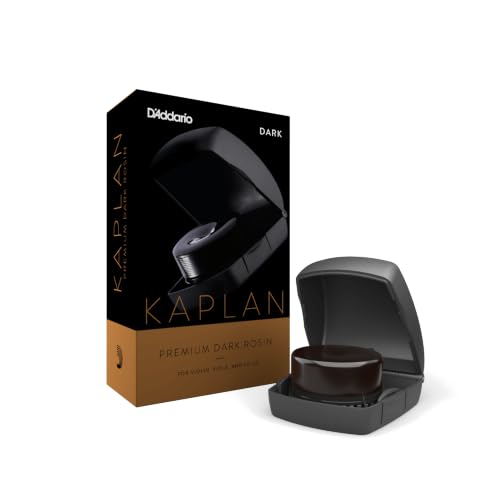
Rosin is what lets bow hair grip the string at all, and it is the accessory players most often run out of or drop. The Kaplan Premium dark formula is built for grip: dark rosin is softer and tackier than light rosin, suiting players who want a stronger bite and fuller pull, and it works on violin, viola, and cello bows alike.
What sets this cake apart from loose student rosin is the case. The rosin sits in a protective housing designed for one-handed use, and a dial at the bottom lets you rotate the cake so the bow wears a flat surface instead of cutting a groove down the middle — a small detail that extends the usable life of the cake. D’Addario pours and packages it in New York using the original Kaplan recipe.
Dark rosin produces more dust than light formulas and can feel grabby on very light bowing, so players in hot climates sometimes choose the light version of the same product. For most violinists replacing a cracked or glazed-over cake, the dark Kaplan in its dial case is the tidy, long-lasting option.
Specs
- Formula: Kaplan Premium dark
- Instruments: violin, viola, and cello
- Bow hair: horsehair or synthetic
- Case: protective case with rotating bottom dial
- Model: KRDD
- Origin: poured and packaged in New York per the listing
4. Korg TM-70 Tuner-Metronome Combo Pack, White

Intonation and rhythm are the two skills violinists drill daily, and the TM-70 combo pack puts both tools in one unit. This bundle pairs the TM-70T tuner-metronome with Korg’s CM-400 contact microphone, which clips to the instrument and reads pitch from vibration — far more reliable in a noisy rehearsal room or group class than a built-in microphone alone.
The chromatic tuner covers a wide C1 to C8 range, so it handles the violin’s full compass and any other instrument in the household, and adds sound-out and sound-back modes plus a transpose function. The metronome runs from 30 to 252 beats per minute with 15 rhythm variations, from slow scale practice to fast subdivision work, and both functions can run at the same time.
It is a handheld unit rather than a clip-on tuner, so it sits on the stand or table instead of the scroll — most violinists prefer that anyway, since nothing extra vibrates on the instrument. Battery type is worth a quick check on the product page before ordering.
Specs
- Contents: TM-70T tuner-metronome plus CM-400 contact microphone
- Tuning range: C1 to C8, chromatic
- Metronome: 30 to 252 beats per minute, 15 rhythm variations
- Modes: meter, sound out, sound back, transpose
- Model number: TM70CWH
- Color: white (combo pack)
5. Boveda Music Small Starter Kit, 49 Percent RH

Wood moves with the weather, and a violin that spends winter near heating vents can dry out enough to open seams or crack. The Boveda small starter kit is a two-way humidity system sized for violin cases: a 49 percent relative humidity pack sits inside the included fabric holder, releasing moisture when the case air is dry and absorbing it when damp.
There is nothing to fill, charge, or calibrate. Remove the outer wrap, slip the pack into the holder, place it in an open area of the case, and keep the case closed. Boveda suggests replacing the pack roughly every three months, or sooner when it turns hard and crunchy — the built-in signal that it is spent.
The kit is also listed for viola, clarinet, ukulele, and other small wooden instruments, so one system covers a multi-instrument household. Players in very dry climates may go through packs faster than the guideline; exact lifespan depends on how airtight the case is, so confirm on the listing.
Specs
- System: two-way humidity control, 49 percent RH target
- Pack size: Size 70 standard pack, 60 grams
- Includes: 1 humidity pack and 1 fabric holder
- Fits: small instruments including violin and viola cases
- Target range: maintains roughly 45 to 55 percent RH in a closed case per the listing
- Replacement: about every 3 months per the brand guidance in the listing
How to Choose
Buy in the order your playing needs help. If the violin slips or your neck aches after twenty minutes, a shoulder rest comes first, and fit matters more than brand: match the rest to your instrument size and look for height adjustment if you have a longer neck. If the sound has gone dull or strings fray at the pegs, a fresh set like the Dominants is the fix.
Rosin choice comes down to grip and climate: dark rosin grips harder and suits players who dig in, while light rosin feels cleaner in warm rooms. Either way, a cased cake with a rotating dial outlasts a bare cake. For practice tools, a tuner-metronome with a contact microphone stays accurate in real rooms, not just quiet ones. And if your home has forced-air heating or big seasonal swings, treat humidity control as instrument insurance.
Who Should Skip
Players renting an instrument for a short trial should check what the rental shop already includes, since outfits often bundle a rest, rosin, and a tuner. Violinists with fractional-size instruments (1/2, 1/4, and smaller) should skip the 4/4-specific picks here and buy the same accessory types in the matching size. If your case already has a humidifier you refill faithfully, the Boveda kit is a convenience rather than a necessity. And anyone whose teacher has prescribed a specific rest or string set should follow that prescription over any general guide.
FAQ
Do beginners really need a shoulder rest?
Most teachers recommend one. A shoulder rest fills the space between the violin and the shoulder so the instrument stays level without squeezing, which supports relaxed posture while the left hand learns to move freely. A minority of players and schools prefer a small sponge or no rest at all, so treat it as the default starting point rather than a rule.
How often should violin strings be replaced?
It depends on playing time, but many advancing students change a full set every six to twelve months. Replace sooner if a string unravels, turns buzzy, or stops holding pitch. Changing the whole set at once keeps the four strings balanced in age and response.
What is the difference between light and dark rosin?
Dark rosin is softer and stickier, so it grips the string more strongly and is often favored for a fuller, heavier pull; light rosin is harder, produces less dust, and feels cleaner in warm conditions. Neither is better in absolute terms — match the formula to your climate, your bowing style, and the sound you are after.
Why does a violin case need humidity control?
Violins are thin carved wood, and dry air can shrink the plates enough to open seams or cause cracks, while excess moisture can swell the wood and dull the response. A two-way system like the Boveda kit holds the air inside the closed case near the middle range makers recommend, with no filling or monitoring.
Final Verdict
Five accessories cover nearly every everyday violin need: the Kun Original rest for a stable hold, Dominant strings for a dependable replacement set, Kaplan Premium dark rosin for grip that lives safely in its case, the Korg TM-70 combo pack for tuning and tempo discipline, and the Boveda starter kit for humidity insurance. Buy them in the order your current setup hurts most.

More from Amazon
Programs that pair well with the guide above. Offers and eligibility are set by Amazon and may change.
Free shipping on eligible items, Prime Video and more. Eligible new members can start with a free trial.
Start a Prime free trialAudiobooks and podcasts to listen to on the go. Eligible new members can start with a free trial.
Try Audible freeAd-free music streaming. Eligible new subscribers can start with a free trial.
Try Music Unlimited freeA free business account with business pricing and bulk-buying tools for work, shop or home office.
Create a business accountAs an Amazon Associate we earn from qualifying purchases.






Write Your Review
No reviews yet. Be the first to share your experience!