

Key takeaways
- Compare the best coaxial bookshelf speakers with removable grilles for small listening rooms, from compact Uni-Q pairs to a detailed three-way ELAC set.
A small listening room changes the speaker question. Instead of chasing the deepest bass or the largest cabinet, the decision becomes how to get a focused, even soundstage from speakers that sit close to the walls, close to the listener, and often close to each other. A coaxial bookshelf speaker answers that problem by placing the tweeter at the centre of the midrange driver, so high and mid frequencies leave from the same point and the image stays stable at short listening distances.
This guide is for nearfield desk listeners, vinyl listeners in a bedroom, and apartment dwellers who want a stereo image without filling the room with large cabinets. It also suits anyone who wants a grille on the front most of the time, whether for a cleaner look, dust, or curious hands, and off again for listening. The three pairs below were chosen from the names and specifications shown on their Amazon listings, with the coaxial layout, the removable grille, and small-room placement kept in mind throughout.
Quick Picks
As an Amazon Associate we earn from qualifying purchases.
| Product | Best for | Key spec from title |
|---|---|---|
| KEF Q150 Bookshelf Speakers (Pair, Black) | Compact rooms and nearfield desk listening | Uni-Q coaxial driver array |
| KEF Q350 Bookshelf Speakers (Pair, Black) | Small rooms that need more bass weight | Uni-Q driver array with CFD port |
| ELAC Uni-Fi 2.0 UB52 Bookshelf Speakers (Pair), Black | Detailed three-way sound in a small room | Concentric 4-inch midrange and 1-inch tweeter |
How to Choose
The coaxial driver and the small-room sweet spot
With a coaxial driver, the tweeter sits inside the midrange cone, so both ranges radiate from one point in space. That matters more in a small room than in a large one, because the listener is usually two metres or less from the speakers and off-axis changes are easy to hear. A conventional two-way layout can shift its balance as you lean forward, stand up, or slide across a sofa, while a coaxial layout keeps the direct sound consistent across a wider listening window. Nearfield desk setups and tight listening corners suit this layout well. Check the listing for words such as Uni-Q, coaxial, or concentric, since different brands describe the same idea in different ways.
Frequency response and bass in a compact space
A small room adds its own bass. Walls close to the speaker reinforce low frequencies, so a speaker that already reaches very low can sound boomy in a bedroom or study. Look at the low end of the stated frequency response and treat it as a guide, not a guarantee: a speaker rated down to the low 50 Hz region will usually give a small room enough weight on its own, while one reaching into the 40s can fill a slightly larger space but may need more distance from the rear wall. A front port is a useful sign for shelf or near-wall placement, because a rear port needs breathing room behind the cabinet.
Sensitivity, impedance and amplifier matching
Sensitivity and impedance decide how hard your amplifier must work. A speaker rated around 85 dB needs noticeably more amplifier power to reach the same volume as one rated near 88 dB, and that gap matters when the amplifier is a compact integrated unit on a desk or a shelf. Impedance matters too: an 8 ohm speaker is an easy load for almost any amplifier, while a 6 ohm or 4 ohm speaker asks more of the amplifier and can run a modest receiver harder than expected. Before buying, compare the speaker’s impedance and sensitivity with the amplifier you already own, and check the recommended power range on the listing rather than guessing from the size of the cabinet.
Room size, placement and the grille
A bookshelf speaker still needs space to breathe, even in a small room. Start with the pair on stands or a solid shelf at ear height, toed in slightly, with the tweeters aimed at the listening seat and spaced about as far apart as the distance to the listener. Leave a gap behind a rear-ported cabinet and keep the speakers out of room corners unless the bass stays controlled. The grille is part of the same decision: a removable grille protects the drivers and keeps a tidy front when the room is shared, then lifts off for listening sessions. Confirm whether the grille comes in the box or is sold separately, because that varies by model.
The 3 Best Options
KEF Q150 Bookshelf Speakers (Pair, Black)
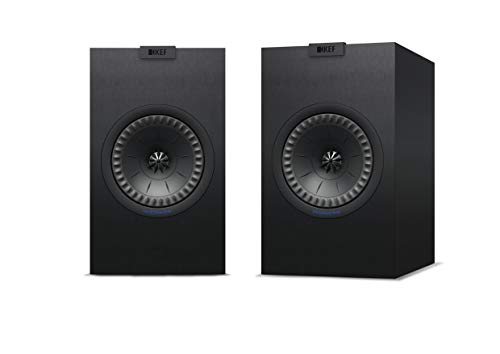
The Q150 is the compact pick here and the easiest fit for a genuinely small room. Its Uni-Q coaxial driver array keeps the soundstage coherent at desk distance or from a chair pulled close, and the cabinet is small enough for a shelf or a pair of stands without dominating the wall. Sold as a pair in black, it suits listeners who want a focused stereo image for vinyl or streaming at modest volume, and who would rather have precision than sheer bass weight. The magnetic Q150 grille is a separate accessory, so the front can be covered in everyday use and left open when it is time to listen.
Specs
- Uni-Q coaxial driver array with the tweeter at the centre of the midrange driver
- Nominal impedance: 8 ohms
- Recommended amplifier power: 10 to 100 watts
- Sold as a pair in Black
- Magnetic Q150 grille available as a separate accessory
Best for: Compact rooms, desks, and nearfield listening where imaging matters more than bass weight.
Watch out for: Check the grille situation before ordering, since the magnetic grille is a separate accessory, and confirm your amplifier suits an 8 ohm load within the recommended power range.
KEF Q350 Bookshelf Speakers (Pair, Black)

The Q350 takes the same Uni-Q idea as the Q150 and puts it in a larger cabinet, giving a small room more low-end weight without moving to floorstanding speakers. That suits listeners whose room is small but not tiny: a spare bedroom, a home office with a listening chair, or a living-room corner the speakers must fill at comfortable volume. The Computational Fluid Dynamics port helps keep bass tidy, though placement still matters, and the cabinet asks for more shelf or stand space than the Q150. A magnetic Q350 grille is a separate accessory, so the front can be dressed the same way once that part is ordered.
Specs
- Uni-Q coaxial driver array
- Computational Fluid Dynamics (CFD) port
- Sold as a pair in Black
- Magnetic Q350 grille available as a separate accessory
Best for: Small rooms that need more bass weight than a compact bookshelf pair can give.
Watch out for: Measure your shelf or stands first, since the larger cabinet needs more depth and more clearance behind it than the Q150, and check grille availability before ordering.
ELAC Uni-Fi 2.0 UB52 Bookshelf Speakers (Pair), Black

The UB52 is the only true three-way design here, which shows in how it separates the work: a concentric midrange and tweeter handle voices and detail, while a separate bass driver covers the low end. For listeners who play acoustic music, jazz, or vocal-heavy records, that split can bring a clearer midrange and a steadier image at low volume. The front port helps when the speakers sit close to a wall, and the removable fabric grilles come with the pair, so nothing extra is needed for a tidy front. It is the most demanding of the three to amplify, the trade-off for the extra driver and a more complex crossover.
Specs
- True 3-way bookshelf design
- Concentric driver: 4-inch aluminum midrange with 1-inch wide-roll surround tweeter
- 5-1/4-inch bass driver
- Sensitivity: 85 dB; nominal impedance: 6 ohms
- Maximum power input: 140 watts
- Front port for placement close to a wall
- Removable fabric grilles included
- Sold as a pair in Black (UB52-BK)
Best for: Detailed three-way listening in a small room, especially acoustic and vocal music at modest volume.
Watch out for: At 85 dB and 6 ohms this pair asks more of an amplifier than the KEF models here, so confirm your amplifier has enough clean power before buying.
Which One Fits Your Situation
A desk or nearfield setup in a very small room
The Q150 fits here because its compact cabinet and coaxial driver hold a stable image at arm’s length. On a desk or a small stand beside a listening chair, the Uni-Q array keeps voices centred when you lean in or shift position, and the modest cabinet does not crowd the workspace. Add the magnetic grille if the speakers share the desk with everyday clutter, and keep the volume moderate, where this speaker is most at home.
A small living room that needs more bass
When the room is bigger than a bedroom corner and the speakers must fill it, the Q350 earns its extra cabinet size. The larger Uni-Q driver and CFD port give more low-end weight than the Q150, so acoustic bass and kick drums carry further into the room at comfortable volume. Give the pair space from the rear wall, measure your stands, and remember that the magnetic grille is a separate accessory.
Critical listening with acoustic and vocal music
If the priority is hearing the texture of a voice or a guitar rather than sheer impact, the UB52 is the match. Its three-way layout and concentric midrange keep detail clear at the low volumes a small room encourages, and the front port suits shelves and near-wall spots where a rear port would struggle. The included fabric grilles keep the front tidy between sessions, and a capable amplifier is the one extra thing to plan for before the pair arrives.
A shared room where the grille stays on most days
Rooms shared with children, pets, or guests call for a grille that is actually in the box. The UB52 ships with removable fabric grilles, so the drivers stay covered during everyday use and the grilles lift off for focused listening. The Q150 and Q350 can do the same job once their magnetic grilles are added, but that means ordering a separate accessory. If a tidy, protected front matters every day, the included grilles settle the choice.
Common Mistakes
- Pushing rear-ported speakers hard against the wall, then blaming the speaker for boomy bass instead of giving the port room to breathe.
- Pairing an 85 dB, 6 ohm speaker with a small amplifier and expecting room-filling volume from a modest power supply.
- Choosing on driver size alone, without checking sensitivity, impedance, cabinet depth, and whether the grille is included.
- Placing the two speakers at different heights or different distances from the wall, which skews the stereo image before a single note plays.
- Assuming every listing includes the grille: on some models it is a separate accessory, so check the box contents before ordering.
Frequently Asked Questions
Do coaxial speakers sound better in small rooms?
They often suit small rooms well, because the tweeter and midrange radiate from the same point and the sound stays consistent as you move your head or shift seats. At short small-room distances, that stable imaging is easier to hear than in a large space. It does not guarantee a good result on its own: placement, amplifier matching, and the room itself still decide much of the outcome.
Should I listen with the grille on or off?
A grille protects the drivers and gives a tidier front, which matters in a shared room. Most listeners remove it for focused sessions, since fabric and frames can soften the very top end slightly. Try both in your own room with familiar music and keep whichever you prefer for everyday listening. If the grille is a separate accessory on the model you choose, factor that into the decision before ordering.
Do I need a subwoofer with these speakers?
For music in a small room, usually not at first. All three pairs here give enough low-end weight for acoustic, jazz, and vocal music at normal listening levels. A subwoofer becomes worth considering only if you play bass-heavy music or films at higher volume, or if the room is larger than a typical bedroom. Set the main pair up properly first, live with them for a few weeks, then decide.
What amplifier power do I need?
Match the amplifier to impedance and sensitivity, not a single wattage number. The Q150 is an 8 ohm load with a 10 to 100 watt recommended range, so most integrated amplifiers suit it. The ELAC UB52 is rated 6 ohms at 85 dB with a 140 watt maximum, so it needs an amplifier with more clean power in reserve. For the Q350, check the recommended power range on its listing.
More from Amazon
Programs that pair well with the guide above. Offers and eligibility are set by Amazon and may change.
Free shipping on eligible items, Prime Video and more. Eligible new members can start with a free trial.
Start a Prime free trialAudiobooks and podcasts to listen to on the go. Eligible new members can start with a free trial.
Try Audible freeAd-free music streaming. Eligible new subscribers can start with a free trial.
Try Music Unlimited freeA free business account with business pricing and bulk-buying tools for work, shop or home office.
Create a business accountAs an Amazon Associate we earn from qualifying purchases.
Write Your Review
No reviews yet. Be the first to share your experience!