

Key takeaways
- Compare three ported bookshelf speakers with removable grilles for small listening rooms, and find the pair that fits your amplifier, shelf and space.
A small listening room changes the speaker question. Instead of chasing the biggest cabinet or the deepest bass, you are deciding how much low end a ported design can add before the room itself starts to fight back. A port tunes the cabinet to reinforce bass, so a compact pair can sound far larger than it looks, yet it turns boomy when speakers sit hard against a wall or inside a closed shelf. Removable grilles add a second choice: keep them on for a tidy look and protection, or take them off to expose the drivers.
This guide is for listeners setting up a small room, a bedroom system, or a nearfield desk rig where every inch matters. It suits renters and vinyl listeners who want stereo sound without a subwoofer taking up floor space. The three pairs below were chosen from their names and specifications on Amazon: a warm ELAC pair, a lively Klipsch pair built around a horn, and a compact KEF pair with a coaxial driver.
Quick Picks
As an Amazon Associate we earn from qualifying purchases.
| Product | Best for | Key spec from title |
|---|---|---|
| ELAC Debut 2.0 B6.2 Bookshelf Speakers, Black (Pair) | Full, warm bass in a small room without a subwoofer | 6.5-inch aramid-fiber woofer |
| Klipsch Reference Premiere RP-600M II Ebony Bookshelf Speakers | Lively, detailed sound at low listening volumes | 6.5-inch Cerametallic woofer with Tractrix horn |
| KEF Q150B Q150 Bookshelf Speakers (Pair, Black) | Wide, even sound from a compact cabinet on a shelf | 5.25-inch Uni-Q driver array |
How to Choose
The port and the bass it adds
A port is a tuned opening in the cabinet that lets the woofer move air more efficiently at low frequencies, so a bookshelf speaker can reach noticeably deeper than a sealed box of the same size. In a small room that extra bass is welcome, because a subwoofer may not fit and the room itself already reinforces low notes. The trade-off is control: a ported speaker placed tight against a wall or deep inside a bookcase can sound thick and muddy, since the port output bounces straight back into the room. Look for a front port if your speakers must sit close to the wall, and plan on a few inches of breathing room behind any rear-ported pair.
Driver size and what it means in a small room
Woofer size sets the character of the speaker more than any other single part. A 5.25-inch woofer, like the one in the KEF pair below, keeps the cabinet compact and the midrange clean, which suits desks, shelves, and rooms where the listening seat is only a few feet away. A 6.5-inch woofer, found in both the ELAC and Klipsch pairs, moves more air and fills a small room more easily, so music gains weight without a subwoofer. Bigger is not automatically better here: an oversized woofer in a tiny room can overwhelm the space, while a well-matched smaller driver often sounds faster and more balanced.
Sensitivity, impedance and your amplifier
Sensitivity tells you how much sound a speaker makes from a given amount of amplifier power, and impedance tells you how hard the amplifier must work to drive it. In a small room you rarely need much power, since the listening distance is short, so a modest integrated amplifier or stereo receiver usually does the job. Even so, check the numbers before you buy: a speaker rated at 8 ohms with a recommended amplifier range of 10 to 100 watts, like the KEF Q150, pairs comfortably with most entry-level amplifiers. If your amplifier is low-powered, favour a more sensitive design; if it is a budget receiver, avoid speakers that dip to very low impedance.
Room size, placement and the grille
Placement matters more in a small room than the speaker brand does. Start with the pair on stands or a solid shelf, spaced roughly as far apart as you sit from them, with the tweeters near ear height and the cabinets toed in slightly toward your seat. Keep rear-ported speakers a few inches from the wall and avoid stuffing them between books, which chokes the port and dulls the sound. Removable grilles give you a useful option in a shared living space: leave them on to protect the drivers from dust and curious hands, then lift them off for serious listening sessions when you want the drivers fully exposed.
The 3 Best Options
ELAC Debut 2.0 B6.2 Bookshelf Speakers, Black (Pair)

The ELAC Debut 2.0 B6.2 suits the listener who wants a small-room system to sound complete on its own, with no subwoofer and no fuss. Its 6.5-inch aramid-fiber woofer gives acoustic music, vocals, and film soundtracks a warmth and body that smaller speakers struggle to match, while the soft-dome tweeter keeps the top end smooth rather than sharp. Because the cabinet is a genuine bookshelf size, it works on stands in a spare room or on a sturdy shelf in a bedroom, and the removable grille lets you switch between a clean black front and the exposed drivers.
Specs
- 6.5-inch aramid-fiber woofer
- 1-inch soft-dome tweeter
- Ported cabinet
- Dimensions: 7.69 x 14.76 x 10.55 inches
- Weight: 16.3 pounds
- Maximum power handling: 120 watts
Best for: listeners who want full, warm bass in a small room without adding a subwoofer.
Watch out for: the cabinet is nearly 15 inches tall and more than 10 inches deep, so measure your shelf depth first and leave space behind the port for the bass to breathe.
Klipsch Reference Premiere RP-600M II Ebony Bookshelf Speakers

The Klipsch RP-600M II fits the listener who plays music at modest volume and still wants every detail to come through. Its horn-loaded tweeter projects vocals and instruments with a lively, forward character, so quiet evening listening stays engaging instead of fading into the background. The 6.5-inch Cerametallic woofer adds real punch for rock, jazz, and film soundtracks, and the removable grille means you can show off the copper woofer and horn or cover them for a plainer look. Bi-wire binding posts also give you room to experiment with cabling later.
Specs
- 6.5-inch Cerametallic woofer
- 1-inch titanium LTS tweeter
- 90-degree x 90-degree Tractrix horn
- Rear-firing port
- Bi-wire and bi-amp capable binding posts
- Removable grille
Best for: low-volume listening where detail, energy, and vocal clarity matter most.
Watch out for: the rear-firing port needs several inches of clearance from the wall, so confirm your shelf or stand placement before ordering, and check that your amplifier has enough power for your room size.
KEF Q150B Q150 Bookshelf Speakers (Pair, Black)
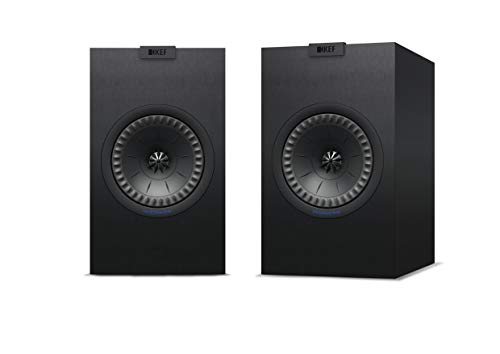
The KEF Q150 is the pick for tight spaces where a big cabinet simply will not fit. Its Uni-Q driver places the tweeter inside the woofer, so sound spreads evenly across the room and the sweet spot stays wide even when you move around, which helps in a small room where the listening seat is rarely in the perfect position. The compact cabinet sits happily on a desk, a shelf, or small stands, and the rear port adds useful low-end weight for its size. It is a natural partner for a modest amplifier in a bedroom or study system.
Specs
- 5.25-inch Uni-Q driver array
- Rear port
- Nominal impedance: 8 ohms
- Recommended amplifier power: 10 to 100 watts
- Magnetic grille available
Best for: tight shelves and desks where a compact cabinet and a wide sweet spot matter most.
Watch out for: the magnetic grille is sold separately from the standard pair listing, so check the listing contents before ordering if you want grilles included, and leave clearance behind the rear port.
Which One Fits Your Situation
You want the fullest bass without a subwoofer
Choose the ELAC Debut 2.0 B6.2. Its 6.5-inch aramid-fiber woofer and ported cabinet deliver the most low-end weight of the three pairs, so acoustic music and films sound complete without extra boxes on the floor. Just make sure your shelf is deep enough for a cabinet over 10 inches front to back.
You mostly listen at low volume
Choose the Klipsch RP-600M II. The horn-loaded tweeter keeps vocals and fine detail present even when the volume stays low, which suits late-night listening and shared walls. That makes it a strong match for apartments, where turning the volume up is rarely an option. Give the rear port a few inches of room from the wall so the bass stays clean.
Your shelf or desk space is tight
Choose the KEF Q150. Its 5.25-inch Uni-Q driver and compact cabinet fit where larger pairs cannot, and the wide dispersion means the sound holds together even when your seat is off to one side. The 8-ohm impedance and 10 to 100 watt amplifier range also make it an easy match for the compact amplifiers that usually sit beside a desk system. Confirm whether the listing you order includes the magnetic grille.
You want to switch between grilles on and off
Choose the Klipsch RP-600M II or the ELAC Debut 2.0 B6.2. Both ship with removable grilles, so you can keep a tidy, protected front during the day and lift the grilles off for focused listening. The KEF grille is a separate purchase, so factor that in if the on-and-off routine matters to you.
Common Mistakes
- Pushing a rear-ported speaker hard against the wall, which makes the bass boomy and masks the midrange.
- Buying a cabinet that is deeper or taller than the shelf it must sit on, then discovering the port has no room to breathe.
- Pairing a low-powered amplifier with a demanding speaker and wondering why the sound turns thin at higher volumes.
- Leaving the grilles on permanently without ever comparing the sound with them off, or removing them and leaving the drivers unprotected in a busy room.
- Skipping the grille question at checkout and finding out after delivery that the grille was sold separately.
Frequently Asked Questions
Do ported bookshelf speakers work in a small room?
Yes, ported bookshelf speakers often work very well in a small room, because the port adds bass that a compact sealed cabinet cannot produce on its own. The key is placement: keep rear-ported pairs a few inches from the wall and avoid enclosing them inside a closed shelf. With that breathing room, a ported pair can fill a small space without a subwoofer.
Should I leave the grilles on or off?
Either choice is fine, and that is the point of a removable grille. Leave grilles on to protect the drivers from dust, sunlight, and accidental knocks, especially in a shared living space. Take them off for focused listening if you prefer the look of exposed drivers. Try both in your own room, since the audible difference is usually small.
Do I need a subwoofer with these speakers?
Most small-room listeners will not need one. The ELAC and Klipsch pairs use 6.5-inch woofers with ported cabinets that reach low enough for music and everyday film watching, while the KEF pair covers most music comfortably. Add a subwoofer only if you watch a lot of action films or listen to bass-heavy music and still feel something is missing.
How far from the wall should ported bookshelf speakers sit?
Start with at least a few inches between the back of the cabinet and the wall, more for rear-ported models like the Klipsch and KEF pairs. Then move the speakers in small steps while listening to a familiar track: too close sounds thick and boomy, while too far can thin out the bass. Small moves make a clear difference in a small room.
More from Amazon
Programs that pair well with the guide above. Offers and eligibility are set by Amazon and may change.
Free shipping on eligible items, Prime Video and more. Eligible new members can start with a free trial.
Start a Prime free trialAudiobooks and podcasts to listen to on the go. Eligible new members can start with a free trial.
Try Audible freeAd-free music streaming. Eligible new subscribers can start with a free trial.
Try Music Unlimited freeA free business account with business pricing and bulk-buying tools for work, shop or home office.
Create a business accountAs an Amazon Associate we earn from qualifying purchases.
Write Your Review
No reviews yet. Be the first to share your experience!