

Key takeaways
- Compare three-way passive bookshelf speakers with removable grilles for small rooms, covering driver layout, sensitivity, placement and amplifier matching.
A small listening room changes the speaker decision in ways a specification sheet alone never quite captures. With walls close by, a three-way passive bookshelf speaker has to earn its place twice over: first by splitting bass, midrange and treble across dedicated drivers, and then by sounding balanced at modest volume, a few feet from the listener, without overwhelming the space. The removable grille matters here as well, because it lets you choose between a tidy, protected front and an exposed driver array.
This guide is for listeners setting up a dedicated stereo pair in a bedroom, study or compact living room, for vinyl and streaming listeners who already own an amplifier, and for anyone replacing a two-way pair that sounded thin on vocals or congested when music got busy. Each speaker below was chosen from the name and specifications shown on its Amazon listing, with a three-way layout, a passive design that needs an external amplifier, and a cabinet size that can work on stands or a sturdy shelf.
Quick Picks
As an Amazon Associate we earn from qualifying purchases.
| Product | Best for | Key spec from title |
|---|---|---|
| Sony SS-CS5M2 3-Way 3-Driver Hi-res Bookshelf Speakers (Pair) | A compact first three-way pair for a small room | 3-way, 3-driver design with 5.12-inch woofer |
| ELAC Uni-Fi 2.0 UB52 Bookshelf Speakers (Pair) | Detailed midrange and a front port near a wall | True 3-way design with concentric tweeter and midrange |
| Wharfedale EVO 4.2 Bookshelf Speakers (Pair) | A larger, more dynamic sound on solid stands | 3-way design with AMT tweeter and 6.5-inch woofer |
How to Choose
Driver layout and crossover design
In a three-way bookshelf speaker, the woofer handles bass, a separate midrange driver carries voices and instruments, and a tweeter takes the top end. That split matters because no single driver has to stretch across the whole range, so vocals stay clearer when bass and treble play together. Look at the driver arrangement as well as the count. ELAC places its tweeter inside its midrange driver, which keeps the sound centred and makes listening height less critical. Sony splits the treble in the SS-CS5M2 between a main tweeter and a super tweeter. Either approach can work in a small room, but a closely spaced array is often easier to live with when you sit close.
Frequency response and bass in a small room
A headline frequency range tells you where a speaker starts and stops, not how loud it stays at those extremes. A model rated down to 46 Hz will still need room gain or a subwoofer for the deepest organ notes and electronic bass, while a model rated from 53 Hz can sound full on acoustic music in a compact space. In a small room, bass builds up quickly in corners, so a controlled speaker that reaches a little less low often sounds better than a boomy one that digs deeper on paper. Check the port position, too. A front port is more forgiving close to a wall, whereas a rear port usually wants several inches of clear space behind it.
Sensitivity and impedance
Sensitivity and impedance decide how hard your amplifier has to work. Sensitivity, in decibels, shows how loud a speaker plays from a given input. A speaker rated at 85 dB needs noticeably more power to reach the same volume as one rated at 90 dB, which matters if you listen loud or your amplifier is modest. Impedance, in ohms, is the electrical load the speaker presents. The Sony and ELAC models here are rated at 6 ohms, so confirm that your receiver or amplifier is rated for that load and set any impedance selector to match. A low-sensitivity speaker with a weak amplifier is a common reason a promising setup sounds flat or strained.
Room size, placement and the grille
Small rooms reward careful placement more than extra cabinet size. Start with the speakers on stands, or on a solid shelf, with the tweeters close to ear height when seated, angled slightly toward the listening seat, and kept clear of side walls where possible. Leave room behind a rear-ported cabinet, and avoid pushing any bookshelf speaker hard into a corner unless you enjoy exaggerated bass. A removable grille gives you a practical choice: leave it on to protect the drivers from dust, pets and curious hands, or take it off when you want the drivers visible. Before ordering, measure the shelf or stand, including depth, because a speaker that fits the width but overhangs the front is easy to knock.
The 3 Best Options
Sony SS-CS5M2 3-Way 3-Driver Hi-res Bookshelf Speakers (Pair)

Sony updated its long-running compact bookshelf design for 2025, and the SS-CS5M2 keeps the formula that made the earlier model popular in small rooms: a modest cabinet, a three-driver layout and an easy 6-ohm load that suits most stereo amplifiers and AV receivers. It fits listeners who want a straightforward stereo pair for music and films, without moving to a large cabinet or a demanding amplifier. The super tweeter extends the top end well beyond the usual range, which suits high-resolution recordings, while the compact footprint leaves more freedom on a shelf or a pair of stands.
Specs
- 3-way, 3-driver bookshelf speaker system, sold as a pair
- 5.12-inch reinforced cellular cone woofer
- 0.98-inch tweeter
- 0.75-inch super tweeter
- Frequency response: 53 Hz to 50,000 Hz
- Impedance: 6 ohms
- Maximum input power: 100 W
Best for: A compact first three-way pair for a small room, paired with a modest stereo amplifier or AV receiver.
Watch out for: The cabinet is rear-ported, so leave clear space behind each speaker rather than pushing it flat against the wall, and confirm your amplifier is rated for 6-ohm speakers before you connect it.
ELAC Uni-Fi 2.0 UB52 Bookshelf Speakers (Pair)

ELAC built the UB52 around a concentric driver, with a 1-inch tweeter set inside a 4-inch aluminium midrange, plus a separate 5.25-inch aluminium woofer for the lower frequencies. That arrangement gives vocals a focused, stable quality, and it helps when the listening seat is close or slightly off-centre, which is common in a small room. The front-firing ports are another practical advantage, because the pair can sit nearer a wall than a rear-ported design without the bass turning muddy. It suits listeners who already have a capable amplifier and want detail and imaging ahead of sheer loudness.
Specs
- True 3-way bookshelf speaker design
- 1-inch soft-dome tweeter concentric with 4-inch aluminium midrange
- 5.25-inch aluminium woofer
- Frequency response: 46 Hz to 35,000 Hz
- Sensitivity: 85 dB
- Nominal impedance: 6 ohms
- Maximum power input: 140 watts
- Bass-reflex cabinet with front-firing ports
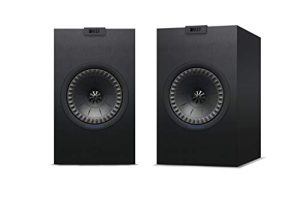
- Removable cloth grilles
- Dimensions: 7-5/16 inches W x 13-5/8 inches H x 10-7/8 inches D
- Weight: 18.26 lbs each
Best for: Detailed midrange and vocal clarity in a small room, especially where the speakers must sit close to a wall.
Watch out for: Sensitivity is 85 dB, so pair these with an amplifier that has enough clean power for your listening level, and check the depth and weight against your stands or shelf before ordering.
Wharfedale EVO 4.2 Bookshelf Speakers (Pair)

Wharfedale takes a bolder approach with the EVO 4.2, combining an AMT tweeter with a soft-dome midrange and a 6.5-inch Kevlar woofer in a three-way cabinet. The larger woofer and higher sensitivity give it a more dynamic, full-bodied character than the compact models here, which suits listeners who want scale and weight from a stand-mounted pair without moving to floor-standing speakers. It is the largest cabinet in this guide, so it belongs on solid stands with space around it rather than squeezed onto a shallow shelf. The fabric grille lifts off to reveal the drivers, and the wood finish suits a room where the speakers stay visible.
Specs
- 3-way bookshelf speaker design
- AMT tweeter, 30 x 60 mm
- 2-inch soft-dome midrange
- 6.5-inch Kevlar woofer
- Frequency response: 54 Hz to 22 kHz
- Sensitivity: 90 dB
Best for: A larger, more dynamic sound on solid stands in a small-to-medium listening room.
Watch out for: Measure your stands and the available floor space first, because this is a taller and deeper cabinet than a typical compact bookshelf speaker, and give it room to breathe rather than crowding it against a wall or furniture.
Which One Fits Your Situation
You want the simplest small-room setup
Choose the Sony SS-CS5M2. Its compact cabinet fits a shelf or a pair of stands without dominating the room, the 6-ohm load suits a wide range of amplifiers and receivers, and the three-driver layout still gives vocals and treble more room than a basic two-way pair. It is the easiest of the three to place, wire and live with, and it works well as a first serious stereo pair or as the front pair in a compact home theatre setup.
You listen close up and care most about voices
Choose the ELAC Uni-Fi 2.0 UB52. The concentric tweeter and midrange keep vocals focused and stable when you sit near the speakers, and the front ports make it the most forgiving choice when the cabinets have to sit close to a wall. Plan for a capable amplifier, because its 85 dB sensitivity asks for more power than the other two models, and the reward is a detailed, well-imaged sound in a small room.
You want more scale without floor-standing speakers
Choose the Wharfedale EVO 4.2. Its 6.5-inch woofer and 90 dB sensitivity deliver a bigger, more dynamic presentation than the compact models, so orchestral music, rock and film soundtracks carry more weight. Put it on sturdy stands, leave space around each cabinet, and treat it as a stand-mounted speaker rather than a shelf speaker, because its size is part of what gives it that scale.
You need the speakers near a wall or on a shelf
Choose the ELAC Uni-Fi 2.0 UB52 first, and the Sony SS-CS5M2 only if you can leave space behind it. Front ports cope better with a wall directly behind the cabinet, while a rear port needs clearance to avoid boomy bass. Whichever model you choose, keep the tweeter near seated ear height, angle the speakers slightly inward, and leave the grille off or on according to how the room is used.
Common Mistakes
- Buying on woofer size alone and ignoring sensitivity, impedance and cabinet depth, which decide whether the speaker suits your amplifier and your shelf.
- Pushing a rear-ported bookshelf speaker flat against the wall, then blaming the speaker when the bass sounds boomy or muffled.
- Placing the speakers too high, too low or too far apart, so the tweeter misses seated ear height and the stereo image falls apart.
- Choosing an amplifier that is not rated for a 6-ohm load, or running a low-sensitivity speaker loud on a weak amplifier.
- Leaving the grille decision until after delivery, instead of checking how it attaches and whether the drivers need protection from dust, pets or children.
Frequently Asked Questions
Do I need a subwoofer with a three-way bookshelf speaker in a small room?
Not always. A three-way bookshelf speaker covers vocals, instruments and most bass, and in a small room the walls add bass reinforcement that helps. A subwoofer becomes useful for film soundtracks, electronic music and organ music, where deepest notes fall below what a compact cabinet can reproduce cleanly. Try the pair first, then add a subwoofer only if the lowest notes still feel missing.
Can I use these passive speakers with a home theatre receiver?
Yes, provided the receiver is rated for the speaker impedance and has enough power for the sensitivity. All three models here need an external amplifier or receiver, because passive speakers have no built-in amplification. Connect them with speaker wire to the front left and right outputs, set the receiver impedance setting to match, and run its speaker setup routine so levels and distances are correct.
Should I listen with the grille on or off?
Either can work, and the removable grille is there so you can choose. Leave it on to protect the drivers and keep the front tidy, especially in a shared room. Take it off for listening if you prefer the drivers exposed, and store the grilles safely so they do not get bent or lost. The sound difference is usually small.
How far from the wall should a bookshelf speaker sit?
It depends on the port. A front-ported speaker can sit closer to a wall, often with only a few inches behind it, while a rear-ported speaker needs more clearance so air can move freely from the port. Start with a few inches behind a rear-ported cabinet, listen, and move it out further if the bass sounds thick or boomy.
More from Amazon
Programs that pair well with the guide above. Offers and eligibility are set by Amazon and may change.
Free shipping on eligible items, Prime Video and more. Eligible new members can start with a free trial.
Start a Prime free trialAudiobooks and podcasts to listen to on the go. Eligible new members can start with a free trial.
Try Audible freeAd-free music streaming. Eligible new subscribers can start with a free trial.
Try Music Unlimited freeA free business account with business pricing and bulk-buying tools for work, shop or home office.
Create a business accountAs an Amazon Associate we earn from qualifying purchases.
Write Your Review
No reviews yet. Be the first to share your experience!