

Key takeaways
- Find the best coaxial bookshelf speakers for nearfield listening, from compact Uni-Q pairs to a powered three-way monitor, with desk placement and amp guidance.
Nearfield listening changes what matters in a speaker. At a desk, with the cabinets a metre or so from your ears, the tweeter and woofer of a conventional two-way design reach you from slightly different points, and that small offset can smear the stereo image at close range. A coaxial design puts the tweeter at the centre of the midrange or woofer cone, so highs and mids leave from one acoustic point and the image stays locked in place even as you shift position or listen at low volume.
This guide is for desk listeners building a first stereo pair, home-studio owners mixing in a small room, and music lovers who want a compact bookshelf pair for a bedroom or reading corner. The five picks below were chosen from the names and specifications on each Amazon product page: three passive KEF Uni-Q pairs in different sizes, one powered KEF Uni-Q system for listeners who want no separate amplifier, and one powered three-way coaxial monitor for critical desktop work.
Quick Picks
As an Amazon Associate we earn from qualifying purchases
| Product | Best for | Key spec from title |
|---|---|---|
| KEF Q150 Bookshelf Speakers (Pair, Black) | A first coaxial pair for a small desk | 5.25-inch Uni-Q driver array |
| KEF LS50 Meta (Pair, Mineral White) | Detailed listening in a small room | Uni-Q driver with Metamaterial Absorption Technology |
| KEF Q350 Bookshelf Speakers (Pair, Black) | A larger desk or shelf setup needing fuller midrange | 6.5-inch Uni-Q driver array |
| Kali Audio IN-5 3-Way Studio Monitor (Single, Black) | Critical nearfield monitoring at a desk | 3-way coaxial design with 5-inch woofer |
| KEF LSX II LT Wireless HiFi Speakers (Pair, Stone White) | A powered desk system with streaming built in | 11th-generation Uni-Q driver array |
How to Choose
The coaxial driver itself
Not every speaker labelled coaxial behaves the same way at close range, so look at how the tweeter sits inside the other driver. In the KEF Uni-Q designs here, a dome tweeter sits at the centre of the mid-bass cone, while the Kali Audio IN-5 places its tweeter inside a dedicated midrange driver, with a separate woofer below. Both arrangements aim for a single point source, yet the three-way Kali splits the workload further, which can keep the midrange cleaner when a vocal and a bass line arrive together. Check driver sizes too: a 5.25-inch Uni-Q suits a tight desk, a 6.5-inch version moves more air in a slightly larger space, and a dedicated midrange helps when you listen analytically.
Frequency response and low-end reach
Frequency response tells you how low and how high a speaker is listed to play, and nearfield listeners should read it with desk reality in mind. The KEF Q150 is listed at 51Hz to 28kHz, which is useful bass for its size, while the LS50 Meta is listed up to 28kHz at the top end. A wider low-end figure does not remove the need for care with placement, because a desk, a wall, and a shelf all reinforce bass differently. If your desk sits against a wall, a speaker with a rear port needs breathing room, and you may still want a subwoofer later for the lowest octave rather than expecting a compact cabinet to do everything alone.
Sensitivity and impedance
Sensitivity and impedance decide how much work your amplifier must do, and they matter more than many first-time buyers expect. The KEF Q150 is listed at 86dB sensitivity and 8 ohms nominal impedance, with a recommended amplifier range of 10 to 100 watts. Lower sensitivity means the amplifier must deliver more power for the same volume, so a modest desktop amplifier can run out of headroom sooner than the speaker itself does. Check the minimum impedance as well, since the Q150 lists a minimum of 3.7 ohms, and confirm that your amplifier is comfortable driving that load. Powered picks remove this question entirely, because their amplification is built in and matched by the maker.
Desk placement and cabinet size
Nearfield sound is shaped by the surface under the speakers as much as by the drivers inside them. Measure your desk before ordering: the KEF Q150 measures 303 by 180 by 278 mm per cabinet, and the LS50 Meta measures 302 by 200 by 280.5 mm, so both need a stable surface with room behind them for a rear port. Aim the tweeters toward your ears, keep the pair the same distance from your head, and angle them slightly inward so the stereo centre sits in front of you rather than drifting to one side. Isolation pads or small stands help when a hollow desk adds its own resonance, and a few centimetres from the wall usually tightens the bass.
The 5 Best Options
KEF Q150 Bookshelf Speakers (Pair, Black)
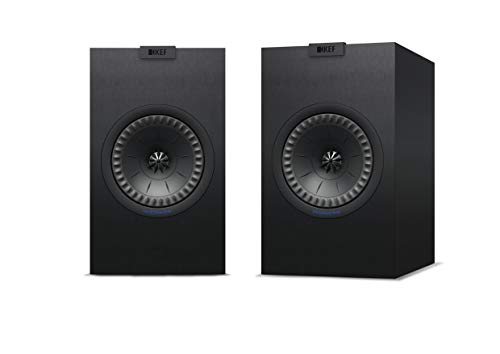
The Q150 is the natural starting point in this group for anyone moving from ordinary computer speakers to a proper coaxial pair. Its 5.25-inch Uni-Q driver keeps vocals and instruments centred at arm’s length, and its compact cabinet fits desks and shelves where a larger bookshelf speaker would crowd the workspace. It is a passive pair, so it suits listeners who already own an amplifier or who enjoy choosing one, and its bass-reflex cabinet with a CFD port is designed to keep low frequencies controlled rather than boomy in a small room.
Specs
- 5.25-inch Uni-Q driver array with 1-inch vented aluminium dome tweeter
- Frequency response listed as 51Hz to 28kHz
- Sensitivity listed as 86dB
- Nominal impedance listed as 8 ohms, minimum 3.7 ohms
- Recommended amplifier power listed as 10 to 100 watts
- Two-way bass reflex design with CFD port
- Dimensions listed as 303 x 180 x 278 mm per speaker
- Sold as a pair
Best for: A first coaxial bookshelf pair for a small desk or bedroom listening setup.
Watch out for: It is a passive pair, so confirm your amplifier covers its 10 to 100 watt recommendation and 8 ohm nominal impedance, and leave space behind the rear port rather than pushing the cabinets flat against a wall.
KEF LS50 Meta (Pair, Mineral White)
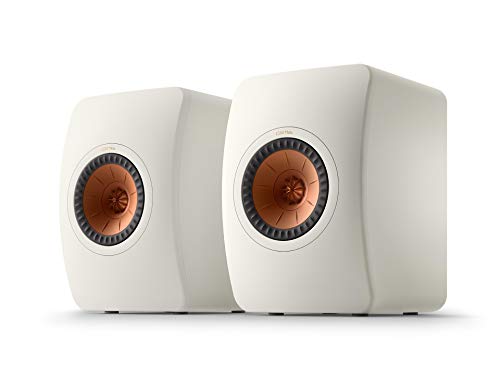
The LS50 Meta is the detailed listener’s pick in this group, built around the same Uni-Q idea as the Q150 but with Metamaterial Absorption Technology behind the tweeter to absorb unwanted sound inside the cabinet. That design suits quiet, focused sessions where small details in a recording matter, from the texture of a bowed string to the room sound around a vocal. Its cabinet is close in size to the Q150, so it still works on a sturdy desk or a pair of stands, yet it asks more of its amplifier and rewards careful placement with a precise, stable image.
Specs
- Uni-Q driver array with Metamaterial Absorption Technology
- Speaker type listed as Bookshelf
- Maximum output power listed as 100 watts
- Frequency response listed up to 28000 Hz
- Dimensions listed as 302 x 200 x 280.5 mm
- Sold as a pair
Best for: Detailed, focused listening in a small room where imaging and clarity matter most.
Watch out for: It is a passive pair that benefits from a capable amplifier and careful placement, so measure your desk or stands first and check the amplifier guidance on the listing before ordering.
KEF Q350 Bookshelf Speakers (Pair, Black)

The Q350 is the larger sibling of the Q150, and its 6.5-inch Uni-Q driver gives it a fuller midrange and a more substantial presence for listeners whose desk or shelf has room for a bigger cabinet. It suits a small living room as well as a desk, because the larger driver fills the space between the speakers more convincingly at moderate volume. Like the Q150, it is a passive two-way bass-reflex design with a CFD port, so it pairs with an amplifier you choose and rewards a setup with a little space behind the cabinets.
Specs
- 6.5-inch Uni-Q driver array
- Two-way bass reflex design
- CFD port
- Rear port design
- Sold as a pair
Best for: A larger desk or shelf setup where a fuller midrange and bigger soundstage are wanted.
Watch out for: The larger cabinet needs more desk or shelf depth than the Q150, and the rear port needs clearance from the wall, so measure the space and confirm your amplifier pairing before ordering.
Kali Audio IN-5 3-Way Studio Monitor (Single, Black)
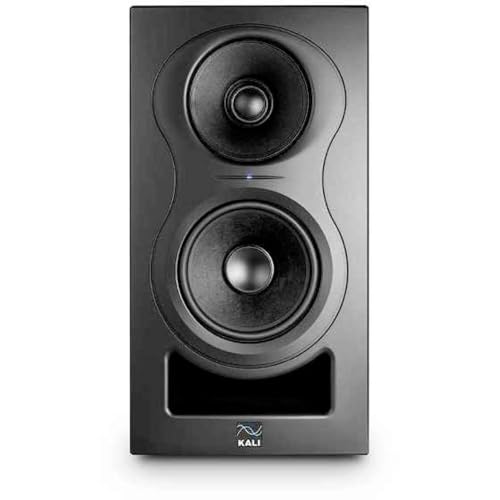
The Kali Audio IN-5 takes a different route to the same nearfield goal: a three-way powered monitor whose tweeter sits coaxially inside a 4-inch midrange driver, with a separate 5-inch woofer handling the low end. That split keeps the midrange working in its own band, which suits mixing, editing, and critical listening at a desk, where a vocal or a guitar should stay clear of the bass. It is sold as a single unit, so a stereo pair needs two, and its powered design means no separate amplifier is required, only a line-level source.
Specs
- 3-way coaxial studio monitor design
- 5-inch woofer
- 4-inch midrange driver with coaxial 1-inch tweeter
- Powered active monitor, sold as a single unit
- Model listed as IN-5
Best for: Critical nearfield monitoring and mixing at a desk, where midrange clarity matters most.
Watch out for: It is sold singly, so order two for stereo, and check the rear-panel connections and placement switches against your audio interface or source before ordering.
KEF LSX II LT Wireless HiFi Speakers (Pair, Stone White)

The LSX II LT is the simplest route to coaxial nearfield sound in this group, because amplification, streaming, and digital processing are built into the pair. Its 11th-generation Uni-Q driver array delivers the same point-source imaging as the passive KEF picks, while HDMI ARC, USB-C, optical input, Bluetooth 5.0, AirPlay 2, and Chromecast cover a desk computer, a television, and a phone without extra boxes. At 24 cm tall, 15.5 cm wide, and 18 cm deep per speaker, it is genuinely compact, and the KEF Connect app adds placement presets for desk, bookshelf, and free-space positions.
Specs
- 11th-generation Uni-Q driver array
- 19 mm aluminium tweeter and 115 mm magnesium and aluminium mid-bass driver
- Total power output listed as 200 watts
- HDMI ARC, USB-C, and optical inputs
- Bluetooth 5.0, AirPlay 2, and Chromecast streaming
- High-resolution streaming listed as 24bit/384kHz
- Dimensions listed as 24 cm tall, 15.5 cm wide, and 18 cm deep per speaker
- Includes a 3 m interspeaker cable, power cord, and remote
- Sold as a pair
Best for: A powered desk or small-room system for streaming, computer audio, and television sound with no separate amplifier.
Watch out for: Only the primary speaker needs a mains connection, with the secondary fed through the interspeaker cable, so plan cable routing between the pair and confirm the inputs match your television and computer before ordering.
Which One Fits Your Situation
You want your first coaxial pair for a desk
Choose the KEF Q150. Its 5.25-inch Uni-Q driver and compact cabinet suit a small desk, its listed 51Hz to 28kHz response covers most music without extra help, and its passive design lets you start with a modest amplifier and upgrade later. Keep the cabinets a little clear of the wall and aim the tweeters at your ears.
You listen closely and want the most detail
Choose the KEF LS50 Meta in Mineral White. Its Metamaterial Absorption Technology and Uni-Q driver are aimed at listeners who sit still, listen attentively, and notice fine detail in recordings. Give it a capable amplifier, a stable surface, and careful placement, and its imaging rewards the effort in a small room.
You mix, edit, or judge recordings at your desk
Choose the Kali Audio IN-5, remembering to order two for stereo. Its three-way coaxial layout separates the midrange from the woofer, which helps vocals and instruments stay distinct during long sessions, and its powered design also keeps the desk free of an extra amplifier box. Check the rear-panel connections against your audio interface before ordering, and give each monitor the same clear space on the desk.
You want coaxial sound with no separate amplifier
Choose the KEF LSX II LT. Its built-in amplification, streaming support, and HDMI ARC and USB-C inputs cover a computer and a television in one compact pair, and its placement presets help it adapt to a desk or a shelf without extra equipment. Only one mains socket is needed for the pair, which keeps cable clutter down on a busy desk.
Common Mistakes
- Sitting too close to a large bookshelf pair and expecting the drivers to blend, when a compact coaxial model suits the distance better.
- Pushing rear-ported cabinets flat against the wall, which thickens the bass and blurs the image.
- Pairing a low-sensitivity passive speaker with a weak amplifier and blaming the speaker when the sound runs out of headroom.
- Ordering a single powered monitor such as the IN-5 and expecting stereo sound from one cabinet.
- Placing both speakers at different heights or distances from the listening seat, so the stereo centre drifts to one side.
- Skipping isolation or stands on a hollow desk, letting the furniture add resonance the speaker never produced.
Frequently Asked Questions
Are coaxial bookshelf speakers better for nearfield listening?
Coaxial bookshelf speakers suit nearfield listening because the tweeter and midrange share one acoustic centre, so the sound reaches your ears as a single coherent source at short distance. That helps the stereo image stay stable when you sit close, lean sideways, or listen at low volume, which is harder for a conventional two-way design with separated drivers.
Do I need a subwoofer with coaxial bookshelf speakers?
A subwoofer is optional rather than essential for most nearfield setups. Compact coaxial pairs such as the Q150 already cover much of the musical range, and adding a subwoofer mainly extends the lowest octave for electronic music or film sound. Try the pair on your desk first, then decide whether the lowest notes are missing in your room.
Do passive coaxial speakers need a powerful amplifier?
Passive coaxial speakers need an amplifier matched to their sensitivity and impedance, not necessarily a large one. The Q150, for example, lists 86dB sensitivity, 8 ohms nominal impedance, and a 10 to 100 watt recommendation, so a modest amplifier can work well at desk volume. Check the listing for each model and leave headroom for dynamic peaks.
Can I use studio monitors such as the Kali IN-5 for music listening?
Studio monitors such as the Kali IN-5 work well for music listening as well as mixing, because their coaxial three-way design aims for clear, accurate sound at close range. They are powered, so they connect to a line-level source such as an audio interface or DAC, and they are sold singly, so a pair is needed for stereo.
More from Amazon
Programs that pair well with the guide above. Offers and eligibility are set by Amazon and may change.
Free shipping on eligible items, Prime Video and more. Eligible new members can start with a free trial.
Start a Prime free trialAudiobooks and podcasts to listen to on the go. Eligible new members can start with a free trial.
Try Audible freeAd-free music streaming. Eligible new subscribers can start with a free trial.
Try Music Unlimited freeA free business account with business pricing and bulk-buying tools for work, shop or home office.
Create a business accountAs an Amazon Associate we earn from qualifying purchases.
Write Your Review
No reviews yet. Be the first to share your experience!