

Key takeaways
- The best clarinet stands compared: in-bell K&M and Hercules Travlite models, plus folding tripods from Andoer and BESPORTBLE for home, school, and stage.
A clarinet spends a surprising share of its life being set down: between pieces at rehearsal, during lesson breaks, and while you turn pages, swap reeds, or pick up a second instrument. Resting it on a chair, a music desk edge, or the floor invites bent keys, cracked tenons, and chipped bells, which is why a dedicated stand is one of the simplest forms of protection a player can own.
The five stands below cover the two designs that dominate the market: in-bell models whose legs screw into the peg so the whole unit travels inside the instrument, and folding tripods that open wider for home practice. We compared leg counts, base width, folded size, weight, and which instruments each peg is actually built to fit, so you can match a stand to how and where you play.
Quick Picks
As an Amazon Associate we earn from qualifying purchases.
| Product | Best for | Key spec from title |
|---|---|---|
| BESPORTBLE Clarinet Stand Flute Holder | Multi-instrument households | Foldable tripod for wind instruments |
| K&M 15222 In-Bell Clarinet Stand | Always-in-case carry | 4-leg folding base, fits A and B clarinets |
| K&M 15228 In-Bell Clarinet Stand | Widest in-bell base | 5-leg base with 7.7-inch base diameter |
| Hercules DS440B Travlite Clarinet Stand | Bell protection on the road | Velvet pads, stores inside the bell |
| Andoer Tripod Stand Holder | Doublers on a simple setup | Foldable for oboe, flute, clarinet, saxophone |
How to Choose
In-Bell or Tripod: Pick a Storage Style First
The first decision is where the stand lives when you are not using it. In-bell stands break down so the leg base screws into the peg, and the peg then slides into the clarinet’s bell, meaning the stand travels inside your existing case and adds nothing to carry. Tripod stands fold flat or collapse into a short bundle instead, so they suit a practice room, a studio corner, or a gear bag with spare room. Players who walk to lessons usually prefer in-bell designs, while players with a fixed practice spot often prefer the wider footprint of a tripod.
Leg Count and Base Width Decide Stability
A clarinet is tall and top-heavy relative to its footprint, so the base does most of the safety work. Three-legged tripods are the lightest option and work well on calm, level floors. Four and five-legged in-bell stands spread the load across a wider circle, and the K&M 15228 stretches that circle to a 7.7-inch base diameter, the widest in this roundup. Check the base diameter or radius in the specifications rather than judging by photographs, because product images rarely show scale. On carpet, a wider base also resists the slow lean that a narrow tripod can develop.
Check the Peg Against Your Instrument
Pegs are not universal. The K&M stands in this guide are built for A and B clarinets, the pairing most orchestral players own, while the tripod models from BESPORTBLE and Andoer use a shared peg listed for clarinet, flute, oboe, and straight saxophone. A peg that is too slim lets the bell rock, and one that is too wide can stress the bell rim. Look for protective contact points as well: the Hercules DS440B uses velvet pads where the stand meets the bell, and the K&M 15222 adds a felt ring, both of which guard the finish at the contact point.
Weight, Folded Size, and What Travels With You
Stand weights in this category run from about 0.1 kg for the Hercules Travlite to just under 0.3 lb for the five-legged K&M, so none of them will burden a case. Folded size matters more than weight: the DS440B folds to a cylinder roughly 55 mm across and 106 mm long, small enough to disappear into a bell. If you carry the stand separately, a included bag keeps legs from snagging case lining or scratching other accessories, which is one reason the Travlite’s velvet bag is worth noting. Match the folded dimensions to the space your case actually has free.
The 5 Best Options
BESPORTBLE Clarinet Stand Flute Holder
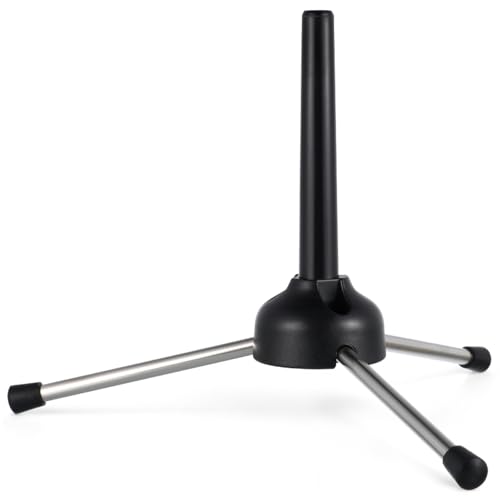
This folding tripod is the generalist of the group, built around a single peg that the listing rates for oboe, flute, clarinet, and saxophone. Three foldable metal feet swing out to form the base, and each foot ends in a plastic cap that adds grip and keeps the metal off finished floors. The plastic and metal body keeps the weight down to 0.18 lb, and the whole unit folds into a bundle under seven inches long, so it drops into a gig bag pocket or a case accessory compartment without rearranging everything else you carry.
Specs
- Fits oboe, flute, clarinet, and saxophone
- 3 foldable metal feet with plastic caps
- Material: plastic and metal
- Size: 17.5 x 6 x 6 cm (6.9 x 2.4 x 2.4 inches)
- Item weight: 0.18 lb
- Item dimensions: 6.88 x 2.36 x 2.36 inches
Best for: households where one stand has to serve several wind instruments.
Watch out for: the listing notes the height changes with how far the feet are folded out, so open them fully and evenly on a level surface.
ASIN: B0F6KR3K1J
K&M 15222 In-Bell Clarinet Stand

K&M’s four-leg in-bell stand is the minimalist’s pick: a plastic peg, four zinc die-cast legs, and a screw-in leg base that lets the entire unit store inside the bell of the instrument. A felt ring cushions the point where the bell meets the stand. At 180 mm tall and 0.149 kg, it adds almost nothing to a case, and because it lives in the bell it is simply always with the clarinet, ready at rehearsals, lessons, and gigs without a separate packing decision. It is made for A and B clarinets, the standard orchestral pairing.
Specs
- 4 zinc die-cast legs with screwable leg base
- Plastic peg with felt ring
- Leg base screws into the peg so the unit stores in the bell
- Fits A and B clarinets
- Height: 180 mm
- Weight: 0.149 kg
Best for: students and gigging players who want the stand to live inside the case.
Watch out for: the legs must be unscrewed and stowed after each use, which adds a small step to packing up.
ASIN: B000NTEVKS
K&M 15228 In-Bell Clarinet Stand

The 15228 takes the same in-bell idea as its four-legged sibling and adds a fifth zinc die-cast leg, widening the base diameter to 7.717 inches for players who want the steadiest footing this format offers. The detachable metal leg base screws into the peg, and the short peg then fits completely into the bell, so it still travels inside common instrument cases. At 130 mm it sits lower than the 15222, keeping the clarinet’s center of gravity closer to the floor. Like the smaller model, it is built for A and B clarinets and weighs 0.282 lb.
Specs
- 5 zinc die-cast legs with screwable leg base
- Plastic peg; legs store inside the peg for in-bell transport
- Base diameter: 7.717 inches (196 mm)
- Height: 5.118 inches (130 mm)
- Weight: 0.282 lb
- Fits A and B clarinets
Best for: players who want the widest, steadiest base an in-bell stand offers.
Watch out for: the short 130 mm peg holds the instrument low, which suits seated practice areas better than crowded walkways.
ASIN: B01BHJRUVO
Hercules DS440B Travlite Clarinet Stand

Hercules built the Travlite around protecting the bell as much as holding it. The in-bell design folds down for storage inside the instrument, velvet pads cushion the contact points, and a velvet bag comes in the box for carrying the stand on its own. The published figures make it the lightest stand here at 0.1 kg, folding to about 55 mm in diameter and 106 mm long, with a base radius of 115 mm once opened. Its rated load capacity is 3 kg, comfortably above what a soprano clarinet asks of it, and the 170 mm height keeps the instrument easy to lift clear.
Specs
- Travlite in-bell design, folds for storage inside the bell
- Velvet pads protect the bell; velvet carry bag included
- Height: 170 mm (6.7 inches)
- Weight: 0.1 kg (0.2 lb)
- Base radius: 115 mm (4.5 inches)
- Folded size: 55 mm diameter x 106 mm
- Load capacity: 3 kg (6.6 lb)
Best for: traveling players who want padded contact points and a carry bag included.
Watch out for: the 3 kg load rating is sized for a clarinet, so this is not a stand for heavier woodwinds.
ASIN: B002E5C49E
Andoer Tripod Stand Holder

Andoer’s tripod is a straightforward folding holder listed for oboe, flute, clarinet, and straight saxophone, aimed at players who double and want one stand to cover rehearsal-room duty for several instruments. Three durable metal feet spread evenly for balance, and the end of each foot carries rubber padding for extra friction on smooth floors. It folds down to a compact bundle for a gear bag, and at 4.2 oz it is light enough to leave in the bag permanently as a spare. The mini-size construction keeps the footprint modest on a crowded practice stand row.
Specs
- Foldable tripod for oboe, flute, clarinet, and straight saxophone
- 3 metal feet with rubber padding at the ends
- Weight: 4.2 oz
- Dimensions: 7.32 x 3.46 x 2.6 inches
Best for: doublers who want one simple folding stand for several instruments.
Watch out for: a single peg serves four instrument types, so confirm your bell seats fully on the peg before relying on it.
ASIN: B00T46UYSE
Which One Fits Your Situation
You Carry Your Clarinet to Lessons Every Week
Choose an in-bell stand and remove one packing decision. The K&M 15222 and the Hercules DS440B both store inside the bell, so the stand is present at every lesson, rehearsal, and performance without occupying case space. The Hercules adds velvet pads and a carry bag; the K&M adds a felt ring and a slightly taller stance. The stand travels with the instrument instead of depending on your memory.
You Play Both A and B♭ Clarinets
Orchestral players switching between A and B clarinets need a stand rated for both, and the two K&M models are the explicit fits. The 15228’s five legs and 7.7-inch base diameter give the wider margin in a busy orchestra pit, while the 15222 trades a little base width for a taller, lighter build. Check the fit line before ordering, since not every stand covers the A instrument.
You Double on Flute or Oboe
If your stand has to hold whichever instrument you just put down, the shared-peg tripods make more sense than a clarinet-only in-bell model. The BESPORTBLE lists oboe, flute, clarinet, and saxophone on one peg, and the Andoer covers the same four with rubber-padded feet. Keep expectations realistic about fit: a shared peg is a compromise, so seat each instrument once at home and learn how it balances before trusting the stand on stage.
You Want a Stand That Stays in the Practice Room
A stand that never travels can trade portability for presence. The BESPORTBLE tripod folds away when the room is needed but opens into a stable three-foot base for daily practice, and its plastic-capped feet are kind to wood floors. Leaving the stand set up in a corner, away from foot traffic, also removes the daily assembly step that in-bell designs require, which makes short practice sessions easier to start.
Common Mistakes
- Resting the clarinet on a chair, bed, or music desk between pieces, where a sleeve or a passing elbow can knock it to the floor.
- Buying a stand sized for a different instrument, such as a bass clarinet or saxophone model, and assuming the peg will suit a soprano clarinet bell.
- Forgetting that an in-bell stand must be assembled before use and stowed in the bell afterward, then leaving the legs loose in the case to rattle against the instrument.
- Setting the stand in a walkway or beside a swinging door instead of a corner where foot traffic never passes.
- Judging base size from product photographs rather than the published base diameter, radius, or folded dimensions.
Frequently Asked Questions
Can a clarinet stand really fit inside the instrument case?
Yes, that is exactly what in-bell designs are made for. The leg base unscrews and stores inside the peg, and the peg then slides into the clarinet’s bell, so the K&M 15222, K&M 15228, and Hercules DS440B all travel inside the bell without taking any separate case space. Tripod models fold flat instead and ride in a pocket or accessory compartment.
Will a flute stand hold a clarinet safely?
Some will, because many folding tripods use one peg listed for flute, clarinet, oboe, and straight saxophone, as the BESPORTBLE and Andoer models here do. The bell has to seat fully and sit steady on the peg, though, so test the fit at home first. A clarinet is heavier than a flute, and a peg that feels fine with the lighter instrument deserves a careful check with the heavier one.
How many legs should a clarinet stand have?
Three legs are enough on a level floor in a calm room, which is why basic tripods use them. Four and five-legged bases spread the footprint wider and resist tipping better in rehearsal rooms and on stage, where chairs move and people pass close by. Compare the base diameter or radius in the specifications, since that measurement predicts stability more honestly than leg count alone.
Is it fine to leave a clarinet on its stand between practice sessions?
For short breaks during the day, yes; holding the instrument upright and ready is what a stand is for. For storage stretching into days, the case is the safer home, since it shields the clarinet from dust, sunlight, knocks, and dry room air. Think of the stand as a working rest during playing hours, and the case as the place the instrument sleeps.
More from Amazon
Programs that pair well with the guide above. Offers and eligibility are set by Amazon and may change.
Free shipping on eligible items, Prime Video and more. Eligible new members can start with a free trial.
Start a Prime free trialAudiobooks and podcasts to listen to on the go. Eligible new members can start with a free trial.
Try Audible freeAd-free music streaming. Eligible new subscribers can start with a free trial.
Try Music Unlimited freeA free business account with business pricing and bulk-buying tools for work, shop or home office.
Create a business accountAs an Amazon Associate we earn from qualifying purchases.


Write Your Review
No reviews yet. Be the first to share your experience!