

Key takeaways
- The 3 best drum tuners compared: a clip-on pitch tuner that saves whole-kit settings, plus two head-tension gauges for quiet, repeatable tuning.
A drum kit rarely sounds bad because of the drums. It sounds off because one lug sits tighter than its neighbors, the resonant head fights the batter head, or last week’s tuning drifted as the heads settled. Tuning by ear alone can fix all of that, but it is slow, and it is hard to repeat the exact sound you liked once a head comes off. A drum tuner turns that guesswork into numbers you can return to.
This guide is for home players, rehearsal-room regulars and anyone who shares a kit and needs it sounding consistent without a long tuning session before every play. The three picks below come from current Amazon listings and split into two camps: one clip-on tuner that reads pitch in hertz and stores whole-kit settings, and two gauges that read head tension directly, so you can even out every lug without striking the drum at all.
Quick Picks
As an Amazon Associate we earn from qualifying purchases.
| Product | Best for | Key spec from title |
|---|---|---|
| Tune-Bot Studio TBS-001 Digital Drum Tuner | Recalling tunings across several kits | Stores 50 pitches, 5 kits of 10 drums |
| DrumDial Precision Drum Tuner (ADD) | Even lug tension without striking the head | Measures tympanic pressure, not rod torque |
| TAMA Tension Watch (TAMTW100) | A battery-free analog meter | Reads actual head tension on a dial |
How to Choose
Pitch in Hertz or Pressure at the Lug
Every tuner in this guide measures one of two things. Pitch tuners listen to the drum: you clip the unit to the hoop, strike the head near each lug, and read the fundamental note in hertz, which lets you tune drums to actual musical pitches and match intervals across a kit. Tension gauges never hear the drum at all. They press on the head and report how much it deflects, so the number tells you whether every lug is pulling evenly, not what note the drum makes. Neither method is wrong, but they answer different questions, and mixing the two sets of numbers up is the most common beginner confusion.
Repeatability and Saved Settings
A tuner earns its place when it gives you the same sound twice. The simplest form of repeatability is a notebook: write down the reading at each lug and dial back to those numbers after a head change. Digital pitch tuners go further and store the settings on the device itself, so a whole kit’s worth of pitches is one recall away. Analog gauges cannot store anything, but their numbered scales serve the same purpose if you record them. Decide how many drums you realistically retune: one practice kit needs little memory, while several kits or frequent head changes reward built-in storage.
Where You Will Tune: Noise and Light
Think about the room, not just the drum. A pitch tuner needs a clear strike for every reading, which is fine in a practice space and awkward in a quiet house late at night or a shared rehearsal room between songs. A tension gauge works in complete silence because the head is never struck, which also makes it the safer choice around sleeping family members. Light matters too: a backlit or color display stays readable on a dim stage, while an analog needle needs decent light and a steady eye. Match the tool to the worst conditions you regularly tune in, not the best.
Fit, Placement and Upkeep
Small handling details decide whether a tuner gets used weekly or lives in a drawer. Clip-on pitch tuners must grip your hoop style securely; the listings here fit standard rims, but deep or wooden hoops deserve a test fit. Tension gauges depend on consistent placement: the base has to sit the same distance from the hoop at every lug, which is why one pick ships with an edge gauge and the other builds placement into its base design. Finally, plan for upkeep. Battery models need spares in the stick bag, and every gauge, analog or digital, drifts unless you recalibrate it on a flat surface as the maker directs.
The 3 Best Options
Tune-Bot Studio TBS-001 Digital Drum Tuner

The Studio is the pick for players who think in notes rather than numbers on a dial. It clips to the hoop, listens to each strike, and reports the lug pitch in hertz alongside the nearest note, so you can set a floor tom to a deliberate interval below the rack tom instead of just making both heads even. Its Filter Mode rejects stray overtones when a room is lively, and the memory holds complete tunings for five kits, which suits players who rotate between a home kit, a rehearsal kit and a shared backline kit.
Specs
- Model TBS-001, clip-on tuner for acoustic drum kits
- Tuning range of 30 to 400 Hz, extending to 450 Hz in high range
- Absolute, Difference and Filter modes
- Resolution of 0.5 Hz with a 750 millisecond response time
- Memory for up to 50 pitches, saved as 5 kits of 10 drums
- Four-color LCD display
- Runs on 2 AAA batteries; case included
Best for: Players who tune to musical pitches and want saved settings for more than one kit.
Watch out for: Every reading needs a drum strike, so it cannot help during a silent setup, and the batteries need replacing over time.
ASIN: B06ZYCC7YG
DrumDial Precision Drum Tuner (ADD)

The DrumDial is the long-running analog answer to uneven lugs. You set the gauge on the head beside each tension rod and read the tympanic pressure, which reflects the head itself rather than the torque on the rod, so corroded or mismatched hardware cannot skew the result the way it skews a torque key. Because nothing is struck, you can work through a whole kit in a quiet room. The numbered dial lets you record a target reading for each drum, and the included edge gauge keeps placement consistent from lug to lug.
Specs
- Measures tympanic pressure at the head, not tension rod torque
- Silent operation, with no need to strike the drum
- Model ADD, alloy steel body in black
- Edge gauge and instruction sheet included
- Item weight of 1.6 pounds
Best for: Quiet, repeatable lug matching with a purely mechanical gauge.
Watch out for: The Amazon page captured for this listing showed ‘No featured offers available’, so check the current buying options before ordering; its readings are tension numbers, not pitches.
ASIN: B0002E2TVM
TAMA Tension Watch (TAMTW100)
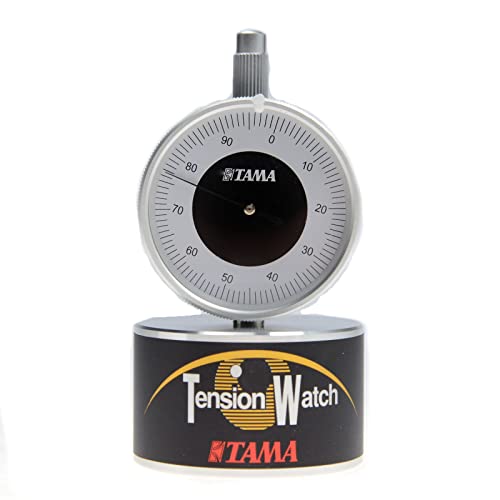
TAMA’s Tension Watch takes the same head-pressure approach as the DrumDial but wraps it in TAMA’s own meter and scale. The product description stresses that it measures actual head tension rather than rod tension, and the point of the tool is documentation: read the meter at each lug, write the numbers down, and you can rebuild a favorite tuning after a head swap in minutes. It is a deliberately simple instrument — no display modes, no memory, just a meter, a base and a set of sample tunings in the directions to start from.
Specs
- Measures actual head tension, not just rod tension
- Easy-to-read analog meter; record readings to duplicate a tuning later
- Sample tunings included in the directions
- Model TAMTW100
- Item weight of 1 pound; dimensions of 6 x 3 x 3 inches
Best for: Players who want a simple, durable gauge and keep their own tuning notes.
Watch out for: Its scale is TAMA’s own, so its numbers cannot be compared with DrumDial readings or shared charts written for the other gauge.
ASIN: B006DRT44C
Which One Fits Your Situation
You Rotate Between Several Kits
If the same tunings have to reappear on a home kit, a rehearsal-room kit and a borrowed backline kit, the Tune-Bot Studio is the natural fit. Save each kit’s pitches once, then recall them drum by drum instead of rebuilding the sound from memory. Hertz readouts also help when two kits should match, because a note is a note on any drum, while a tension number means something only on its own head and gauge.
You Tune in a Quiet House
When a strike on a snare would wake the household, a tension gauge is the only workable route. Both the DrumDial and the TAMA Tension Watch read the head without a single hit, so a full tuning pass can happen at conversation volume. The DrumDial’s edge gauge makes placement repeatable in near-darkness by feel, while the TAMA rewards players who keep written notes for each drum.
You Are Still Training Your Ear
A tuner is a teacher if you use it after listening, not instead of listening. Tune by ear first, then measure and note what the numbers were when the drum sounded right. The Tune-Bot Studio’s note readout connects tension to pitch most directly, which speeds up that learning. Either analog gauge teaches evenness: chase matching numbers around the lugs and you quickly hear how one stray lug was muddying the whole drum.
You Play a Shared or House Kit
Shared kits get retuned by everyone and owned by no one, so the goal is a documented baseline the next player can restore. A tension gauge suits this best: agree on target numbers for each head, tape the list inside the hardware case, and anyone can bring the kit back in minutes. Between the two gauges, pick the DrumDial if several players share one tool, since its placement gauge keeps different hands consistent.
Common Mistakes
- Chasing one lug at a time around the head instead of small turns in a star pattern, which keeps pulling the head off-center.
- Mixing numbers between systems, since a tension reading from one gauge brand means nothing on another brand’s scale and neither equals a pitch in hertz.
- Measuring with the gauge base at a different distance from the hoop at every lug, which manufactures differences that are not really in the head.
- Skipping recalibration on a flat surface after the gauge has been dropped, traveled with or stored for months.
- Tuning only the batter head and ignoring the resonant head, which shapes sustain and pitch bend as much as the top head does.
Frequently Asked Questions
Do drum tuners replace tuning by ear?
No tool in this guide hears tone the way you do. A tuner reports pitch or head tension at each lug, which guarantees evenness and repeatability, but the target is still a judgment call. The reliable workflow is to tune by ear until the drum sounds right, measure every lug, and save those numbers. Next time, the tuner rebuilds that sound quickly, and your ear only confirms it.
What is the difference between a pitch tuner and a tension gauge?
A pitch tuner, like the Tune-Bot Studio, listens to a struck drum and reports the fundamental note in hertz, so it can tune drums to musical pitches. A tension gauge, like the DrumDial or TAMA Tension Watch, never hears the drum; it presses the head and reports deflection, showing whether the lugs are even. Pitch suits players who tune to notes, while tension suits quiet work and fast lug matching.
Can these tuners tune the resonant head too?
Yes. Both methods work on the bottom head: clip the pitch tuner to the hoop and tap near each lug, or set the gauge on the resonant head the same way as the batter side. The relationship between the two heads shapes sustain and pitch bend, so record both sets of numbers once you like the sound, not just the top head’s.
Do drum tuners work on electronic kits or mesh heads?
These three tools are made for acoustic drums with tunable heads. A pitch tuner needs a real fundamental tone to read, and a tension gauge is calibrated for how an acoustic head deflects, so neither gives meaningful numbers on a mesh practice head or an electronic pad. Mesh-head players adjust feel with the tension rods alone and have no pitch to match.
More from Amazon
Programs that pair well with the guide above. Offers and eligibility are set by Amazon and may change.
Free shipping on eligible items, Prime Video and more. Eligible new members can start with a free trial.
Start a Prime free trialAudiobooks and podcasts to listen to on the go. Eligible new members can start with a free trial.
Try Audible freeAd-free music streaming. Eligible new subscribers can start with a free trial.
Try Music Unlimited freeA free business account with business pricing and bulk-buying tools for work, shop or home office.
Create a business accountAs an Amazon Associate we earn from qualifying purchases.



Write Your Review
No reviews yet. Be the first to share your experience!