

Key takeaways
- Compare four rackmount graphic EQs for live sound: two 31-band pro units, a flexible ART dual 31-band, and a dual 21-band Rockville for RCA DJ rigs.
Buying a graphic equalizer for live work is really a decision about where it will earn its keep. A unit assigned to monitor wedges spends the night making narrow cuts at ringing frequencies, while one parked on the main mix mostly shapes overall tone and tames room boom. Those two jobs reward different hardware: fine band spacing and honest sliders for the first, clean gain staging and useful filters for the second. Picking by band count alone, without settling the assignment first, is how racks end up with the wrong tool.
This guide is written for three kinds of buyers: engineers running mains and monitors for working bands, volunteers and installers voicing fixed systems in halls and houses of worship, and mobile DJs or rehearsal-room rigs built around simpler connections. Every pick below was chosen from the names and published specifications on its Amazon product page, and each entry quotes only what that listing states.
Quick Picks
As an Amazon Associate we earn from qualifying purchases
| Product | Best for | Key spec from title |
|---|---|---|
| dbx 231s | Notching feedback on two monitor mixes | Dual channel 31-band, 1/3-octave equalization |
| Behringer FBQ6200HD | Front-of-house tuning with a subwoofer in ringing rooms | 31-band stereo with FBQ Feedback Detection System |
| ART EQ355 | Racks that mix balanced gear with RCA playback sources | Dual channel 31-band with XLR, TRS and RCA connectors |
| Rockville REQ42-B | DJ and rehearsal rigs wired with RCA cables | Dual 21-band, 19-inch rack mount, VU meters |
How to Choose
Band count and spacing set your surgical reach
Thirty-one bands at 1/3-octave spacing put a slider close to almost any frequency that starts ringing on stage, so a cut can stay narrow and leave neighbouring content alone. Fifteen or twenty-one bands spread across 2/3-octave steps move more of the spectrum with every adjustment, which suits broad tone shaping but makes feedback surgery clumsy. A vocal wedge that rings at one stubborn frequency is the classic case for 31 bands. A DJ rig that mainly needs a gentle low-end lift and a tamed top end can live happily with fewer, wider bands.
Decide the assignment: mains, monitors, or one of each
A dual-channel unit can serve two monitor mixes, a stereo main pair, or one channel on the mains and the other on a single wedge mix. That flexibility only helps if you plan the patch before buying. Count the mixes you actually run: a four-wedge stage already outgrows one dual unit, while a duo act with two mixes is perfectly covered. Also think about who touches the unit mid-show. If the person running sound stands at front of house, an EQ living in the monitor chain needs settings that can be set at soundcheck and left alone.
Match the connectors to the rest of your chain
Balanced XLR and TRS connections reject hum and interference over the long cable runs that live rigs demand, and they are the standard language of pro mixers, crossovers, and amplifiers. RCA-only units belong to a different world of DJ mixers, media players, and home-style amplifiers, and forcing them into a balanced chain with adapters invites noise and level mismatches. Before ordering, trace the exact path the EQ will sit in, from mixer output to amplifier input, and confirm every connector on that path matches what the equalizer offers on its rear panel.
Weigh the extras, and notice where budget designs save money
Feedback detection that lights the offending slider, sweepable low-cut filters that strip stage rumble, hard bypass switches, and output metering all solve real show-night problems. Limiters and a pink noise generator turn an equalizer into a system-tuning station. Cheaper designs trim elsewhere: shorter sliders that make fine cuts fiddly, higher noise floors that surface during quiet passages, fixed rather than adjustable filters, and lighter power supplies. None of that makes a budget unit useless, but it does mean you should match the feature list to your noisiest, least forgiving gig rather than your easiest one.
The 4 Best Options
dbx 231s Dual Channel 31-Band Equalizer

The 231s is the plain, professional answer for engineers who want two channels of genuine 1/3-octave control and nothing they have to babysit. Each channel carries 31 bands with a switchable boost and cut range, so the same unit can make aggressive feedback cuts during soundcheck or gentle tonal moves on a main mix. Its input gain range and output level metering make gain staging straightforward in a working rack. This is the pick for a band’s own engineer or a venue that needs dependable monitor control without a learning curve.
Specs
- Two channels of 31-band, 1/3-octave equalization
- Switchable ±6 dB or ±12 dB boost/cut range
- ±12 dB input gain range
- 20mm nonconductive sliders
- Output level metering
- Frequency response: below 10Hz to above 50kHz, +0.5/-3dB
- Item model number: 231s
Best for: Working engineers who need honest 31-band control over two monitor mixes or a stereo main pair.
Watch out for: The 20mm sliders are short, so very narrow cuts take a steady hand; confirm that travel is fine enough for your monitor work before committing.
ASIN: B004NDHZTY
Behringer ULTRAGRAPH PRO FBQ6200HD

Behringer loads this dual 31-band unit with the tools a front-of-house engineer usually buys separately. The FBQ Feedback Detection System lights the slider sitting on a ringing frequency, the built-in limiters guard each channel against overload, and a pink noise generator supports room tuning from the same chassis. A dedicated mono subwoofer output with its own crossover control makes it a natural centrepiece for a mains rack running subs. Choose it when one box has to handle tuning, feedback hunting, and speaker protection for a system that plays different rooms every week.
Specs
- 31-band stereo graphic equalizer for live and studio applications
- FBQ Feedback Detection System reveals critical frequencies
- Ultra-low noise 4580 operational amplifiers
- Dedicated limiters with gain reduction meters for each channel
- Pink noise generator for adapting the system to room acoustics
- Mono subwoofer output with adjustable crossover frequency, 30 to 200 Hz
- Sweepable high-cut and low-cut filters for each channel
- Long-throw 45mm frequency faders
- 8-segment LED input and output metering with input gain controls
- Planet Earth switching power supply, 100 to 240 V
Best for: Front-of-house racks with a subwoofer, where feedback detection and limiting protect the show.
Watch out for: Make sure the listing is the current HD model rather than the older FBQ6200, and budget soundcheck time to set the limiter thresholds properly.
ASIN: B01D4L2R4I
ART EQ355 Dual Channel 31-Band Equalizer
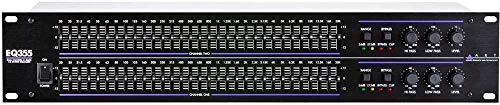
The EQ355 covers the same dual 31-band ground as the dbx but adds connection flexibility the others here do not match. Balanced XLR, active balanced quarter-inch, and unbalanced RCA inputs and outputs sit on the rear panel, so one unit can bridge a pro mixer and consumer playback gear without adapter chains. Variable high-pass and low-pass filters on each channel handle rumble and hiss trimming that fixed filters cannot aim as precisely. Installers, DJ rack builders, and instrument-rack owners who patch odd combinations of gear will get the most from this one.
Specs
- Dual channel 31-band graphic equalizer, 1/3 octave, ISO spacing
- Constant-Q filtering
- Balanced XLR, active balanced 1/4-inch, and unbalanced RCA input and output connectors
- Variable high-pass filter, 10Hz to 250Hz, and low-pass filter, 3kHz to 40kHz, 12 dB per octave
- Boost and cut range selectable at ±6 dB or ±12 dB
- 20mm center-detented frequency band sliders
- Independent level and bypass controls per channel
- Ground lift switch
- Frequency response: 20Hz to 20kHz, +0.5dB
- Signal to noise ratio: -94dB
- Rugged all-steel construction, 2U rackmount, 9.0 lb
Best for: Fixed installs and mixed racks where balanced and RCA sources must share one equalizer.
Watch out for: The three connector sets on each channel are wired in parallel, so use only one input type per channel, and check the rear line-voltage switch matches your mains supply.
ASIN: B0002E53WY
Rockville REQ42-B Dual 21-Band Graphic Equalizer
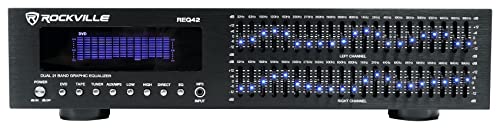
Rockville aims this unit squarely at DJ racks, rehearsal rooms, and small live setups that already run on RCA cables. Two 21-band sections give broad, musical control over a stereo feed, and the front panel is built for quick glances: illuminated sliders, individual LED indicators, dual VU meters, and a multi-colour display. A front 3.5mm input makes phone or laptop playback painless between sets. It will not pretend to be a touring monitor EQ, but for shaping a playback-driven rig in a fixed room, the feature set matches the job honestly.
Specs
- Dual channel 21-band graphic equalizer, 42 bands in total
- 19-inch rack mountable with removable rack brackets
- RCA stereo inputs with front panel selector switch
- RCA stereo record output
- Front panel 3.5mm MP3 input jack
- Blue LED on each equalizer slide control
- Dual VU meters and individual LED indicators
- Each band adjusts from -12 dB to +12 dB
- Frequency response: 20 to 20,000 Hz
- Signal to noise ratio: 80dB
- Item weight: 6.5 pounds
- Power requirement: 110V AC
Best for: DJ, karaoke, and rehearsal-room systems wired with RCA connections that need broad stereo shaping.
Watch out for: There are no balanced XLR or TRS connections at all, so confirm your mixer and amplifier chain is genuinely RCA before ordering.
ASIN: B00LZDSL7U
Which One Fits Your Situation
Your wedges ring before the vocals are loud enough
Reach for the dbx 231s. Two independent 31-band channels let you ring out two separate monitor mixes, and the narrow 1/3-octave spacing keeps each cut tight enough that the vocal keeps its body. If the whole system, mains included, fights feedback in a reflective room, the Behringer FBQ6200HD and its slider-lighting detection system will find the offending frequencies faster during a short soundcheck.
Your system plays a different room every weekend
The Behringer FBQ6200HD was built for this pattern. Pink noise for quick room checks, sweepable low-cut filters for whatever rumble a new stage adds, limiters for unfamiliar amplifiers, and a subwoofer output with its own crossover mean the tuning toolkit travels in one chassis. Engineers who prefer a simpler box and already own a separate crossover can step down to the dbx 231s and give up nothing they actually use.
You are wiring a permanent install with mixed sources
Choose the ART EQ355. A house system that takes a balanced feed from the mixer on Sunday and RCA playback from a media player on Saturday needs exactly its connector spread, and the ground lift switch earns its place the first time a hum appears. Its variable high-pass and low-pass filters also let an installer fence off the extremes once, then leave the rack locked and untouched.
Your rig is a DJ or rehearsal setup on RCA cables
The Rockville REQ42-B fits without adapters or rewiring. It drops into the rack, takes the RCA feed your mixer already provides, adds a front input for a phone, and gives you visible meters and illuminated sliders in a dark room. Spend the savings on the cables and speaker placement, which will change your sound more than a costlier equalizer would in this kind of chain.
Common Mistakes
- Boosting frequencies to fix problems that a cut elsewhere would solve, which eats headroom and invites the feedback you were trying to avoid.
- Setting one EQ curve at soundcheck in an empty room and never revisiting it once the audience absorbs the reflections you tuned against.
- Patching an RCA-only equalizer into a balanced pro chain with adapters, then chasing the hum and level loss that follow.
- Running both channels of a dual unit with identical curves on two different monitor mixes instead of ringing out each wedge on its own.
- Ignoring input gain staging, so the equalizer clips internally long before the amplifier shows any sign of trouble.
Frequently Asked Questions
Is a 31-band equalizer always better than a 15-band for live sound?
Not always. Thirty-one bands give the narrow cuts that monitor feedback control demands, and they matter most on loud stages with several open microphones. For broad tone shaping on a main mix, or a small acoustic rig, wider bands can be quicker to dial in and harder to make sound unnatural. Match the resolution to the job the unit will actually do.
Should a graphic equalizer go on the mains or the monitors?
Both placements are legitimate, and many rigs run one of each. Mains EQ corrects the room and the speakers as a system, while monitor EQ exists mainly to buy gain before feedback. If you can only afford one dual-channel unit, put it where feedback costs you shows, which for most vocal-heavy acts is the monitor chain.
Can one dual-channel unit handle mains and a monitor mix together?
Yes, with a compromise. One channel can serve a mono main mix while the second handles a single monitor mix, and several units here are built with exactly that split in mind. The compromise is that stereo mains and additional wedges each need their own channels, so count your mixes honestly before assuming one box covers the whole stage.
Does a graphic EQ replace proper speaker placement and microphone technique?
No. Equalization trims the symptoms of a system fighting its room, but a microphone pointed at a wedge or speakers firing into a wall will keep creating problems no slider can fully remove. Place speakers and microphones sensibly first, gain-stage the system, then let the equalizer do the final, smaller corrections it is good at.
More from Amazon
Programs that pair well with the guide above. Offers and eligibility are set by Amazon and may change.
Free shipping on eligible items, Prime Video and more. Eligible new members can start with a free trial.
Start a Prime free trialAudiobooks and podcasts to listen to on the go. Eligible new members can start with a free trial.
Try Audible freeAd-free music streaming. Eligible new subscribers can start with a free trial.
Try Music Unlimited freeA free business account with business pricing and bulk-buying tools for work, shop or home office.
Create a business accountAs an Amazon Associate we earn from qualifying purchases.

Write Your Review
No reviews yet. Be the first to share your experience!