
Our Short List of 3
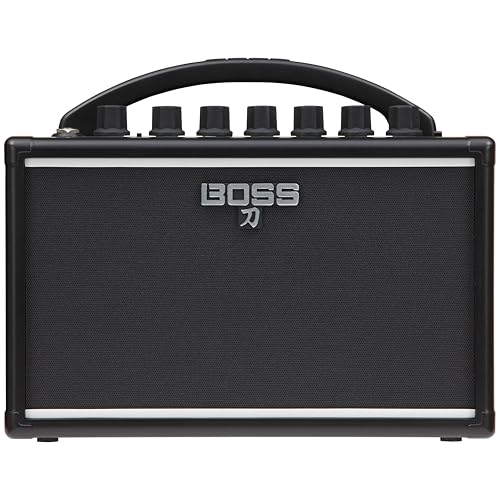
- Best for: Players who want analog-style gain and delay in a take-anywhere amp with no phone required.
- Output wattage: 7 watts
- Speaker: 4-inch
- Amp types: Clean, Crunch, Brown
- Effects: tape-style delay
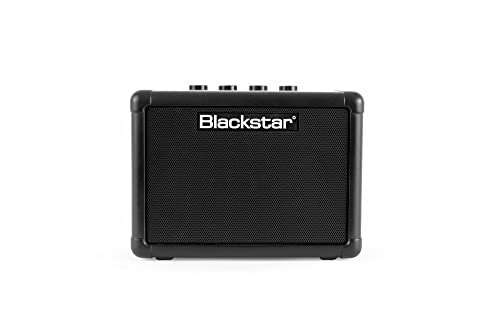
- Best for: Beginners and travellers who want the smallest, lightest battery amp that still has two channels and a headphone jack.
- Output wattage: 3 watts
- Speaker: 3-inch full-range
- Channels: Clean and Overdrive, with ISF control
- Effects: digital tape delay
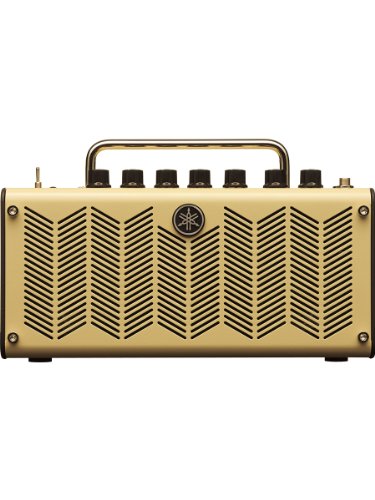
- Best for: Home players who want one battery-capable amp for the desk that also records over USB.
- Rated output: 10W (5W + 5W)
- Speakers: 8cm full-range x 2
- Amp types: Clean, Crunch, Lead, Brit Hi, Modern
- Effects: chorus, flanger, phaser, tremolo, delay, delay/reverb, spring reverb, hall reverb
All 5 Picks at a Glance
| Product | Specs | Action |
|---|---|---|
| BOSS Katana Mini |
| Check price on Amazon |
| Blackstar FLY 3 |
| Check price on Amazon |
| Yamaha THR5 |
| Check price on Amazon |
 Positive Grid Spark GO |
| Check price on Amazon |
 Pignose 7-100 |
| Check price on Amazon |
Our Top Picks
A battery operated portable guitar amp is bought for one reason: playing where there is no wall outlet, or no patience for cables. That makes the real decision a power decision before it is a tone decision. Amps in this class run on disposable AA cells, on a built-in rechargeable pack, or on either batteries or an adapter, and that choice fixes your running costs, your play time between swaps or charges, and how much weight you carry. Wattage, speaker size and connections only matter after the power question is settled.
This guide is for bedroom players who want to practise anywhere in the house, travellers and buskers who play outdoors, and desktop players who want one small amp that also records. Every pick below genuinely runs on batteries according to its Amazon listing, and the products were chosen from the names and specifications printed on those listings, not from headline claims.
Quick Picks
As an Amazon Associate we earn from qualifying purchases.
| Product | Best for | Key spec from title |
|---|---|---|
| BOSS Katana Mini | Analog-style crunch without a menu or an app | 7W, 4-inch speaker, battery powered |
| Blackstar FLY 3 | The smallest amp for a desk corner or a backpack | 3W, 3-inch speaker, 6 AA batteries or DC |
| Yamaha THR5 | Desktop playing that doubles as a recording interface | 10W stereo, two 8cm speakers, AA batteries or AC |
| Positive Grid Spark GO | App-driven tones with a rechargeable battery | 5W, USB-C rechargeable, up to 8 hours |
| Pignose 7-100 | One-knob vintage grit you can sling over a shoulder | 5W, 5-inch speaker, 6 AA batteries |
How to Choose
Start with the battery system, not the wattage
Battery format decides what owning the amp feels like. Models that run on AA cells, like the Katana Mini, FLY 3 and Pignose 7-100, can be revived in seconds with a fresh set, and spare cells are easy to carry and easy to find anywhere in the world. The trade-off is a recurring cost and extra weight, especially on an eight-cell design like the THR5. A built-in rechargeable pack, as on the Spark GO, removes the battery bill entirely but ties you to a USB-C cable and a charging wait when it runs flat. Check the listing for the exact cell count and whether batteries or an adapter are included before you buy.
Match output and speaker size to the room you actually play in
Small battery amps are personal-volume devices, and their listings are honest about it if you read the numbers. A 3-watt amp through a 3-inch speaker, like the FLY 3, is built for one listener at arm’s length. Five to seven watts through a 4- or 5-inch speaker fills a bedroom or a quiet patio comfortably. The THR5 spreads 10 watts across two speakers in stereo, which sounds wider and larger than the wattage suggests at desk distance. None of these will hold up against a drummer, so buy for the space you play in most, not the loudest space you can imagine.
Decide how much tone shaping you want on the amp itself
The five picks split into two philosophies. Analog-style amps keep everything on the panel: the Katana Mini offers three amp types, EQ and a tape-style delay, while the Pignose reduces the whole instrument to a single volume knob that adds grit as you turn it. Modelling amps move the variety into software. The Spark GO puts dozens of amp models and effects behind an app, and the THR5 carries five amp types plus a full effects set on its top panel. If you dislike playing through a phone screen, choose an amp whose sounds are all reachable from its own knobs.
Check the connections, because they decide the amp’s second job
A portable amp often doubles as a practice and recording tool, so the jack list matters. An aux input lets you play along with songs from a phone, a headphone output keeps late-night practice silent, and a USB connection turns the amp into a recording interface, which is the THR5’s party trick and part of the Spark GO’s design too. Not every mini amp includes all three: the Pignose has a preamp output but no headphone jack or aux input. Compare the connector list on the listing against the jobs you actually plan to give the amp.
The 5 Best Options
BOSS Katana Mini
- Best for: Players who want analog-style gain and delay in a take-anywhere amp with no phone required.
- Output wattage: 7 watts
- Speaker: 4-inch
- Amp types: Clean, Crunch, Brown
- Effects: tape-style delay
Players who want analog-style gain and delay in a take-anywhere amp with no phone required.
Batteries and the optional AC adapter are separate purchases, so factor in a set of AAs from day one.
The Katana Mini is the pick for players who want real amp feel from a battery box. Its multi-stage analog gain circuit produces three voices, Clean, Crunch and the high-gain Brown sound, shaped by an analog EQ and finished with an onboard tape-style delay, all from the top panel with no app involved. At 7 watts through a 4-inch speaker it is voiced for a sofa, a patio or a hotel room rather than a stage, and the listing confirms battery power as its source, so it can live wherever you actually pick up the guitar.
Blackstar FLY 3
- Best for: Beginners and travellers who want the smallest, lightest battery amp that still has two channels and a headphone jack.
- Output wattage: 3 watts
- Speaker: 3-inch full-range
- Channels: Clean and Overdrive, with ISF control
- Effects: digital tape delay
Beginners and travellers who want the smallest, lightest battery amp that still has two channels and a headphone jack.
The matching extension cabinet and the DC power supply are sold separately, and 3 watts is strictly personal practice volume.
The FLY 3 is the smallest serious option here, a 3-watt amp built around a 3-inch full-range speaker that still manages two channels, Clean and Overdrive, plus Blackstar’s ISF tone control and a digital tape delay. The listing spells out the flexibility that makes it easy to live with: it runs on six AA batteries or a DC supply, takes an MP3 or line input for backing tracks, and offers a headphone output with speaker emulation for silent practice. It weighs just over a pound, so it disappears into a gig bag pocket or a desk drawer between sessions.
Yamaha THR5
- Best for: Home players who want one battery-capable amp for the desk that also records over USB.
- Rated output: 10W (5W + 5W)
- Speakers: 8cm full-range x 2
- Amp types: Clean, Crunch, Lead, Brit Hi, Modern
- Effects: chorus, flanger, phaser, tremolo, delay, delay/reverb, spring reverb, hall reverb
Home players who want one battery-capable amp for the desk that also records over USB.
Battery life is quoted for moderate use and shrinks at high volume, and this generation has no Bluetooth audio streaming.
The THR5 is the desktop option, built for players whose portable amp will spend most of its life next to a computer. It delivers 10 watts in stereo, 5 watts per side, through two 8cm full-range speakers, with five amp types running from Clean to Modern and a full effects set that includes chorus, flanger, phaser, tremolo, delay and two reverbs. A USB connection makes it a recording interface, while the aux input and phones jack cover backing tracks and silent practice. It runs on AA batteries for roughly six hours on alkalines, or on the included AC adapter at home.
Positive Grid Spark GO
- Best for: Players who want the widest tone library in the smallest rechargeable package, and who already practise with apps.
- Output wattage: 5 watts
- Power source: battery powered, USB-C rechargeable
- Battery: 1 lithium polymer battery included, up to 8 hours
- Amp models and effects: 33 amps, 43 effects via the Spark app
Players who want the widest tone library in the smallest rechargeable package, and who already practise with apps.
Most tones and features need the companion app and a phone, and the Pearl colour is a separate listing from the black version.
The Spark GO takes the opposite route from the Pignose: almost everything lives in the app. The listing highlights 33 amp models and 43 effects behind its 5-watt output, along with smart features that generate backing tracks and chord charts, yet the hardware itself is tiny and runs on a built-in lithium polymer battery charged over USB-C, rated for up to eight hours of play. It also works as a Bluetooth speaker and a headphone amp, and a USB connection covers recording. If your practice routine already runs through your phone, this is the amp that fits it.
Pignose 7-100
- Best for: Buskers and blues players who want instant vintage grit with zero setup and nothing to configure.
- Output wattage: 5 watts
- Speaker: 5-inch
- Controls: single volume and power knob
- Power source: battery powered, 6 AA batteries or optional AC adapter
Buskers and blues players who want instant vintage grit with zero setup and nothing to configure.
Batteries and the AC adapter are not included, and there is no headphone output for silent practice.
The 7-100 is the original portable guitar amp formula, unchanged in spirit since the seventies: a 5-watt solid-state combo with a 5-inch speaker and exactly one control, a pig-snout knob that works as both power switch and volume. Turn it up and the amp moves from clean to a gritty, vintage overdrive on its own. It runs on six AA batteries or an optional AC adapter, the hinged case stores a cable inside, strap buttons let you carry it over a shoulder, and a preamp output can feed a bigger system. There is no EQ, no effects and no headphone jack, and that is precisely the appeal.
Which One Fits Your Situation
You practise quietly at home, often late
Choose the Blackstar FLY 3 or the BOSS Katana Mini. Both run happily on AA batteries anywhere in the house, and both give you a headphone output for the hours when the rest of the home is asleep. The FLY 3 is the smaller, lighter desk option, while the Katana Mini answers with more output and a gain structure that rewards players who live on crunch and high-gain sounds.
You play outdoors, travel or busk
Take the Pignose 7-100 or the Spark GO. The Pignose was designed for the street: strap buttons for carrying it over a shoulder, a case that swallows a cable, and one knob between you and playing. The Spark GO is the modern version of the same idea, far smaller, rechargeable over USB-C, and able to stream backing tracks to play along with. Either way, a fresh set of AAs or a full charge is your fuel gauge.
Your amp lives on a desk and feeds your recordings
The Yamaha THR5 is the natural fit. Its stereo speakers are voiced for nearfield listening, its five amp types and effects cover a full practice session without pedals, and its USB connection records straight into your software. Battery power still matters here: it lets the THR5 move to a sofa, a garden table or a friend’s house without hunting for the adapter, then settle back on AC power at the desk.
You want endless tones without buying more gear
Pick the Positive Grid Spark GO. The app behind it holds dozens of amp models and effects plus a large shared tone library, so experimenting costs nothing but time, and the built-in battery means the experiment can happen on a train or in a park. Just accept the trade: the screen is part of the instrument, and players who hate that idea should take the Katana Mini instead.
Common Mistakes
- Buying a “portable” amp that is only portable in size, with no battery option on the listing at all.
- Assuming batteries or a power adapter are in the box, when several of these amps sell both separately.
- Expecting a 3-watt battery amp to keep up with other musicians instead of one listener.
- Ignoring the cell count: an eight-AA amp costs more to feed and weighs more than a rechargeable one.
- Overlooking a missing headphone jack or aux input until the first late-night or play-along session.
Frequently Asked Questions
How long do the batteries last in a portable guitar amp?
It depends on the design and on how loud you play. The Yamaha THR5 listing rates AA alkaline batteries at roughly six hours, and the Spark GO’s rechargeable pack is rated for up to eight hours. Small AA amps like the FLY 3 and Katana Mini run for many practice sessions per set, but high volume always shortens the figure, so regular players should keep spare cells or a charging cable nearby.
Is a battery powered amp loud enough for busking?
For a solo player in a reasonably quiet spot, yes. A 5-watt amp like the Pignose 7-100 or Spark GO projects well enough for a street corner, a market stall or a park bench, especially with the speaker aimed at listeners. What these amps cannot do is compete with traffic noise, a crowd of amplified performers or a drummer, so treat them as personal and small-group tools rather than public address systems.
Can I use a battery guitar amp with an acoustic guitar or a bass?
Some are built for it and some are not. The Spark GO’s listing names electric guitar, acoustic and bass among its uses, while amps like the Pignose 7-100 and Katana Mini are voiced for electric guitar and will sound boxy or strained with a bass at volume. An acoustic-electric through a clean channel works fine at low volume on most of these, but check the listing’s stated instruments before buying for anything beyond electric guitar.
Is a rechargeable amp better than one that takes AA batteries?
Each system wins somewhere different. A rechargeable amp like the Spark GO costs nothing to feed and charges from the same USB-C cable as your phone, but a flat battery means a charging wait. AA-powered amps like the FLY 3, Katana Mini and Pignose are playing again in the time it takes to swap cells, and cells are sold everywhere, which matters on the road. Choose based on whether you value zero running cost or instant refuelling more.
More from Amazon
Programs that pair well with the guide above. Offers and eligibility are set by Amazon and may change.
Free shipping on eligible items, Prime Video and more. Eligible new members can start with a free trial.
Start a Prime free trialAudiobooks and podcasts to listen to on the go. Eligible new members can start with a free trial.
Try Audible freeAd-free music streaming. Eligible new subscribers can start with a free trial.
Try Music Unlimited freeA free business account with business pricing and bulk-buying tools for work, shop or home office.
Create a business accountAs an Amazon Associate we earn from qualifying purchases.

Write Your Review
No reviews yet. Be the first to share your experience!