
Our Short List of 3

- Best for: Drivers building a complete four-speaker system with room to add a subwoofer later.
- 1,000 watts maximum power output
- 60 watts RMS x 4 at 4 ohms; 190 watts RMS x 2 bridged
- Class AB, bridgeable 4-channel design
- Variable high- and low-pass filters with bass boost

- Best for: Drivers who want more clarity from factory speakers without replacing the head unit or running new power cable.
- 45 watts RMS x 4 at 4 ohms or 2 ohms; 90 watts RMS x 2 bridged at 4 ohms
- Class D head unit power pack
- Frequency response: 20–20,000 Hz
- High-pass crossover: 60, 80, 120 Hz

- Best for: Simple two-speaker upgrades or a single bridged subwoofer in a car with limited mounting space.
- 500 watts maximum power output
- Class AB, bridgeable 2-channel design
- Automatic signal sensing and turn-on
- Frequency response: 10 Hz to 70 kHz
All 4 Picks at a Glance
| Product | Specs | Action |
|---|---|---|
| Pioneer GM-A6704 1000W Max Class AB Bridgeable 4-Channel Car Amplifier |
| Check price on Amazon |
| Alpine KTP-445U Universal Power Pack Amplifier |
| Check price on Amazon |
| Pioneer GM-A3702 500W Max Class AB Bridgeable 2-Channel Car Amplifier |
| Check price on Amazon |
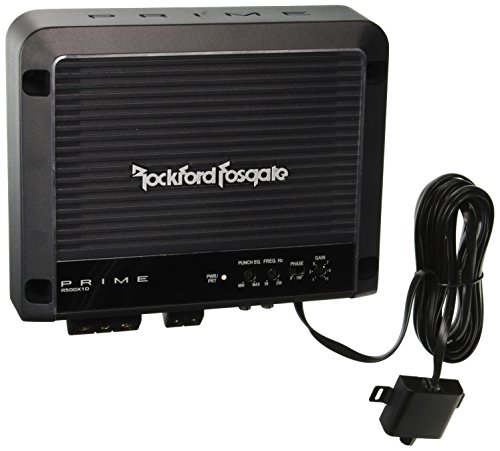 Rockford Fosgate R500X1D Prime 1-Channel Class D Amplifier |
| Check price on Amazon |
Key takeaways
- Four car amplifiers for cleaner sound, from a compact head-unit power pack to four-channel and subwoofer amps. Compare RMS power and fit before you buy.
A factory stereo rarely runs out of volume before it runs out of clarity. Turn it up on the highway and the sound thins out, bass turns muddy, and quiet passages disappear under road noise. An amplifier fixes that shortage of clean power, yet the choice is wider than most buyers expect: two-channel, four-channel, monoblock, and compact power-pack designs all promise better sound, and Class AB competes with Class D for the same dashboard space. Picking the wrong type means paying for channels you will never use, or starving speakers that needed more headroom.
This guide is for drivers upgrading a factory system, commuters who want vocals to stay clear at speed, and anyone adding a subwoofer without rebuilding the whole car. Every pick below comes from the name and specifications stated on its Amazon product page, so you can compare RMS output, channel count, and crossover controls on equal terms before you buy.
Quick Picks
As an Amazon Associate we earn from qualifying purchases.
| Product | Best for | Key spec from title |
|---|---|---|
| Pioneer GM-A6704 1000W Max Class AB Bridgeable 4-Channel Car Amplifier | Complete four-speaker upgrades with a path to a subwoofer | 1000W max, Class AB, 4-channel |
| Alpine KTP-445U Universal Power Pack Amplifier | Adding power behind a factory head unit | 45W RMS x 4, Class D, compact power pack |
| Pioneer GM-A3702 500W Max Class AB Bridgeable 2-Channel Car Amplifier | Two-speaker upgrades or a single bridged subwoofer | 500W max, Class AB, 2-channel |
| Rockford Fosgate R500X1D Prime 1-Channel Class D Amplifier | Single-subwoofer bass builds | 500W RMS, Class D, 1-channel |
How to Choose
Match RMS output to your speakers
Maximum wattage looks impressive on a box, but RMS output is the number that decides how clean your system sounds at real listening levels. A speaker rated for 60 watts RMS pairs naturally with an amplifier channel that delivers the same continuous power; far less leaves the music flat, while far more risks damage if the gain is set carelessly. Check the RMS figure at the impedance your speakers actually present, usually 4 ohms for full-range drivers and 2 ohms or 1 ohm for subwoofers. Bridged ratings matter too, since a two-channel amplifier bridged to one channel can feed a subwoofer that a single channel could not. Ignore peak figures and compare RMS at the same impedance instead.
Pick the channel count for the system you will build
Channel count should follow the speakers you plan to drive, not the amplifier with the biggest headline number. Two channels suit a pair of front speakers or a single bridged subwoofer, and keep wiring simple in a small car. Four channels cover front and rear speakers, and most four-channel models can bridge two channels to a subwoofer later, which makes them the flexible middle ground. A monoblock has one job, driving a subwoofer with authority, so it belongs in a system where the full-range speakers already have their own power. Count the speakers first, add one channel for a future subwoofer if you expect one, and buy that layout rather than improvising around the wrong amplifier.
Weigh Class AB warmth against Class D efficiency
Class AB amplifiers have a long reputation for smooth, natural full-range sound, and they remain a strong choice for door speakers where tonal balance matters most. They generate more heat than Class D designs, so they need airflow and a sensible mounting spot away from carpet and trim. Class D amplifiers run cooler and smaller, which makes them easy to hide under a seat or behind a dashboard, and modern designs handle subwoofer duty with ease. For bass-only use, Class D is the obvious pick. For front speakers in a car with room to mount a larger chassis, Class AB still earns its place.
Check fit, wiring, and inputs before ordering
An amplifier that cannot fit where you plan to mount it is a return waiting to happen, so measure the space under a seat, behind the dashboard, or in the trunk before you order. Compact power packs hide behind a head unit, while full-size amplifiers need a dedicated power cable, a ground point, and a fuse close to the battery. Look at the inputs as well: RCA inputs suit an aftermarket head unit, while speaker-level inputs or automatic signal sensing let an amplifier work with a factory radio that has no RCA outputs. Confirm the fuse rating and the wire gauge the amplifier expects, and budget for a wiring kit if the box does not include one.
The 4 Best Options
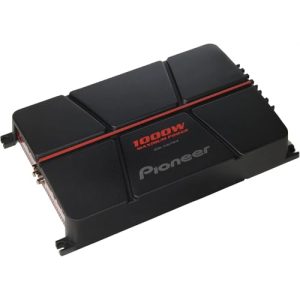
Pioneer GM-A6704 1000W Max Class AB Bridgeable 4-Channel Car Amplifier
- Best for: Drivers building a complete four-speaker system with room to add a subwoofer later.
- 1,000 watts maximum power output
- 60 watts RMS x 4 at 4 ohms; 190 watts RMS x 2 bridged
- Class AB, bridgeable 4-channel design
- Variable high- and low-pass filters with bass boost
Drivers building a complete four-speaker system with room to add a subwoofer later.
Measure the mounting space first — at 14 inches long, this is one of the larger amplifiers in this guide.
Four-channel flexibility is the reason this Pioneer leads the list. It drives front and rear speakers with 60 watts RMS per channel, then bridges two channels into a subwoofer when the system grows, so one purchase covers several upgrade paths. Class AB circuitry keeps the presentation smooth across vocals and instruments, while high- and low-pass filters let each speaker play only the frequencies it handles well. Automatic signal sensing switches the amplifier on with a factory radio, which removes a common installation headache. Drivers who want one amplifier to carry a complete system, rather than a collection of single-purpose boxes, get the most from it.
Watch out for: Measure the mounting space first — at 14 inches long, this is one of the larger amplifiers in this guide.
Alpine KTP-445U Universal Power Pack Amplifier
- Best for: Drivers who want more clarity from factory speakers without replacing the head unit or running new power cable.
- 45 watts RMS x 4 at 4 ohms or 2 ohms; 90 watts RMS x 2 bridged at 4 ohms
- Class D head unit power pack
- Frequency response: 20–20,000 Hz
- High-pass crossover: 60, 80, 120 Hz
Drivers who want more clarity from factory speakers without replacing the head unit or running new power cable.
Confirm your head unit has room behind it and that the wiring harness matches your vehicle before ordering.
Not every upgrade needs a trunk full of hardware. Alpine built this power pack to sit behind a head unit and lift factory or aftermarket stereo output by up to 150 percent, without RCA cables or a separate gain setup. Its 45 watts RMS per channel gives door speakers the headroom they lack, and the Class D design stays small and cool in a dashboard cavity. High-pass crossover settings at 60, 80, and 120 Hz keep bass out of small speakers that cannot reproduce it cleanly. Anyone who wants a meaningful improvement with minimal wiring and no visible equipment should start here.
Watch out for: Confirm your head unit has room behind it and that the wiring harness matches your vehicle before ordering.
Pioneer GM-A3702 500W Max Class AB Bridgeable 2-Channel Car Amplifier
- Best for: Simple two-speaker upgrades or a single bridged subwoofer in a car with limited mounting space.
- 500 watts maximum power output
- Class AB, bridgeable 2-channel design
- Automatic signal sensing and turn-on
- Frequency response: 10 Hz to 70 kHz
Simple two-speaker upgrades or a single bridged subwoofer in a car with limited mounting space.
Check that your speakers or subwoofer match a two-channel or bridged layout before you buy.
Two channels are enough when the plan is simple: a pair of front speakers that deserve more than head-unit power, or one subwoofer fed by a bridged output. This Pioneer covers both jobs with 500 watts of maximum power in a Class AB chassis, and automatic signal sensing lets it wake with a factory radio that offers no remote turn-on lead. Its smaller footprint fits under many seats, and the bridgeable layout means the amplifier stays useful if the system changes from speakers to a subwoofer. Buyers who know exactly what two channels must do will find little here they do not need.
Watch out for: Check that your speakers or subwoofer match a two-channel or bridged layout before you buy.
Rockford Fosgate R500X1D Prime 1-Channel Class D Amplifier
- Best for: Drivers adding a single subwoofer who want dedicated bass power with front-panel tuning controls.
- 500 watts RMS, 1-channel Class D design
- Punch EQ bass boost with frequency, phase, and gain controls
- Variable low-pass crossover
- High-level inputs and RCA pass-through outputs
Drivers adding a single subwoofer who want dedicated bass power with front-panel tuning controls.
This amplifier powers subwoofers only — it cannot drive full-range door speakers, so plan a separate amp or head-unit power for those.
Bass has different needs from the rest of the system, and this Rockford Fosgate monoblock is built around them. A single Class D channel delivers 500 watts RMS to a subwoofer, with Punch EQ, phase, and gain controls on the front panel for shaping low-end response to the enclosure. High-level inputs let it join a factory system, while RCA pass-through and a remote punch-level port keep the installation flexible. Because it does one job only, its power supply and cooling focus entirely on sustained bass rather than splitting attention across channels. Subwoofer owners who want depth without distortion get a dedicated tool here.
Watch out for: This amplifier powers subwoofers only — it cannot drive full-range door speakers, so plan a separate amp or head-unit power for those.
Which One Fits Your Situation
Your factory speakers sound thin at highway speed
Start with the Alpine KTP-445U. It hides behind the head unit, adds 45 watts RMS to each of the four channels, and needs no new power cable or RCA outputs. The high-pass crossover keeps small door speakers from struggling with bass they cannot reproduce, which alone clears up much of the distortion drivers hear at speed.
You are replacing all four door speakers at once
Choose the Pioneer GM-A6704. Its four channels deliver 60 watts RMS each to the new speakers, the Class AB design suits full-range listening, and the bridgeable layout leaves a path to a subwoofer later without buying another amplifier. Variable filters let you tune each pair to its location, so the front stage stays clear while the rear fill stays restrained.
You only want stronger, cleaner bass
Pick the Rockford Fosgate R500X1D. It sends 500 watts RMS to a single subwoofer, and the Punch EQ and phase controls let you blend the bass with the rest of the system instead of letting it overwhelm the cabin. Full-range speakers can stay on head-unit power until you decide to upgrade them.
You have almost no room to mount an amplifier
Take the Alpine KTP-445U for a factory system, or the Pioneer GM-A3702 when two channels will do. Both fit in tight spots — the Alpine behind the dashboard and the Pioneer under many seats — while still delivering a real increase in clean power over a head unit alone. That makes either one a practical upgrade when trunk space is already spoken for.
Common Mistakes
- Shopping by maximum wattage instead of RMS output at the impedance your speakers present.
- Buying a monoblock to power full-range speakers, or a two-channel amp for a four-speaker system with no plan to bridge it.
- Skipping the tape measure and discovering the amplifier does not fit under the seat or behind the dashboard.
- Using thin factory wiring, or no fuse near the battery, for a full-size amplifier.
- Setting the gain to maximum instead of matching it to the head unit output, which adds distortion rather than volume.
Frequently Asked Questions
How much amplifier power do I need for better sound quality?
More than the head unit supplies, but not an extreme number. A channel delivering roughly the RMS rating of the speaker — commonly 45 to 60 watts for door speakers — gives clean headroom at highway volume. Extra power beyond that helps only if the speakers can use it, so match RMS figures rather than chasing maximum wattage.
Is a four-channel amplifier better than a monoblock?
Neither is better in general — they serve different parts of a system. A four-channel amplifier powers full-range speakers and can bridge to a subwoofer, while a monoblock drives only a subwoofer with focused power. Many complete systems use one of each, so choose by what your speakers still lack.
Can I add an amplifier to a factory radio?
Yes, when the amplifier accepts speaker-level inputs or offers automatic signal sensing. The Alpine power pack and the Pioneer models in this guide work with factory head units that have no RCA outputs. Confirm the input type on the product page and check that the wiring harness suits your vehicle.
Does a bigger amplifier always sound better?
No. Sound quality depends on matching RMS power, clean gain settings, and speakers that suit the amplifier’s channels. An oversized amplifier with the gain set too high distorts sooner than a smaller one set correctly, and a mismatched channel layout wastes money on power you cannot use.
More from Amazon
Programs that pair well with the guide above. Offers and eligibility are set by Amazon and may change.
Free shipping on eligible items, Prime Video and more. Eligible new members can start with a free trial.
Start a Prime free trialAudiobooks and podcasts to listen to on the go. Eligible new members can start with a free trial.
Try Audible freeAd-free music streaming. Eligible new subscribers can start with a free trial.
Try Music Unlimited freeA free business account with business pricing and bulk-buying tools for work, shop or home office.
Create a business accountAs an Amazon Associate we earn from qualifying purchases.


Write Your Review
No reviews yet. Be the first to share your experience!