
Our Short List of 3
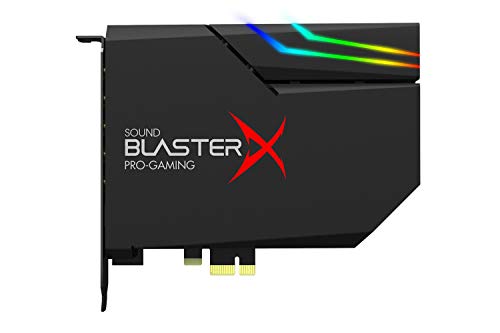
- Best for: desktop listeners whose priority is music quality, with gaming surround as a bonus.
- Internal PCIe card (model SB1740)
- SABRE32 Ultra-class DAC
- Playback: 32-bit/384 kHz
- SNR: 122 dB
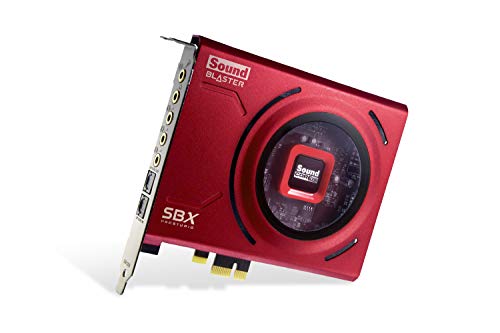
- Best for: PC gamers who spend as much time in voice chat as in the game itself.
- Internal PCIe x1 card (model SB1500)
- Sound Core3D processor
- Playback: 24-bit/192 kHz
- SNR: 116 dB

- Best for: console and laptop players who cannot install an internal card.
- External USB sound card
- DNR: 130 dB
- DAC playback: 32-bit/384 kHz
- 7.1 virtual surround
All 5 Picks at a Glance
| Product | Specs | Action |
|---|---|---|
| Creative Sound BlasterX AE-5 Plus |
| Check price on Amazon |
| Creative Sound Blaster Z SE |
| Check price on Amazon |
| Creative Sound BlasterX G6 |
| Check price on Amazon |
 Creative Sound Blaster AE-7 |
| Check price on Amazon |
 ASUS Xonar SE |
| Check price on Amazon |
Key takeaways
- Five playback sound cards for music and gaming compared: PCIe picks with hi-res DACs and strong headphone amps, plus one USB card for console players.
Buying a sound card in 2026 is really a decision about what your motherboard audio cannot do. Onboard codecs sit in an electrically noisy environment, and their headphone outputs are often too weak for demanding headphones. A dedicated card moves conversion to a better DAC, raises the rated noise figure, and adds a proper headphone amplifier. For music, that means cleaner playback of hi-res files; for gaming, it means virtual surround processing and enough drive for the headset you already own.
The five cards below split into two camps. Desktop builders with a free PCIe slot get three internal Creative cards and one ASUS card, chosen from the DAC, sample-rate and amplifier figures printed on their listings. Console and laptop players get one external USB model instead. Four of the five picks are Creative and one is ASUS, which reflects how this market now looks: the Sound Blaster line carries most of the playback category, and padding the list with adapters or recording interfaces would help nobody.
Quick Picks
As an Amazon Associate we earn from qualifying purchases.
| Product | Best for | Key spec from title |
|---|---|---|
| Creative Sound BlasterX AE-5 Plus | Music-first desktop listeners | 32-bit/384 kHz SABRE32 DAC, 122 dB SNR |
| Creative Sound Blaster Z SE | Gamers who use voice chat | 24-bit/192 kHz, 116 dB SNR, Mic EQ |
| Creative Sound BlasterX G6 | Console and laptop players | 130 dB DNR, 7.1 virtual surround over USB |
| Creative Sound Blaster AE-7 | Desk setups wanting a control module | 127 dB DNR ESS SABRE-class 9018 DAC |
| ASUS Xonar SE | Simple 5.1 speaker builds | 192 kHz/24-bit, 116 dB SNR |
How to Choose
Read the DAC and Noise Figures Carefully
Every listing here leads with a converter figure, but the labels are not interchangeable. Creative prints 122 dB SNR for the AE-5 Plus, 127 dB DNR for the AE-7 and 130 dB DNR for the G6, and SNR and DNR are measured differently, so a bigger number on one card does not automatically beat a smaller number on another. Treat these figures as a guide to each card’s class rather than a league table. Sample rate matters more practically: 24-bit/192 kHz already covers hi-res music libraries, while 32-bit/384 kHz playback suits listeners who keep files at the highest resolutions.
Match the Headphone Amp to Your Headphones
Four of the five cards drive headphones up to 600Ω, and the Xonar SE manages 300Ω, which still covers most gaming headsets and mid-impedance headphones. A high drive rating is not the whole story, though. Output impedance shapes how sensitive headphones and in-ear monitors behave, and the AE-7’s Xamp bi-amp is notable for its 1Ω output impedance, the lowest printed here. If your favourite headphones are easy to drive, any card in this group will feed them; if you own high-impedance studio models, the 600Ω-rated Creative cards are the safer match.
Decide Between Discrete 5.1 and Virtual 7.1
These are different tools for different rooms. Discrete 5.1, offered by the AE-5 Plus, Z SE, AE-7 and Xonar SE, sends separate channels to a real speaker set or a receiver, and Dolby Digital Live with DTS Connect encoding on the Creative PCIe cards packages that surround signal for a home-theatre connection. Virtual 7.1 is a headphone effect that widens game audio and helps with positional cues. Speaker owners should shop the discrete column first; headset-only players can prioritise the virtual processing and spend their attention on the amplifier instead.
Pick Internal PCIe or External USB
An internal card needs a free PCIe slot, and on many gaming boards the slot sits directly under a thick graphics card, so check clearance before ordering anything. In exchange you get the strongest DACs in this group and a permanent installation. An external USB card like the G6 trades a little of that ceiling for total flexibility: it moves between a desktop, a laptop and a console, and it is the only option here for players whose machine has no slot at all. Neither format is better in the abstract; your hardware decides.
The 5 Best Options
Creative Sound BlasterX AE-5 Plus
- Best for: desktop listeners whose priority is music quality, with gaming surround as a bonus.
- Internal PCIe card (model SB1740)
- SABRE32 Ultra-class DAC
- Playback: 32-bit/384 kHz
- SNR: 122 dB
desktop listeners whose priority is music quality, with gaming surround as a bonus.
this card also circulates under a regional variant listing code, so order the exact listing named here, and confirm a free PCIe slot clear of your graphics card before buying.
The AE-5 Plus is the music-first pick here. Its SABRE32 Ultra-class DAC plays back at up to 32-bit/384 kHz with a 122 dB SNR figure in the listing title, numbers aimed at listeners with hi-res music libraries. The Xamp discrete bi-amp drives headphones up to 600Ω, so high-impedance studio models are properly fed, not merely made loud. Gamers are covered too: discrete 5.1 output, 7.1 virtual surround and Dolby Digital Live plus DTS Connect encoding handle speaker and receiver setups. The included RGB LED strip is cosmetic; the audio hardware underneath is the strongest here for pure listening.
Creative Sound Blaster Z SE
- Best for: PC gamers who spend as much time in voice chat as in the game itself.
- Internal PCIe x1 card (model SB1500)
- Sound Core3D processor
- Playback: 24-bit/192 kHz
- SNR: 116 dB
PC gamers who spend as much time in voice chat as in the game itself.
the Mic EQ and gaming profiles run through Creative’s software, so check current driver support for your version of Windows before ordering.
The Z SE is built around Creative’s Sound Core3D processor and reads as the gamer’s card in the line. Playback runs to 24-bit/192 kHz with a 116 dB SNR, and the headphone amplifier again drives up to 600Ω. What separates it from the AE-5 Plus is the software side: Mic EQ and SBX gaming profiles tune voice chat and game audio, and ASIO support suits players who also produce audio on the side. Discrete 5.1 and virtual 7.1 are both on board, with Dolby Digital Live and DTS handling receiver connections.
Creative Sound BlasterX G6
- Best for: console and laptop players who cannot install an internal card.
- External USB sound card
- DNR: 130 dB
- DAC playback: 32-bit/384 kHz
- 7.1 virtual surround
console and laptop players who cannot install an internal card.
confirm a live featured offer for B07FY45F2S on the product page before ordering, because tracker reads disagree on current Amazon availability for this model.
The G6 is the only external card here, and that is its whole appeal: it plugs into a PC, PS5, PS4, Xbox One or Switch over USB and needs no internal slot. Its listing leads with a 130 dB DNR figure and 32-bit/384 kHz conversion, plus 7.1 virtual surround and Dolby Digital decoding for console game and movie audio. The Xamp headphone bi-amp covers 16 to 600Ω, and sidetone lets you hear your own voice through the headset while you play. For laptop and console players, it is the only route on this page to a dedicated DAC and amplifier in one box.
Creative Sound Blaster AE-7
- Best for: desk-based listeners who want flagship conversion and physical controls at arm’s reach.
- Internal PCIe card
- ESS SABRE-class 9018 DAC
- DNR: 127 dB
- Playback: 32-bit/384 kHz PCM, DSD64
desk-based listeners who want flagship conversion and physical controls at arm’s reach.
confirm a live featured offer for B07T9YYVV6 before ordering, because distribution stock reads empty even where trackers show the listing in stock.
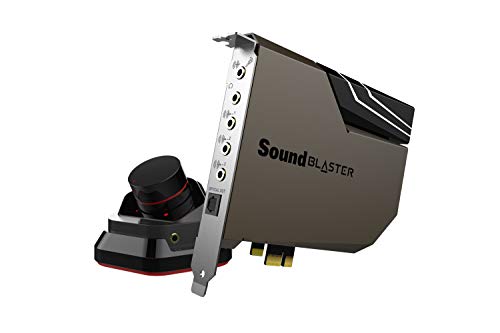
The AE-7 is the flagship internal card in this roundup, built on an ESS SABRE-class 9018 DAC rated at 127 dB DNR, with 32-bit/384 kHz PCM and DSD64 playback for listeners who keep DSD files. Its Xamp bi-amp has a 1Ω output impedance, which suits sensitive in-ear monitors as well as 600Ω headphones. The included Audio Control Module puts a volume knob and quarter-inch and eighth-inch mic and headphone jacks on the desk, within reach. Discrete 5.1, virtual 7.1 and Dolby and DTS encoding round out a card aimed at a permanent, well-used desk setup.
ASUS Xonar SE
- Best for: 5.1 speaker owners and small-case builders who want clean output without extras.
- Internal PCIe card
- 5.1 channel output
- Playback: 192 kHz/24-bit hi-res
- SNR: 116 dB (Realtek ALC1220X codec)
5.1 speaker owners and small-case builders who want clean output without extras.
confirm a live featured offer for B07HCX1NY9 before ordering, because one major retailer lists the model as discontinued, so remaining Amazon stock may be third-party only.
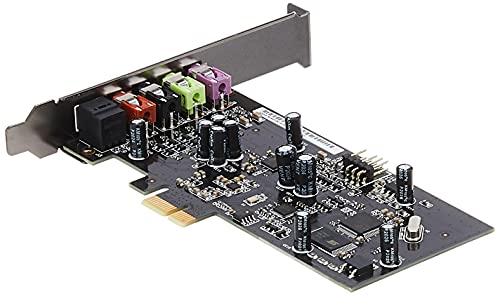
The Xonar SE is the straightforward speaker-owner’s card. It delivers discrete 5.1 channels at up to 192 kHz/24-bit with a 116 dB SNR from its Realtek ALC1220X codec, and ASUS Hyper Grounding is the listing’s answer to electrical noise from the board. The headphone amp drives up to 300Ω, which covers most gaming headsets and mid-impedance headphones comfortably. Xonar Audio Center handles the tuning, and an included low-profile bracket makes it the one pick here that drops easily into a small-form-factor case. It skips the encoding extras and lighting of the Creative cards in favour of simple, quiet 5.1 output.
Which One Fits Your Situation
You Listen to Music More Than You Game
Choose the AE-5 Plus. Its SABRE32 DAC, 122 dB SNR and 32-bit/384 kHz playback are the strongest music credentials in this group, and the Xamp bi-amp feeds high-impedance headphones properly. You still get discrete 5.1 and virtual 7.1 for the games you do play, so nothing is sacrificed; the card simply spends its budget on conversion quality first and gaming features second.
You Game Competitively and Live in Voice Chat
Choose the Z SE. The Sound Core3D processor, Mic EQ and SBX gaming profiles are built for players whose microphone quality matters to their team, and ASIO support helps if you record or stream from the same machine. Playback at 24-bit/192 kHz with a 116 dB SNR is a clear step up from onboard audio, and the 600Ω headphone amp covers serious gaming headphones.
You Play on a Console or a Laptop
Choose the G6, because it is the only card here that can come with you. USB connection covers PC, PS5, PS4, Xbox One and Switch, the 130 dB DNR converter handles music duty between sessions, and sidetone keeps your voice audible to yourself during chat. No slot, no opening the case, and it unplugs and moves to the next machine in seconds.
You Run 5.1 Speakers or a Small Case
Choose the Xonar SE for its discrete 5.1 output, quiet 116 dB SNR and the low-profile bracket that fits compact builds. If your desk mixes speakers with headphones and you would rather reach for a physical volume knob than open software, the AE-7’s Audio Control Module covers that job instead, at the cost of a full-height card and a higher place in the range.
Common Mistakes
- Buying a USB recording interface for playback duty: mic preamps and phantom power serve microphones, not game or music output, and that is a different product class entirely.
- Comparing an SNR figure from one listing against a DNR figure from another as if they were the same measurement, then choosing purely on the bigger number.
- Shopping by the 600Ω headline alone and ignoring output impedance, which is what actually decides how sensitive headphones and in-ear monitors behave.
- Ordering an internal card before checking that a free PCIe slot exists and is not blocked by a thick graphics card shroud.
- Expecting virtual 7.1 through headphones to sound like a room full of discrete speakers; it is a positional effect for headsets, not a speaker replacement.
Frequently Asked Questions
Is a dedicated sound card still worth it over motherboard audio?
For many listeners, yes. A card moves conversion away from the electrically noisy motherboard environment, raises the rated noise figure, and adds a headphone amplifier with real drive behind it. The gains are largest with high-impedance headphones, hi-res music files and speaker setups that need discrete 5.1 or encoded surround sent to a receiver.
What is the difference between the SNR and DNR figures in these listings?
They are related but distinct measurements, and manufacturers choose which one to print. The AE-5 Plus and Xonar SE quote SNR, while the AE-7 and G6 quote DNR. Because the test methods differ, a 130 dB DNR figure does not automatically outrank a 122 dB SNR figure; compare cards on their full spec set instead.
Can one card serve both hi-res music and gaming?
Yes, and that dual role is exactly what this group is built for. The AE-5 Plus and AE-7 pair high sample-rate playback and strong DACs with virtual surround and encoding for games, while the Z SE leans the other way, adding Mic EQ and gaming profiles to still-respectable 24-bit/192 kHz music playback.
Which of these cards works with a console or a laptop?
Only the G6. It connects over USB and lists PC, PS5, PS4, Xbox One and Switch compatibility, so it is the single option here for machines without an internal slot. The AE-5 Plus, Z SE, AE-7 and Xonar SE are all internal PCIe cards and require a desktop motherboard with a free, accessible slot.
More from Amazon
Programs that pair well with the guide above. Offers and eligibility are set by Amazon and may change.
Free shipping on eligible items, Prime Video and more. Eligible new members can start with a free trial.
Start a Prime free trialAudiobooks and podcasts to listen to on the go. Eligible new members can start with a free trial.
Try Audible freeAd-free music streaming. Eligible new subscribers can start with a free trial.
Try Music Unlimited freeA free business account with business pricing and bulk-buying tools for work, shop or home office.
Create a business accountAs an Amazon Associate we earn from qualifying purchases.
Write Your Review
No reviews yet. Be the first to share your experience!