
Our Short List of 3

- Best for: Small to medium rooms where you want a bright, energetic companion to tower speakers.
- 4-inch spun-copper IMG woofer
- 1-inch aluminum LTS tweeter with 90×90 Tractrix Horn
- Frequency response 68 Hz to 21 kHz
- Nominal impedance 8 ohms

- Best for: Home theater surround channels and wall-mounted setups beside tower speakers.
- 5.25-inch woofer
- 100 watts maximum output power
- Nominal impedance 8 ohms
- Wall-mountable with integrated keyhole slot

- Best for: Stereo listening and front-channel use where the companion speaker carries more of the music.
- 1-inch cloth dome tweeter
- 6.5-inch aramid fiber woofer
- 2-way bass reflex design
- Frequency response 46 Hz to 35 kHz
All 3 Picks at a Glance
| Product | Specs | Action |
|---|---|---|
| Klipsch R-41M |
| Check price on Amazon |
| Polk Audio T15 |
| Check price on Amazon |
| ELAC Debut 2.0 B6.2 |
| Check price on Amazon |
Our Top Picks
Tower speakers anchor a home audio setup with deep bass and a wide soundstage, yet they rarely work alone. Surround channels, a second listening zone, or a smaller room all call for companion speakers that blend with the towers instead of fighting them. The right match keeps dialogue clear, effects placed correctly, and music balanced from seat to seat. A mismatched companion can pull attention away from the front of the room or leave gaps in the sound that no amount of receiver calibration fully fixes.
This guide covers three bookshelf speakers that pair well with tower speakers. Each one is a passive, wired speaker that connects to a standard home theater receiver, so it slots into the same system your towers already use. All three are sold as pairs, which suits surround duty and stereo setups alike. We chose bookshelf speakers because they are the most flexible companions: small enough to place almost anywhere, yet capable enough to carry real musical and cinematic weight.
Quick Picks
As an Amazon Associate we earn from qualifying purchases
| Product | Best for | Key spec from title |
|---|---|---|
| Klipsch R-41M | Small rooms and bright, lively sound | 4-inch spun-copper woofer, 1-inch horn tweeter |
| Polk Audio T15 | Wall mounting and home theater surrounds | 5.25-inch woofer, Dolby and DTS surround |
| ELAC Debut 2.0 B6.2 | Full, detailed stereo listening | 6.5-inch aramid fiber woofer, 1-inch cloth dome tweeter |
How to Choose
Match the Sensitivity to Your Towers
Sensitivity tells you how loud a speaker plays from a given amount of amplifier power, and it matters when bookshelf speakers share a receiver with tower speakers. A companion speaker with much lower sensitivity than your towers will sound quieter at the same volume setting, forcing you to push the receiver harder or rebalance every channel. Look for a sensitivity figure close to your towers, or at least in the high eighties, so the whole system stays even. Klipsch designs tend to run efficient, while many compact bookshelves sit a few decibels lower, so check the number before you buy. That quick check saves a lot of fiddling with channel levels later.
Keep Impedance Within Your Receiver Range
Most home theater receivers handle speakers rated at 6 or 8 ohms without trouble, but mixing a 4-ohm bookshelf speaker with 8-ohm towers can strain an entry-level receiver. Check the impedance rating of each candidate and compare it with the range your receiver supports, which is printed on the back panel or in its manual. An 8-ohm companion speaker is the safest match for almost any receiver, while a 6-ohm model still works with most modern units. Staying inside the supported range keeps the amplifier cool and the sound clean. When in doubt, the higher impedance option is the safer match for a modest receiver.
Choose a Woofer Size That Fits the Role
The woofer size sets how much bass a bookshelf speaker can produce on its own, and the right size depends on where it sits in your system. A compact 4-inch woofer works well for surround channels, where a subwoofer handles the deep bass and the bookshelf only needs to carry effects and ambience. A 5.25-inch or 6.5-inch woofer suits front-channel or stereo duty, where the speaker carries more of the music and dialogue. Bigger is not automatically better, since a large bookshelf in a small room can overwhelm the space. If a subwoofer is already in the system, a smaller woofer is often enough.
Plan Placement Before You Buy
Bookshelf speakers need a shelf, a stand, or a wall bracket, and their placement shapes how well they blend with tower speakers. Rear-ported models need breathing room behind them, so they do poorly when pushed flat against a wall, while front-ported or sealed designs are more forgiving in tight spots. Wall-mountable speakers with keyhole slots open up options in rooms where stands would crowd the floor. Measure your shelves and wall space first, and confirm the speaker dimensions against the spot you have in mind. Leave a few inches of clearance behind rear-ported cabinets whenever the layout allows it.
The 3 Best Options
Klipsch R-41M
- Best for: Small to medium rooms where you want a bright, energetic companion to tower speakers.
- 4-inch spun-copper IMG woofer
- 1-inch aluminum LTS tweeter with 90×90 Tractrix Horn
- Frequency response 68 Hz to 21 kHz
- Nominal impedance 8 ohms
Small to medium rooms where you want a bright, energetic companion to tower speakers.
The 4-inch woofer reaches only down to 68 Hz, so deep bass still needs a subwoofer.
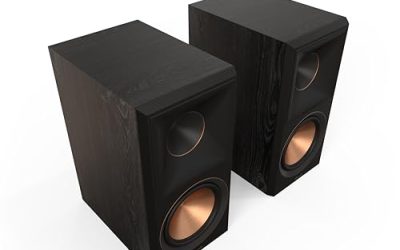
The Klipsch R-41M is a compact bookshelf speaker built around a horn-loaded tweeter, and that design gives it a lively, forward character. Its high sensitivity means it plays loud without demanding much amplifier power, which helps it keep up with tower speakers. The small cabinet fits on a shelf or a stand, so it works as a surround speaker in a home theater or as a second-zone speaker in another room. The copper-colored woofer and black vinyl cabinet give it a distinct look.
Watch out for: The 4-inch woofer reaches only down to 68 Hz, so deep bass still needs a subwoofer.
Polk Audio T15
- Best for: Home theater surround channels and wall-mounted setups beside tower speakers.
- 5.25-inch woofer
- 100 watts maximum output power
- Nominal impedance 8 ohms
- Wall-mountable with integrated keyhole slot
Home theater surround channels and wall-mounted setups beside tower speakers.
The cabinet is plain black, so it blends in rather than standing out as a design piece.
The Polk Audio T15 is a straightforward bookshelf speaker built for surround and secondary speaker duty. Its 5.25-inch woofer and Dynamic Balance design deliver clear highs and a solid midrange, and it handles Dolby and DTS surround formats. The built-in keyhole slot lets you wall-mount it, which frees up shelf space and keeps it at ear height. It pairs naturally with Polk tower speakers from the same series, but its neutral 8-ohm rating also lets it work beside towers from other brands.
Watch out for: The cabinet is plain black, so it blends in rather than standing out as a design piece.
ELAC Debut 2.0 B6.2
- Best for: Stereo listening and front-channel use where the companion speaker carries more of the music.
- 1-inch cloth dome tweeter
- 6.5-inch aramid fiber woofer
- 2-way bass reflex design
- Frequency response 46 Hz to 35 kHz
Stereo listening and front-channel use where the companion speaker carries more of the music.
At 6 ohms it draws more current than an 8-ohm speaker, so confirm your receiver supports it.
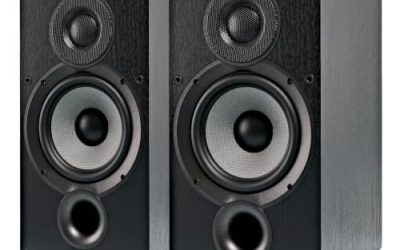
The ELAC Debut 2.0 B6.2 is the fullest-sounding bookshelf speaker here, with a 6.5-inch aramid fiber woofer that reaches lower than the other two picks. That extra bass makes it a strong choice when the companion speakers carry real musical weight, such as front-channel duty or a second listening room. The cloth dome tweeter keeps the highs smooth, and the 2-way bass reflex cabinet is tuned for a balanced sound. It is larger and heavier than the other picks, so give it a sturdy shelf or stand.
Watch out for: At 6 ohms it draws more current than an 8-ohm speaker, so confirm your receiver supports it.
Which One Fits Your Situation
You Are Building a Home Theater Around Towers
Start with the Polk Audio T15. Its wall-mounting option and surround-friendly design make it easy to place behind and beside the seating area, and its 8-ohm rating works with nearly any receiver. Add a center channel and a subwoofer from the same family and the whole system will sound coherent. The T15 also leaves room in the system for a matching center channel, which carries most of the dialogue.
Your Room Is Small and You Want Big Sound
Pick the Klipsch R-41M. Its high sensitivity lets a modest receiver drive it to satisfying volume, and the compact cabinet fits where larger bookshelves cannot. It keeps dialogue and effects clear without crowding a small room, and it leaves floor space for the towers to breathe. Its small footprint also suits apartments and bedrooms, where floor space is already spoken for by the towers.
You Listen to Music as Much as Movies
Choose the ELAC Debut 2.0 B6.2. Its larger woofer and wider frequency range give music more body, and it holds its own as a stereo pair when the towers are silent. It suits a second listening zone or a front-channel role where the companion speakers do serious musical work. If the towers live in the living room, the ELAC pair can anchor a second setup in a study or bedroom.
You Want One Pair to Do Everything
The Polk Audio T15 is the most flexible choice. It works as a surround speaker, a stereo pair, or a second-zone speaker, and its wall-mounting option covers rooms where stands are impractical. Its neutral sound and easy impedance make it a safe match for most tower speakers. It is also the easiest pick to move between roles later, from surrounds today to a stereo pair tomorrow.
Common Mistakes
- Mixing a 4-ohm bookshelf speaker with an entry-level receiver that only supports 6 or 8 ohms
- Placing rear-ported bookshelf speakers flat against a wall and choking off the bass
- Choosing companion speakers with far lower sensitivity than the towers, leaving the surrounds too quiet
- Skipping the center channel and expecting bookshelf speakers to carry dialogue on their own
- Buying a single speaker when the listing is sold as a pair, or buying a pair when only one is needed
Frequently Asked Questions
Do bookshelf speakers need to be the same brand as my tower speakers?
No, they do not need to match by brand, but matching the sound character helps the system blend. Speakers from the same series share tweeters and voicing, so dialogue and effects move smoothly between channels. If you mix brands, compare sensitivity and impedance so no channel ends up noticeably louder or quieter than the rest.
Can I use bookshelf speakers as surround speakers with tower fronts?
Yes, that is one of the most common home theater layouts. Tower speakers handle the front left and right channels, while bookshelf speakers sit behind or beside the seating area for surround effects. Wall-mountable models work well here, and a receiver with room calibration can balance the levels between the towers and the smaller speakers.
What size bookshelf speaker pairs best with tower speakers?
A 5.25-inch woofer is a good middle ground for most rooms, since it handles dialogue and effects with enough body. Compact 4-inch models suit surround duty and small rooms, while 6.5-inch models suit stereo listening and front-channel use. The right size depends on the role the speaker plays and the size of the room.
Do I still need a subwoofer if I add bookshelf speakers to towers?
In most cases, yes. Bookshelf speakers reach down to roughly 46 to 68 Hz, while a subwoofer covers the deepest bass that neither towers nor bookshelves reproduce with full weight. A subwoofer takes the low end off every speaker in the system, which lets the towers and bookshelves play cleaner at higher volume.
More from Amazon
Programs that pair well with the guide above. Offers and eligibility are set by Amazon and may change.
Free shipping on eligible items, Prime Video and more. Eligible new members can start with a free trial.
Start a Prime free trialAudiobooks and podcasts to listen to on the go. Eligible new members can start with a free trial.
Try Audible freeAd-free music streaming. Eligible new subscribers can start with a free trial.
Try Music Unlimited freeA free business account with business pricing and bulk-buying tools for work, shop or home office.
Create a business accountAs an Amazon Associate we earn from qualifying purchases.
Write Your Review
No reviews yet. Be the first to share your experience!