

Key takeaways
- Best all-round home and patio choice: JBL Charge 5. It balances useful bass, a power-bank function, IP67 protection, and a manageable size.
- Best small travel speaker: JBL Flip 6. It is easier to pack than a Charge 5 while still sounding substantially fuller than most tiny portable speakers.
- Best compact speaker for bedrooms and quiet rooms: Bose SoundLink Flex. Its flexible placement and clear vocal presentation are more important indoors than maximum output.
- Best rugged small speaker: Ultimate Ears WONDERBOOM 4. Its compact, floating design is suited to pool days and casual outdoor listening.
- Best large outdoor option: JBL Xtreme 4. The handle and shoulder strap make its extra size practical for gardens, picnics, and group listening.
- Best style-focused home portable: Marshall Emberton III. It is a strong choice when appearance, stereo presentation, and a physical control layout matter as much as ruggedness.
The best Bluetooth speakers for most people are a mid-sized model such as the JBL Charge 5, while smaller speakers suit bedrooms and travel, and larger rugged models such as the JBL Xtreme 4 make more sense when volume, bass, and outdoor coverage matter more than weight.
The right choice is not simply the speaker with the biggest wattage or longest advertised battery life. Size determines how much air the speaker can move, battery capacity adds weight, and water resistance does not automatically mean a speaker can survive sand, drops, or years of charging. Use the comparisons below to match the speaker to the way you will actually use it in 2026.
Our top picks

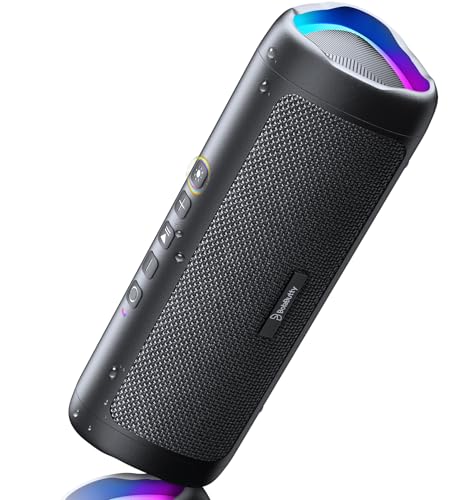


As an Amazon Associate we earn from qualifying purchases at no extra cost to you. Ratings are shown as listed on Amazon.
Quick picks by situation
- Best all-round home and patio choice: JBL Charge 5. It balances useful bass, a power-bank function, IP67 protection, and a manageable size.
- Best small travel speaker: JBL Flip 6. It is easier to pack than a Charge 5 while still sounding substantially fuller than most tiny portable speakers.
- Best compact speaker for bedrooms and quiet rooms: Bose SoundLink Flex. Its flexible placement and clear vocal presentation are more important indoors than maximum output.
- Best rugged small speaker: Ultimate Ears WONDERBOOM 4. Its compact, floating design is suited to pool days and casual outdoor listening.
- Best large outdoor option: JBL Xtreme 4. The handle and shoulder strap make its extra size practical for gardens, picnics, and group listening.
- Best style-focused home portable: Marshall Emberton III. It is a strong choice when appearance, stereo presentation, and a physical control layout matter as much as ruggedness.
What “best” means at each size
A small speaker is convenient because it can sit on a nightstand or fit into a backpack, but its limited driver area makes deep bass and high-volume clarity difficult. A medium speaker usually provides the best size-to-volume compromise: it can fill a kitchen, office, bedroom, or small outdoor seating area without becoming burdensome. Large portable speakers produce more bass and headroom, but their weight becomes noticeable when you carry them more than a few minutes.
| Speaker | Approx. size and weight | Advertised battery | Protection | Best use |
|---|---|---|---|---|
| JBL Flip 6 | 17.8 × 6.8 × 7.2 cm; about 0.55 kg | Up to 12 hours | IP67 | Travel, desk, small rooms |
| Bose SoundLink Flex | About 20.1 × 9.0 × 5.2 cm; about 0.59 kg | Up to 12 hours | IP67 | Bedroom, travel, spoken audio |
| JBL Charge 5 | 22.3 × 9.6 × 9.4 cm; about 0.96 kg | Up to 20 hours | IP67 | Home, patio, day trips |
| Ultimate Ears WONDERBOOM 4 | About 10.4 cm tall; about 0.42 kg | Up to 14 hours | IP67; floats | Pool, bathroom, compact outdoor use |
| JBL Xtreme 4 | About 29.7 × 14.9 × 14.1 cm; about 2.1 kg | Up to 24 hours | IP67 | Large rooms, gardens, group listening |
| Marshall Emberton III | About 16.3 × 7.6 × 7.0 cm; about 0.67 kg | Up to 32 hours | IP67 | Home, travel, style-conscious buyers |
Dimensions and battery figures are manufacturer specifications; real runtime varies with volume, wireless features, temperature, and battery age. The table shows why battery life should not be considered in isolation. The Emberton III is relatively compact yet has a long claimed runtime, while the Xtreme 4 offers greater acoustic headroom at roughly four times the weight of the Flip 6.
Head-to-head: small versus medium speakers
JBL Flip 6 versus JBL Charge 5
The Flip 6 is the sensible pick when the speaker spends most of its life in luggage, a backpack, or beside a laptop. Its 0.55 kg weight is easy to ignore, and 12 hours is enough for a workday or a weekend outing if you charge it beforehand. It will sound best in a small room or near a small group rather than across a noisy garden.
The Charge 5 earns its extra weight with a larger enclosure, longer advertised battery life, and a USB port that can charge a phone. It has more bass authority and stays more comfortable at higher volume. Choose it if you regularly listen in a kitchen, living room, patio, or park and do not need to carry it far.
In practical terms, the Charge 5 is not merely a louder Flip 6. Its extra enclosure volume reduces the strain of reproducing bass, so music is less likely to sound thin when played for a group. The trade-off is that it occupies more room in a bag and approaches the weight of a full water bottle.
Bose SoundLink Flex versus Marshall Emberton III
The SoundLink Flex is a good indoor and travel option for people who care about clear vocals, podcasts, and flexible placement. Its position-aware processing is useful when the speaker is standing, lying flat, or hanging from its utility loop. It is also a sensible choice for listeners who prefer a less visually rugged design.
The Emberton III is more distinctive in appearance and offers physical controls that are easy to operate without opening an app. Its long advertised battery life is attractive for frequent travellers. Its stereo presentation can make a room feel wider, but the smaller cabinet still cannot deliver the low-frequency scale of a larger speaker.
Decision matrix: match the speaker to your routine
| Your situation | Recommended class | Why | What to accept |
|---|---|---|---|
| Daily desk use, under 30 minutes of carrying | Compact or medium | Good sound without occupying much space | Less deep bass than a large model |
| Frequent flights or train travel | Compact, under 0.7 kg | Lower bag weight and easier packing | Lower maximum volume |
| Kitchen, bedroom, and occasional patio use | Medium, around 0.8–1.2 kg | Best balance of volume, bass, and portability | Too large for some small bags |
| Pool, beach, or camping | IP67 rugged model | Sealed construction handles water and dust better | Ports must still be closed before exposure |
| Regular group listening outdoors | Large portable, 2 kg or more | More output and bass headroom | Noticeable carrying weight and higher cost |
| Low budget and occasional use | Small branded speaker | Adequate for background listening | Shorter feature life and limited fullness |
Battery life: calculate the capacity you actually need
Manufacturers generally quote battery life at moderate volume. If you listen for two hours each evening, a speaker rated for 12 hours theoretically covers six sessions. In practice, allowing a 25 percent margin for louder playback, cold weather, and battery aging gives this calculation:
12 hours × 0.75 = about 9 dependable hours.
That is roughly four evenings at two hours each, not six. For a speaker used mostly at home, a 12-hour model may therefore be sufficient. For camping or travel without reliable charging, a 20- to 32-hour model is more convenient, provided you are willing to carry the extra mass. A power-bank feature is useful in an emergency, but charging a phone from the speaker also reduces the time available for music.
Durability and ownership details that listings leave out
IP67 means the speaker is dust-tight and designed to survive temporary immersion in fresh water under specified laboratory conditions. It does not make every speaker immune to salt water, chlorine, grit, impact, or corrosion. Rinse a beach-used speaker with clean water, wipe it dry, and leave the charging port open until completely dry. Never connect a charging cable while the port is wet.
The parts most likely to wear first are the battery, rubber port covers, grille, and carrying loop. Lithium-ion batteries gradually lose capacity, particularly when stored fully charged in hot conditions. Avoid leaving a speaker on a sunny windowsill or inside a hot car. If it will sit unused for months, store it partly charged in a cool, dry place and recharge it periodically.
Sand is a common mistake. Do not push it out of a grille with a sharp object or blast it inward with high-pressure air. Brush loose grit away gently, keep the speaker facing downward where practical, and protect it in a soft pouch during transport. Also check whether the model supports multipoint Bluetooth before buying: pairing with two devices is convenient, but switching behaviour differs between brands.
How to get better sound from any portable speaker
- Place the speaker on a stable surface rather than inside a deep shelf or soft bag. Nearby surfaces can reinforce bass, while enclosed spaces can make vocals muddy.
- Keep it near the listeners. Doubling the distance reduces direct sound significantly, so moving the speaker closer often helps more than increasing volume.
- Use a moderate level outdoors. Open spaces absorb energy quickly, and pushing a small speaker to maximum volume usually produces harsher sound rather than proportionally more coverage.
- Update firmware through the manufacturer’s official app when available, then disable unnecessary voice prompts or sound effects if you want longer runtime.
- Clean the exterior with a lightly damp, lint-free cloth. Avoid solvents, abrasive cleaners, and forcing moisture through the grille.
Final buying advice
Choose the JBL Flip 6 or a similar compact IP67 speaker if portability is the deciding factor. Move up to the Bose SoundLink Flex or Marshall Emberton III when indoor sound, controls, and design matter more. For the broadest balance of battery, bass, and usefulness around a home, the JBL Charge 5 remains the safest category choice. Select a large model such as the JBL Xtreme 4 only when you will regularly use its extra output; otherwise, its size and weight are costs you carry every day without receiving much benefit.





Write Your Review
No reviews yet. Be the first to share your experience!