

Key takeaways
- Full spark protection: A mesh door or screen reduces flying embers, although it does not eliminate fire risk.
- A properly fitted rain cover: This is especially important for clay and painted steel.
- A removable fire grate: It lifts wood above ash, improving airflow and simplifying cleanup.
- A stable base: Wide legs or a low center of gravity matter more than ornamental details.
- A chimney cap: It helps limit rain entry and can reduce downdrafts, but it must not obstruct smoke flow.
- Replaceable hardware: Stainless bolts, screens, grates, and handles are useful because these parts wear before the main body.
- Clear instructions for clearance: The product should state how far it must stand from walls, roofs, furniture, fences, and combustible surfaces.
Best Chimineas for Patio Heating & Wood Burning
The best chiminea for most patios is a medium steel model with a spark screen and rain cover, while clay is better for traditional low-cost warmth in a dry climate and cast iron is best when maximum heat retention matters more than portability.
Choosing between clay, steel, and cast iron is less about appearance than about how often you will burn wood, how much heat your patio needs, and whether your winters are wet or freezing. A chiminea is also a contained wood fire, not a maintenance-free outdoor heater: the flue, fire grate, door, and finish all affect safe and reliable ownership.
Our top picks


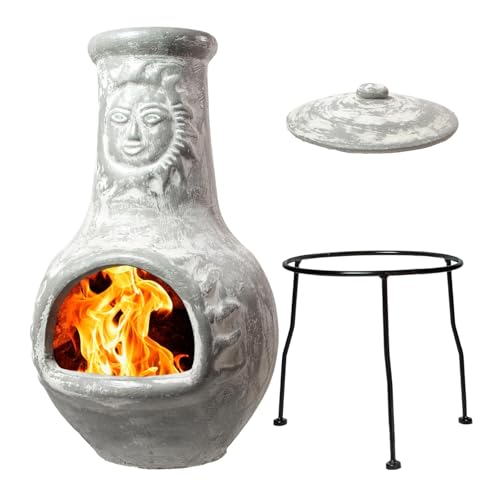

As an Amazon Associate we earn from qualifying purchases at no extra cost to you. Ratings are shown as listed on Amazon.
Clay vs. steel vs. cast iron: the important differences
| Chiminea type | Typical body size | Typical weight | Heat behavior | Weather resistance | Assembly and maintenance |
|---|---|---|---|---|---|
| Clay or terracotta | 24–36 in. tall; 16–22 in. bowl diameter | 25–55 lb | Warms gradually; radiates gentle heat after the fire settles | Low in frost, good in dry conditions when covered | Usually minimal assembly; must be dried and protected from thermal shock |
| Painted or stainless steel | 30–48 in. tall; 18–26 in. bowl diameter | 20–60 lb | Heats quickly; steel walls shed heat quickly after the fire fades | Moderate to high, depending on coating and steel grade | Often requires leg, flue, door, or spark-screen assembly; inspect coating for chips |
| Cast iron | 28–44 in. tall; 18–25 in. bowl diameter | 60–130 lb | Slow to heat but retains and radiates heat for longer | Moderate; unprotected surfaces can rust quickly | More difficult to move; needs drying, seasoning, and periodic rust treatment |
These are useful buying ranges rather than universal specifications. A thick-walled 30-inch model can weigh more than a thin-walled 40-inch model, and a stainless-steel body may outlast painted mild steel in a coastal location. Check the manufacturer’s stated weight, bowl dimensions, and clearance requirements before buying.
Clay: best for dry climates and occasional fires
Clay chimineas provide the classic shape and usually cost less than heavy cast iron. Their porous walls absorb and release heat gradually, producing comfortable radiant warmth rather than an intense blast. They are attractive on a small patio and can be a sensible choice when fires are occasional and the chiminea can remain under a roof or fitted cover.
The weakness is thermal shock. A cold clay body can crack when exposed to a large, rapidly built fire, rain, or freezing temperatures. Start with a small fire, avoid pouring water into the bowl, and let the unit cool completely before covering it. In climates with regular frost, clay is a higher-risk purchase unless it can be stored in a dry, protected place.
Steel: the practical all-rounder
Steel is generally the easiest material for regular patio use. It is lighter than cast iron, less fragile than clay, and commonly available with a removable spark screen, hinged door, cooking grate, and rain lid. Steel also reaches operating temperature quickly, which suits short evening fires.
Look closely at the finish rather than assuming every steel chiminea is rust-resistant. Painted mild steel eventually rusts where ash, moisture, or scratches expose bare metal. Stainless steel resists corrosion better, although its price is usually higher and thin stainless walls may transfer heat quickly. A full-height flue and a stable, wide-legged base are more valuable than decorative cutouts.
Cast iron: best for long, steady heat
Cast iron is the strongest choice when the chiminea will stay in one position and fires will be frequent. Its heavy walls absorb heat and continue radiating after the flames have declined. That makes it comfortable for longer gatherings, but it also means the exterior remains hot for longer and the unit takes more effort to reposition.
Cast iron is not automatically rustproof. Water trapped in the bowl or condensation beneath a cover can produce surface rust, particularly around the fire grate, door hinges, and lower seams. Dry the interior after rain, remove ash once it is fully cold, and restore the protective finish with a high-temperature product intended for outdoor fire equipment.
Best chiminea choices by patio situation
| Your situation | Best fit | Why | What to avoid |
|---|---|---|---|
| Small patio or balcony-like outdoor area | Compact steel, about 24–32 in. tall | Lower weight and quicker heat control | Large cast iron units that radiate beyond the seating area |
| Wet or coastal climate | Stainless steel or well-coated steel with a cover | Better resistance to persistent moisture and salt air | Unsealed clay and bare cast iron |
| Cold climate with freezing winters | Steel or cast iron stored under cover | Less vulnerable to freeze-related cracking than clay | Leaving a porous clay chiminea outdoors through winter |
| Occasional weekend fires | Clay or medium steel | Lower purchase cost and sufficient heat for short sessions | Paying for heavy cast iron that is difficult to move |
| Frequent, long fires | Thick steel or cast iron | More durable firebox and better sustained warmth | Thin decorative steel and oversized logs |
| Cooking as well as heating | Steel or cast iron with a rated grate | More suitable for accessories and repeated heat cycles | Assuming a decorative clay model is food-safe or structurally rated |
How large should your chiminea be?
Measure the actual outdoor seating zone, not the whole yard. A practical starting point is one chiminea for roughly 60–100 square feet of open seating, provided people are within radiant-heat range and wind is limited. The unit does not heat an enclosed room like a furnace; most warmth is felt in front of the bowl and decreases rapidly with distance.
For two to four people, a bowl diameter of 16–20 inches is usually easier to manage. Four to six people may benefit from a 20–26-inch bowl, but a larger fire also needs more clearance and more fuel. Do not fill the bowl to the rim. Keep wood below the opening or at the level specified by the manufacturer so flames do not enter the flue or escape through the mouth.
For a simple fuel estimate, suppose a medium fire consumes about 3 pounds of dry hardwood per hour. A two-hour evening uses approximately 6 pounds. If seasoned hardwood costs a general market range of $0.50–$1.25 per pound, the wood cost is about $3–$7.50 per use, before kindling and maintenance. Burning larger fires does not necessarily make a small patio warmer; it can instead increase smoke, sparks, and material stress.
Features worth paying for
- Full spark protection: A mesh door or screen reduces flying embers, although it does not eliminate fire risk.
- A properly fitted rain cover: This is especially important for clay and painted steel.
- A removable fire grate: It lifts wood above ash, improving airflow and simplifying cleanup.
- A stable base: Wide legs or a low center of gravity matter more than ornamental details.
- A chimney cap: It helps limit rain entry and can reduce downdrafts, but it must not obstruct smoke flow.
- Replaceable hardware: Stainless bolts, screens, grates, and handles are useful because these parts wear before the main body.
- Clear instructions for clearance: The product should state how far it must stand from walls, roofs, furniture, fences, and combustible surfaces.
Setup and maintenance that prevent early failure
- Choose the surface first. Set the chiminea on a level, noncombustible surface such as concrete, masonry, or a purpose-made fireproof base. Do not place it directly on a wooden deck unless the complete setup is specifically rated and protected for that use.
- Assemble and inspect the flue. Tighten legs and handles, check that the chimney is unobstructed, and confirm that the door and spark screen close securely.
- Run a small curing fire. For clay, use several small fires that gradually increase in size. This drives out residual moisture. For painted steel, gentle early fires help the coating settle; follow the finish manufacturer’s instructions if odor or smoke is expected.
- Burn dry, untreated wood. Damp logs create smoke and condensation, while painted, treated, or manufactured construction wood can release unsuitable fumes and damage the firebox.
- Remove ash only when completely cold. Ash retains heat for many hours. Use a metal container with a tight lid, kept away from combustible materials.
- Dry before covering. A cover traps moisture if the chiminea is wet. Empty water, wipe condensation, and allow the body to dry before storage.
- Inspect wearing parts. Replace warped grates, burned-through screens, loose handles, and badly corroded legs before the next fire.
Final buying recommendation
Choose clay when appearance, modest cost, and gentle occasional heating matter most and you can protect the chiminea from frost and rain. Choose steel when you want the best balance of portability, quick heating, accessories, and everyday practicality. Choose cast iron when the chiminea will remain in one place and you value long-lasting radiant heat enough to accept its weight and rust-maintenance demands.
Whatever the material, prioritize a stable base, a usable spark screen, a rain cover, a replaceable grate, and clearly stated safety clearances. Those ownership details will have a greater effect on satisfaction than a decorative finish or the largest available bowl.





Write Your Review
No reviews yet. Be the first to share your experience!